

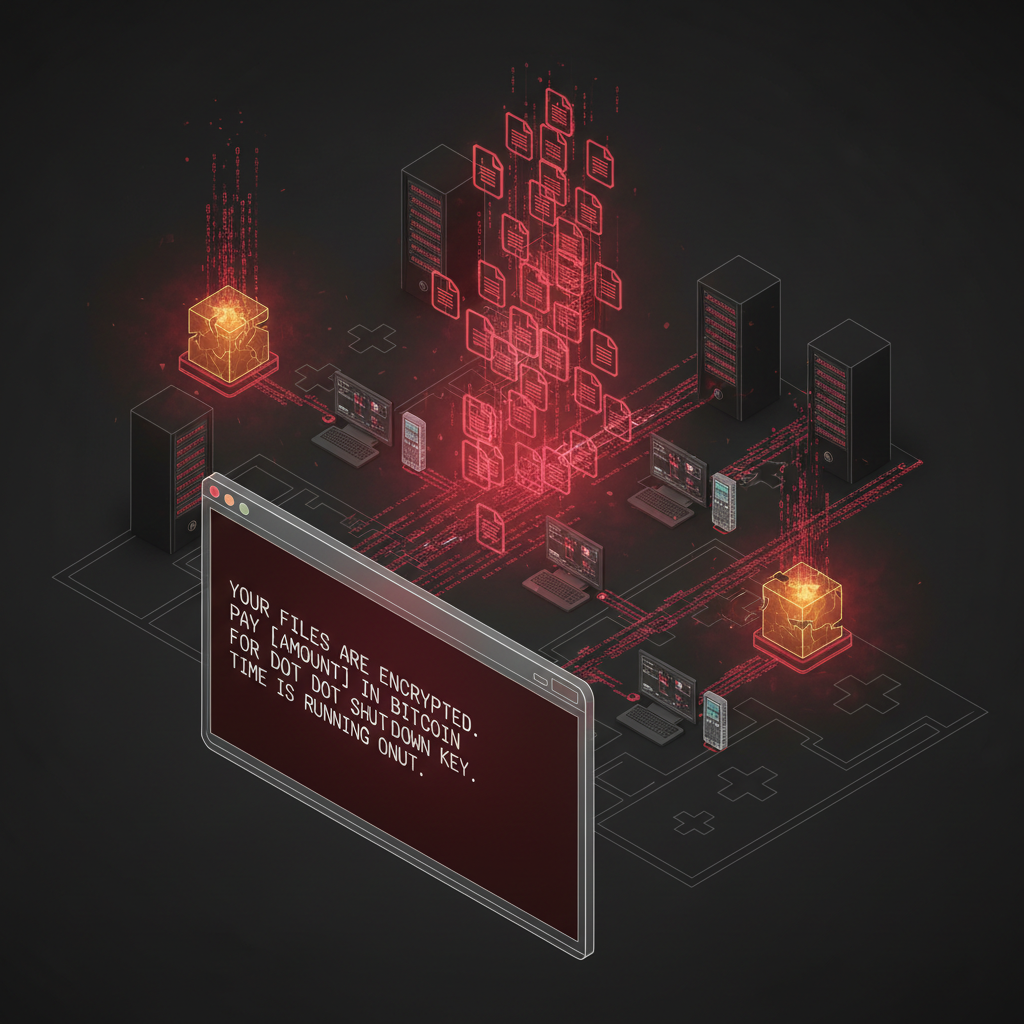
Ransomware Cost the Global Economy Over $42 Billion in 2025 — and 2026 Is Trending Worse
That number comes from Cybersecurity Ventures' tracking data, and it doesn't include the indirect costs: downtime, reputational damage, regulatory fines, or the quiet exodus of patients from hospitals that got hit. Ransomware isn't new. It isn't sophisticated in the way that, say, a zero-day supply chain exploit is sophisticated. But it works. And it keeps working because most organizations still haven't hardened the exact attack surfaces ransomware operators exploit every single time.
This guide is for security engineers, SOC leads, and infrastructure teams who need to understand ransomware technically — not just conceptually — and build a prevention posture that actually holds. We'll cover what ransomware is designed to do at the code level, how crypto-ransomware specifically operates, why healthcare remains the most targeted sector, and what a serious prevention checklist looks like in 2026.
What Is Ransomware Primarily Designed to Do?
Strip away the threat actor branding and the dramatic ransom notes, and ransomware has one core function: deny you access to your own data or systems until you pay. That denial takes two primary forms. Locker ransomware locks the victim out of their device entirely — typically by disabling the OS interface or changing credentials. Crypto-ransomware encrypts files on disk, making data inaccessible without the decryption key held by the attacker.
Modern ransomware operations — LockBit 4.0, BlackCat/ALPHV successors, Cl0p — have evolved well beyond simple encryption. Today's attack chains include data exfiltration before encryption (double extortion), DDoS threats against the victim organization (triple extortion), and in some cases direct contact with customers or regulators to maximize pressure. The malware itself is often modular: a loader drops the ransomware payload, a separate component handles lateral movement across the network, and a command-and-control (C2) channel manages key exchange.
What Is the Primary Function of Crypto-Ransomware?
Crypto-ransomware's primary function is asymmetric key encryption of victim files at scale. Here's the technical sequence: the malware generates a symmetric session key (typically AES-256) locally, uses it to encrypt files rapidly, then encrypts that symmetric key with the attacker's public RSA or elliptic-curve key. The attacker holds the corresponding private key. Without it, the session key is mathematically unrecoverable — and so are the files.
Modern implementations target specific file extensions (.docx, .xlsx, .pdf, .sql, .vmdk, .bak) while deliberately skipping system files needed to keep the OS running and display the ransom note. Some variants, like those based on the leaked Babuk source code, target ESXi hypervisors directly — encrypting virtual machine disk files and taking down entire virtualized infrastructure in minutes. Shadow copy deletion via vssadmin delete shadows /all /quiet is almost universal; it's one of the clearest behavioral indicators for detection.
The Ransomware Kill Chain: How Attacks Actually Unfold
MITRE ATT&CK maps ransomware operators with impressive precision. The typical kill chain looks like this:
Initial Access (T1566, T1190): Phishing remains the dominant entry vector — roughly 41% of ransomware incidents in IBM's 2026 Cost of a Data Breach report traced back to phishing. Exploitation of public-facing applications (unpatched VPNs, RDP exposed to the internet, misconfigured cloud services) accounts for most of the rest. Credential theft via infostealer malware, sold on underground markets, is increasingly how ransomware groups skip the phishing step entirely.
Execution and Persistence (T1059, T1547): PowerShell and WMI abuse are classics. Ransomware loaders establish persistence through scheduled tasks, registry run keys, or service installation. Living-off-the-land binaries (LOLBins) make detection harder — the attack traffic looks like normal Windows administration.
Lateral Movement (T1021, T1550): This is where blast radius expands. Pass-the-hash, Kerberoasting, and abuse of legitimate tools like PsExec or remote management agents let attackers pivot from the initial compromised endpoint to domain controllers, file servers, and backup systems. Reaching and corrupting backups before deploying encryption is a deliberate tactic.
Exfiltration and Impact (T1041, T1486): Data exfiltration happens before encryption. Rclone, MEGAsync, and custom upload tools have all been observed in real incidents. Then the encryption payload deploys — often simultaneously across hundreds of hosts using domain admin credentials acquired during lateral movement.
Ransomware in Healthcare: Why Hospitals Are Prime Targets
Healthcare organizations represent roughly 18% of all ransomware victims despite being a fraction of the enterprise attack surface. The reasons are structural. Electronic health record (EHR) systems, medical imaging infrastructure (PACS), and clinical IoT devices run legacy software that hasn't been patched in years. Downtime isn't just a business inconvenience — it's a patient safety emergency. Threat actors know that a hospital will pay faster than a bank, because the alternative is diverting ambulances and canceling surgeries.
The Change Healthcare attack in early 2024 demonstrated the sector's fragility at scale. A single third-party payment processor going down disrupted claims processing for thousands of healthcare providers across the US, with some smaller clinics unable to make payroll. The financial impact exceeded $870 million in direct costs to Change Healthcare's parent company alone.
Learning how to prevent ransomware attacks in healthcare specifically requires understanding what makes healthcare different: HIPAA compliance obligations, FDA-regulated medical devices that can't easily be patched, flat network architectures connecting clinical and administrative systems, and a culture that historically prioritized availability over security. Segmentation is the single biggest structural fix — and it's still absent in most mid-sized hospital networks.
The Vulnerability Management discipline is especially critical here. Medical device vulnerabilities — many with CVSS scores above 8.0 and EPSS scores indicating active exploitation — go unpatched for months because the vendor patch cycle is slow and clinical downtime windows are rare. Prioritizing by EPSS score rather than raw CVSS gives security teams a more realistic signal for what's actually being exploited in the wild.
The CISA Ransomware Guide: What It Actually Tells You
CISA's #StopRansomware guidance, updated in 2026, is more operationally useful than most people give it credit for. It's not just a checklist — it's a structured framework that maps recommended controls to NIST CSF 2.0 functions: Identify, Protect, Detect, Respond, Recover. The 2026 update added specific guidance on cloud environments, which prior versions underserved badly.
Key CISA recommendations that security teams consistently underimplement: network segmentation with enforced microsegmentation (not just VLAN separation), offline and immutable backup testing (not just backup creation), phishing-resistant MFA on all remote access and privileged accounts, and application allowlisting on endpoints handling sensitive data. The guidance also explicitly calls out the risk of overprivileged service accounts — a finding that shows up in virtually every post-incident forensic report.
Pairing CISA guidance with Policy-as-Code enforcement lets you turn those recommendations into machine-verifiable rules rather than audit checkboxes. If your cloud policy says 'no publicly exposed RDP,' that constraint should be enforced automatically, not discovered manually during a quarterly review.
Ransomware Prevention Checklist for 2026
Practical prevention isn't one thing. It's layers. Here's what a mature prevention posture looks like, organized by control category:
Identity and Access Controls
Enforce phishing-resistant MFA (FIDO2/WebAuthn) on all remote access — VPN, RDP, SSH jumpboxes, cloud console access. Audit and remove stale privileged accounts monthly. Implement just-in-time (JIT) access for administrative functions. Rotate service account credentials automatically. If you're still running accounts with passwords that haven't changed in 180+ days, you're giving ransomware operators a gift.
Network Architecture
Segment networks by function: clinical/OT networks isolated from corporate IT, backup infrastructure on a separate VLAN with no inbound access from production, cloud workloads in dedicated VPCs with restrictive security groups. Microsegmentation within data center environments, enforced via software-defined networking, limits lateral movement to a handful of hosts rather than the entire domain. Disable SMBv1. Block outbound traffic to Tor exit nodes and known C2 infrastructure at the perimeter.
Endpoint and Workload Hardening
Deploy EDR with behavioral detection on all endpoints — signature-based AV is insufficient against modern ransomware loaders. Enable Windows Credential Guard to prevent credential harvesting. Disable PowerShell for standard users or enforce constrained language mode. For cloud workloads, VM Scans that detect known vulnerabilities and misconfigurations before they're exploited are a core preventive control — not a nice-to-have.
Backup and Recovery
The 3-2-1-1-0 rule: three copies, two different media types, one offsite, one offline/air-gapped, zero backup errors verified. Test restoration quarterly — not just backup creation. Ransomware operators specifically target and corrupt backup systems during lateral movement. If your backup solution is network-accessible with the same credentials as your production environment, it's not a backup — it's a second target.
Patch Management and Vulnerability Prioritization
CISA's Known Exploited Vulnerabilities (KEV) catalog should be your top-priority patch list. Any CVE on the KEV list that isn't patched within the required remediation window is an organizational risk acceptance decision that should be documented and escalated. For everything else, EPSS scores give a better signal than CVSS alone. A CVSS 9.8 with an EPSS score of 0.2% is lower urgency than a CVSS 7.0 with an EPSS of 18%.
Detection and Response
Behavioral detection rules that trigger on shadow copy deletion, rapid file rename operations, and anomalous encryption activity should be in every SIEM. MITRE ATT&CK techniques T1490 (Inhibit System Recovery) and T1486 (Data Encrypted for Impact) have well-documented detection logic. Simulate ransomware behavior with tools like Atomic Red Team to validate your detection coverage before an attacker does it for you.
Cloud Environments Are Not Immune
A common misconception: cloud storage can't be hit by ransomware. Wrong. S3 buckets can have versioning disabled and then be overwritten. Azure Blob Storage and GCP Cloud Storage are equally susceptible if access controls are loose and versioning isn't enforced. Ransomware groups have also been observed deploying encryption payloads directly to cloud-hosted VMs after compromising cloud credentials via exposed IAM keys — often found in public repositories.
This is exactly why Secret Detection in CI/CD pipelines matters for ransomware prevention, not just data breach prevention. A hardcoded AWS access key in a GitHub repository gives a ransomware operator direct access to your cloud environment without ever touching your endpoint security stack. Similarly, CSPM continuous monitoring catches the misconfigurations — overly permissive IAM roles, publicly accessible storage, disabled MFA on cloud root accounts — that ransomware operators use as footholds.
Container environments deserve special attention. A compromised container with host network access or excessive capabilities can pivot to the underlying node and beyond. Container Image Scanning at build time catches vulnerable base images and known-bad packages before they're deployed. Coupling that with runtime behavioral monitoring — tools like Falco flag anomalous system calls consistent with encryption behavior — closes the detection gap.
Ransomware Prevention Best Practices: The Mindset Shift
The organizations that weather ransomware attacks best aren't necessarily the ones with the most tools. They're the ones that assume compromise and plan for it. Assume that phishing will eventually succeed. Assume that a credential will eventually be stolen. Design your environment so that a single compromised endpoint can't become a domain-wide encryption event.
That means zero-trust network architecture, not zero-trust marketing. It means Cloud Security posture monitoring that catches drift from secure baselines in real time. It means tabletop exercises that specifically simulate ransomware scenarios — including the decision point around whether to pay, which should be worked through legally and operationally before the incident, not during it.
The CISA ransomware guide is a solid baseline. NIST CSF 2.0 gives you the governance framework to build around it. CIS Benchmarks Level 2 for your OS and application stack provides the hardening specifics. None of these require a massive budget — they require discipline, consistency, and the organizational will to prioritize security debt alongside feature work.
At SECRAILS, we work with security teams to operationalize exactly this kind of layered defense — from code-level vulnerability detection through to cloud posture management and compliance enforcement. Ransomware prevention isn't a product you buy. It's an architecture you build, continuously, with the right controls at every layer.