

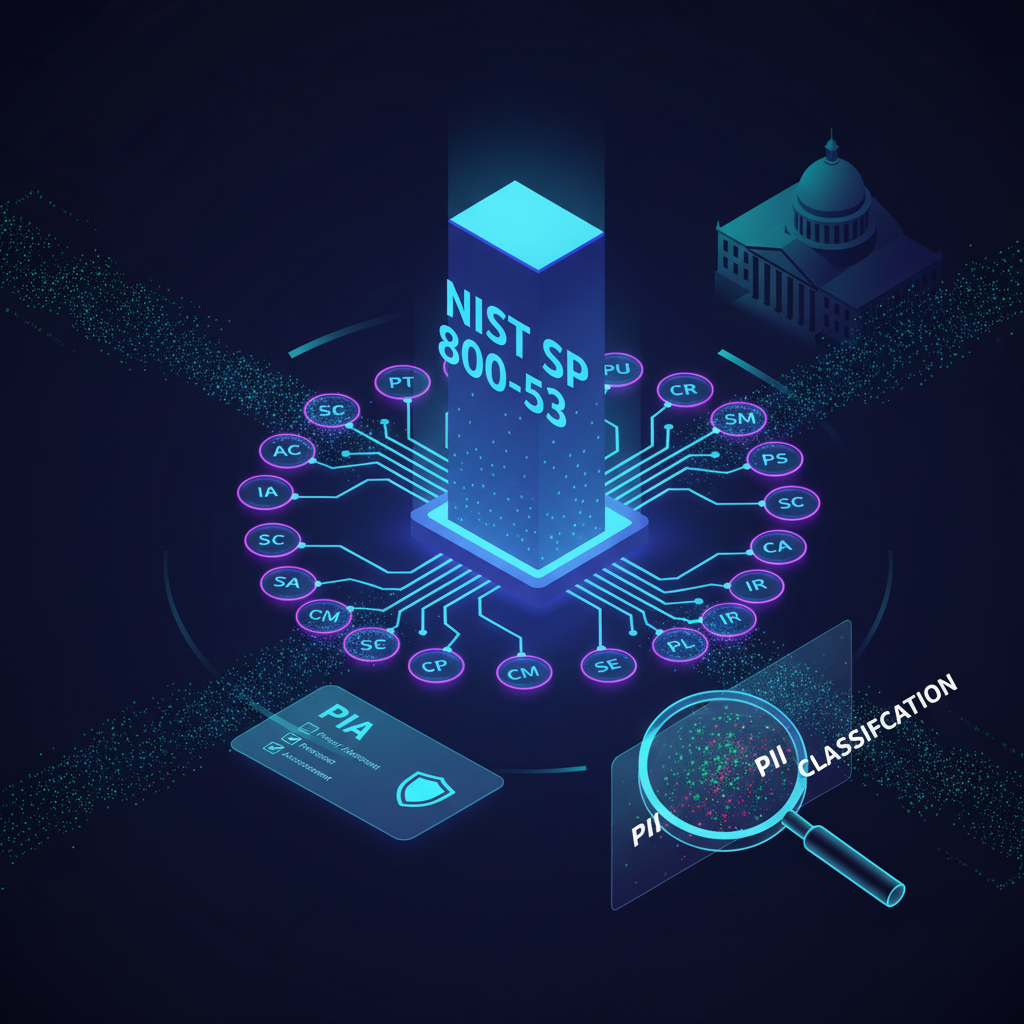
The One Document That Governs Federal Security Controls
NIST Special Publication 800-53 — that is the answer to what guidance identifies federal information security controls. Not FISMA itself, not an OMB memo, not a CIO directive. NIST SP 800-53 is the authoritative catalog of security and privacy controls for federal information systems and organizations, and its current revision, Rev 5, published in September 2020, expanded scope dramatically to cover private sector systems too. Every federal agency operating under FISMA must use it.
But knowing the document title is the easy part. Understanding how those controls actually work — and how they intersect with the Privacy Act of 1974, the E-Government Act of 2002, OMB Circular A-130, and the mechanics of Privacy Impact Assessments — that is where most compliance teams struggle. This post covers the full picture: what the guidance says, what PIAs must do, what qualifies as PII, and where modern security tooling fits into the compliance equation.
FISMA, OMB, and the NIST Framework Ecosystem
The Federal Information Security Modernization Act (FISMA) of 2014 — the updated version of the original 2002 law — requires federal agencies to implement information security programs based on risk. But FISMA is an authorization framework, not a control catalog. It tells agencies that they must protect systems. NIST tells them how.
The guidance hierarchy works like this: FISMA sets the legal requirement. OMB Circular A-130 (revised in 2016) establishes governmentwide policy for managing federal information resources and mandates privacy and security protections. NIST SP 800-53 provides the actual controls. And NIST SP 800-37, the Risk Management Framework (RMF), defines the process for selecting, implementing, and assessing those controls.
NIST SP 800-53 Rev 5 organizes controls into 20 families — from Access Control (AC) and Audit and Accountability (AU) to Supply Chain Risk Management (SR) and Privacy (PT). The PT family is the key addition in Rev 5, integrating privacy controls directly into the security control catalog for the first time. Previously, privacy sat in a separate appendix. Now it is a first-class citizen alongside every other control family. That matters operationally because it means privacy and security teams can no longer work in separate silos — the controls are structurally linked.
NIST SP 800-53 vs. NIST CSF 2.0
Do not confuse SP 800-53 with the NIST Cybersecurity Framework (CSF). The CSF — updated to version 2.0 in February 2024 — is a voluntary framework organized around six functions: Govern, Identify, Protect, Detect, Respond, and Recover. It is designed for any organization, not specifically federal agencies. SP 800-53 is mandatory for federal systems and contains far more granular, prescriptive controls. The two frameworks cross-reference each other extensively, but SP 800-53 is the document that directly answers what guidance identifies federal information security controls.
Privacy Impact Assessments: Definition and Purpose
A Privacy Impact Assessment (PIA) is a structured analysis used to identify and mitigate privacy risks before a federal agency deploys a new IT system or significantly modifies an existing one. The legal basis is Section 208 of the E-Government Act of 2002, which made PIAs mandatory for federal agencies. OMB guidance — particularly OMB Memorandum M-03-22 — operationalized that requirement.
The privacy impact assessment definition is deceptively simple: it is a process for examining the privacy risks of a system. But the actual requirements are specific. PIAs must be completed before systems are deployed, before they collect personal information, and before agencies make substantive changes to existing systems. They must also be publicly available, with limited exceptions for classified or sensitive systems.
Which of the Following Must Privacy Impact Assessments Do?
This question appears constantly in federal compliance training, and the answer comes directly from OMB M-03-22 and the E-Government Act. Privacy impact assessments must:
- Describe what information is being collected and why
- Explain the intended use of the information
- Identify who will have access to the information
- Describe how the information will be secured
- Identify whether the system creates new privacy risks and how those risks will be mitigated
- Explain how long the data will be retained and how it will be disposed of
- Determine whether the information in the system is accurate, timely, complete, and accessible
A PIA is not a checkbox exercise. Done properly, it forces design decisions — it should affect system architecture, data minimization choices, access control models, and retention schedules. If a PIA does not change anything about how a system is built or operated, someone went through the motions without engaging the substance. The privacy impact assessment purpose is to embed privacy by design into federal IT development, not to produce a document that sits in a drawer.
When Is a PIA Not Required?
PIAs are not required for systems that do not collect personally identifiable information. They are also not required for systems that collect PII but fall under specific exemptions — like law enforcement systems where disclosure would compromise investigations. National security systems have their own separate framework. But these are narrow exceptions. If a system touches PII in any meaningful way, a PIA is almost certainly required.
What Counts as PII — and What Does Not
This is where teams consistently get tripped up. The federal definition of PII, drawn from OMB Memorandum M-07-16 and NIST SP 800-122, defines it as any information that can be used to distinguish or trace an individual's identity, either alone or combined with other information. The key phrase: alone or in combination.
Classic examples — Social Security numbers, passport numbers, biometric records, medical records, financial account numbers — are clearly PII. But the combined information principle is what catches organizations off guard. An IP address alone might not be PII. But an IP address combined with a username and browsing history almost certainly is. A job title alone is not PII. But a job title combined with a department name and office location in a small organization can uniquely identify a person.
Which of the Following Is Not an Example of PII?
The federal guidance is explicit that general business contact information, aggregate statistical data, and anonymized datasets that cannot be re-identified do not constitute PII. A ZIP code covering a large population is not PII. A company name is not PII. Age expressed as a broad range covering millions of people is not PII. These distinctions matter for system design — if a system only processes truly non-PII data, the PIA threshold may not be triggered.
But here is the practical reality in 2026: re-identification techniques have become increasingly sophisticated. What looked like anonymized data five years ago may now be re-identifiable using machine learning correlation attacks. NIST guidance in SP 800-188 on de-identification reflects this — it acknowledges that de-identification is not a binary state. Security teams need to assess re-identification risk, not just ask whether data fits a checklist definition of PII.
The Control Selection Process Under RMF
NIST SP 800-37 Rev 2 defines a six-step process: Prepare, Categorize, Select, Implement, Assess, Authorize, and Monitor. The Categorize step uses FIPS 199 to classify systems as Low, Moderate, or High impact based on confidentiality, integrity, and availability. FIPS 200 then sets minimum security requirements for each impact level. SP 800-53B provides control baselines — the minimum set of controls for each impact level — while SP 800-53 itself contains the full catalog from which additional controls can be tailored.
For a High-impact system handling sensitive PII — think a federal benefits system or a healthcare database — the control baseline is extensive. Organizations need robust compliance automation to manage control implementation at that scale without drowning their security teams in manual work.
Continuous Monitoring Is Not Optional
The Authorize step of the RMF produces an Authorization to Operate (ATO). But an ATO is not a permanent hall pass. NIST SP 800-137 and OMB M-14-03 require continuous monitoring — automated, ongoing assessment of control effectiveness. Agencies must track configuration changes, vulnerability findings, and security incidents in near-real-time. Static annual assessments do not satisfy the continuous monitoring requirement.
This is exactly where automated tooling becomes non-negotiable. Cloud Security Posture Management platforms can continuously assess cloud configurations against SP 800-53 control requirements, flagging drift before it becomes an audit finding. Vulnerability management scanning tools map findings directly to SP 800-53 SI (System and Information Integrity) controls. The manual spreadsheet approach does not scale.
Privacy Controls in SP 800-53 Rev 5: What Changed
The integration of the privacy control catalog into SP 800-53 Rev 5 was a fundamental architectural change. The Privacy (PT) family specifically addresses privacy risk assessment (PT-2), processing transparency (PT-3), processing purpose (PT-4), privacy notice (PT-5), privacy preference signals (PT-6), data sharing agreements (PT-7), and computer matching requirements (PT-8). These are not abstract policy requirements — they translate directly into system design decisions, consent flows, data sharing agreements, and audit logging requirements.
Teams building or migrating federal systems need to map these controls to technical implementations from day one, not retroactively during ATO documentation sprints. The PT family integration also means that a system with significant PII processing will have a larger control baseline than its impact level alone would suggest, because the PT controls add requirements on top of the standard Low, Moderate, or High baselines.
Where Modern Security Tooling Fits
Federal compliance often looks like a documentation problem. It is not. It is an engineering problem with a documentation output. The agencies that struggle with FISMA compliance are invariably the ones treating it as paperwork rather than as a security engineering discipline.
Consider the supply chain controls in SP 800-53's SR family. SR-3 requires supply chain controls and processes. SR-4 requires provenance tracking of system components. If you are running containerized workloads, container image scanning addresses SR-4 directly — you need to know exactly what is in every container image in your supply chain. If you are managing infrastructure as code, Policy-as-Code enforcement maps to CM (Configuration Management) controls. If you are worried about hardcoded secrets in source repositories — and you should be, given how common that finding is in federal assessments — secret detection tools address IA (Identification and Authentication) and SC (System and Communications Protection) controls simultaneously.
The point is that SP 800-53 compliance is not achieved by writing control implementation statements. It is achieved by building and operating systems in ways that technically satisfy the control requirements, then documenting what you have done. The documentation is evidence of security, not a substitute for it.
PIAs and System Security Plans: The Overlap
Federal agencies often treat PIAs and System Security Plans (SSPs) as entirely separate documents managed by different teams. That is a mistake. The PIA analyzes privacy risks associated with PII collection and processing. The SSP documents how SP 800-53 controls are implemented. The overlap is substantial — particularly for the PT, AP, and SE control families, which directly address privacy requirements that a PIA must analyze.
Coordinating PIA development with SSP development produces better outcomes on both documents. The PIA informs which privacy controls are relevant and what tailoring decisions are appropriate. The SSP control implementations should be consistent with the risk mitigation commitments made in the PIA. When these documents contradict each other — which happens more than agencies would like to admit — it signals broken process and creates audit findings.
Organizations operating across hybrid cloud and on-premises environments face additional complexity. Cloud environments introduce new categories of PII exposure — misconfigured storage buckets, overly permissive IAM roles, unencrypted data in transit — that traditional PIA templates were not designed to address. A cloud-native approach to cloud security needs to account for these attack surfaces explicitly in PIA methodology.
The 2026 Compliance Landscape: What Has Changed
Executive Order 14028 from 2021 significantly expanded FISMA implementation requirements for federal contractors and software suppliers. Zero trust architecture mandates, SBOM requirements, and enhanced logging standards all derive from that order and subsequent OMB guidance. By 2026, agencies are expected to have mature zero trust implementations, and software vendors selling to the federal government face SP 800-218 (Secure Software Development Framework) requirements that mirror SP 800-53 controls.
For organizations building software that touches federal systems, the compliance surface area is larger than ever. It is not sufficient to have an ATO for your system. You need to demonstrate that your development pipeline — your code repositories, your CI/CD infrastructure, your container build processes — satisfies security control requirements. Static application security testing integrated into CI/CD pipelines is not optional for federal software suppliers anymore. It is an auditable requirement.
The bottom line: NIST SP 800-53 Rev 5 identifies federal information security controls. PIAs are mandatory for federal systems handling PII and must analyze collection purpose, use, access, security, retention, and risk mitigation. PII covers information that identifies individuals alone or in combination, and modern re-identification risks mean organizations cannot rely on static definitions. Compliance is an engineering discipline — automated tooling, continuous monitoring, and shift-left security practices are how mature federal programs actually achieve and maintain it. The documentation follows from the security. Not the other way around.