

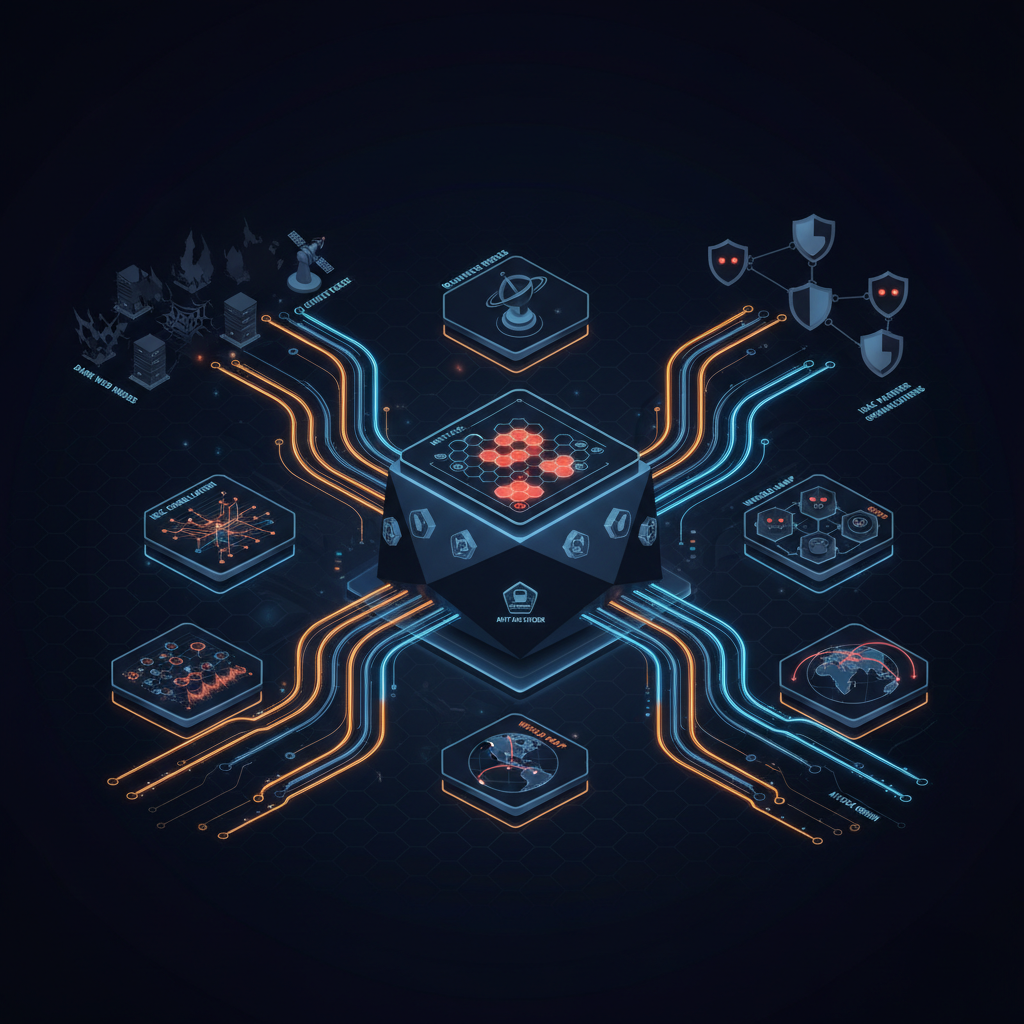
Sixty-seven percent of security teams that suffered a significant breach in 2026 had threat data available — they just could not operationalize it fast enough. That is the core problem a threat intelligence platform is supposed to solve. Not the collection of indicators. The operationalization of them, at machine speed, integrated into the tools your SOC actually uses.
This guide cuts through the vendor marketing. You will get a clear breakdown of what a TIP actually does, how to evaluate the major commercial and open source options, and where a threat intelligence platform fits inside a modern security stack that also needs to handle cloud posture, code risk, and AI exposure.
What a Threat Intelligence Platform Actually Does
A threat intelligence platform — TIP for short — is a centralized system for ingesting, normalizing, correlating, and distributing cyber threat intelligence across your security infrastructure. The key word there is distributing. A TIP that just stores IOCs in a database is a glorified spreadsheet. A real TIP pushes enriched, contextualized indicators to your SIEM, EDR, firewall, and SOAR in near-real-time.
The data it handles includes indicators of compromise (IOCs) like IP addresses, domains, file hashes, and URLs; tactical intelligence mapped to MITRE ATT&CK TTPs; strategic threat actor profiles; and vulnerability intelligence tied to CVE records and EPSS scores. The job of the platform is to make all of that actionable — not just archived.
Core Capabilities That Separate Good from Bad
Not every product calling itself a threat intelligence platform delivers the same value. The ones worth deploying share a few non-negotiable capabilities.
Automated ingestion and normalization. Your TIP needs to consume STIX/TAXII feeds, commercial threat feeds, ISAC data, open source intel (OSINT), and internal telemetry — and normalize it all into a consistent format automatically. Manual normalization at scale does not work.
Confidence scoring and deduplication. Raw threat feeds contain enormous amounts of noise. False positives burn out analysts and degrade alert fidelity across your entire stack. A solid TIP applies confidence scores, deduplicates redundant indicators, and ages out stale IOCs based on configurable TTL policies.
Bidirectional integrations. Push indicators to your SIEM and pull back detection hits. Close the loop. A TIP that only outputs intel without absorbing feedback from your detection environment is half a product.
MITRE ATT&CK mapping. This is table stakes in 2026. Every serious threat intelligence platform maps incoming intelligence to ATT&CK tactics and techniques automatically. This allows you to understand not just what is attacking you, but how — and where your detection coverage has gaps.
Collaboration workflows. Threat intelligence is a team sport. Your TIP should support analyst workflows — annotations, tagging, case management integration, and sharing over trust groups like ISACs or internal teams.
The Major Players: Commercial Threat Intelligence Platforms
Recorded Future
The Recorded Future threat intelligence platform is arguably the most comprehensive commercial TIP available in 2026. It ingests data from the open, deep, and dark web at a scale that most competitors cannot match. The platform strength is contextual intelligence — it does not just tell you that an IP is malicious, it tells you which threat actor controls it, which campaigns it has been associated with, and what your exposure looks like relative to your industry.
Recorded Future Intelligence Cloud maps directly to MITRE ATT&CK and supports automated playbook triggering through integrations with Splunk, Microsoft Sentinel, CrowdStrike, and dozens of others. The enrichment API is solid. Pricing is enterprise-grade — which is a polite way of saying it is expensive — but for organizations with a mature SOC that needs deep, operationalized intelligence, it is difficult to beat.
ThreatConnect
The ThreatConnect threat intelligence platform takes a different angle. Where Recorded Future leads with data breadth, ThreatConnect leads with workflow orchestration. Its built-in SOAR capabilities mean you can build automated playbooks directly inside the TIP itself, without needing a separate SOAR tool. For mid-market security teams that cannot afford a full XSOAR deployment, this is genuinely useful.
ThreatConnect CAL (Collective Analytics Layer) aggregates intelligence from its user community and applies machine learning to produce confidence-adjusted IOCs. The platform Diamond Model and ATT&CK integrations are mature. The ThreatConnect threat intelligence platform is particularly well-suited to teams that want to operationalize intel without building custom pipelines.
Anomali ThreatStream
Anomali positions ThreatStream as the aggregation layer — a platform for collecting and normalizing massive volumes of threat feeds and routing enriched IOCs downstream. It connects to hundreds of OSINT feeds, paid commercial sources, and ISACs. The matching engine against internal logs is fast. Anomali also offers the LENS product for detecting threat intel in unstructured data like emails and documents, which is a genuinely differentiated capability.
Mandiant Threat Intelligence
Since Google acquisition of Mandiant, their threat intelligence offering has been deeply integrated into Google Chronicle and the broader Google Cloud Security portfolio. If your organization is Google-native on the SIEM side, Mandiant intelligence is some of the best front-line attacker data available — drawn from active incident response engagements. The breadth of raw data does not match Recorded Future, but the quality and freshness of APT-level intelligence is exceptional.
Open Source Threat Intelligence Platforms
Not every organization can budget for six-figure TIP licenses. Open source threat intelligence platforms have matured significantly and, for teams willing to invest engineering effort, can deliver serious capability.
MISP (Malware Information Sharing Platform)
MISP is the de facto open source standard for threat intelligence sharing. It handles STIX/TAXII natively, supports complex attribute taxonomies, and has an enormous community producing integrations. The federation model — where multiple MISP instances share data across organizations — is genuinely powerful for ISAC-style sharing.
The honest trade-off: MISP requires real operational effort to maintain. The UI is functional but not elegant. Auto-correlation at scale needs tuning. If you have a dedicated threat intel engineer, MISP can anchor a mature open source TIP stack at minimal license cost.
OpenCTI
OpenCTI (Open Cyber Threat Intelligence Platform) is a newer entry that has gained serious traction. Built around STIX 2.1 natively, OpenCTI produces a graph-based knowledge model that visualizes relationships between threat actors, campaigns, malware, TTPs, and victimology. The UI is significantly more polished than MISP, and the connectors ecosystem is growing fast.
For organizations starting fresh on open source threat intelligence, OpenCTI is worth serious evaluation before defaulting to MISP. The two are not mutually exclusive — many teams run OpenCTI as the analysis layer with MISP as the sharing backbone.
How a TIP Fits Into Your Broader Security Stack
A threat intelligence platform does not operate in isolation. It is a hub that feeds and is fed by the rest of your security tooling. Getting the integrations right is half the work of any TIP deployment.
Your TIP should be receiving internal telemetry from your EDR, cloud security findings from your CSPM, and vulnerability data from your scanner — and enriching all of it with external threat context. When your CSPM flags an exposed S3 bucket, the TIP should immediately surface whether that specific bucket configuration is being actively targeted by known threat actors.
Similarly, your Vulnerability Management program becomes dramatically more effective when it is consuming TIP data. CVSS scores tell you severity in isolation. EPSS scores add exploit probability. But TIP data adds the third dimension: is this CVE actively being exploited by a threat actor that targets your industry, right now? That is the difference between a P3 ticket and an emergency patch.
On the code security side, a TIP can inform Code Security priorities by surfacing which dependency vulnerabilities are being weaponized in active campaigns. If threat intelligence indicates that a CVE in a popular logging library is being used in supply chain attacks against financial services firms, your SAST pipeline should be flagging any usage of that library.
Cloud Environments Add Complexity
Cloud-native environments create specific threat intelligence challenges. Your attack surface is not static — it changes every time a developer pushes infrastructure code. Cloud inventory sprawl means new assets appear faster than traditional TIP integrations can track them.
This is where Cloud Inventory capabilities become intelligence inputs, not just asset management tools. Real-time visibility into what is actually running in your cloud estate — every service, every exposed endpoint, every credential — feeds your TIP with the context it needs to prioritize intelligence against your actual attack surface, not a stale CMDB entry from six months ago.
The same logic applies to secrets. Leaked credentials are among the most operationally useful IOCs a TIP can track. If your Secret Detection tooling flags a hardcoded API key in a repository, your TIP should be cross-referencing that credential against known paste sites and dark web credential dumps immediately.
Evaluating and Selecting a TIP: What Actually Matters
Vendor demos always show the happy path. Here is what to actually test during a TIP evaluation.
Feed quality over feed quantity. Every commercial TIP vendor will show you a number like 500 plus threat feeds. That number is meaningless. Ask for false positive rates on their default feed configurations. Ask what their deduplication logic looks like. Ask how quickly IOCs are aged out after they are no longer relevant.
Integration depth with your existing stack. A TIP that integrates with your SIEM and EDR but not your cloud security tooling is going to leave blind spots. Verify native integrations exist — not just API access that requires custom development.
Analyst workflow support. Talk to the analysts who will use the platform daily, not just the CISO evaluating it quarterly. Can analysts annotate IOCs? Is case management integrated or bolted on? How does the platform handle team-based investigation workflows?
STIX/TAXII compliance. Non-negotiable. If a platform does not support STIX 2.1 and TAXII 2.1 for both import and export, walk away. Proprietary formats create lock-in and block participation in threat sharing communities.
Scalability under load. Ask for performance benchmarks with realistic indicator volumes — millions of IOCs, not thousands. Some platforms degrade significantly as data volumes grow.
TIP Deployment Patterns That Work in 2026
Most TIP deployments that fail do so for one of two reasons: either the platform is deployed without clear use cases defined upfront, or integrations are treated as a day-two problem.
Start with three specific use cases. Example: automated IOC blocking in your firewall via SIEM integration; vulnerability prioritization by correlating CVE data with active threat campaigns; and threat actor tracking for your three highest-priority adversary groups. Build the integrations for those use cases before you try to expand.
Treat intelligence quality as an ongoing operational concern. Run quarterly audits on your feed configurations. Track false positive rates from automated IOC blocks. Kill feeds that are generating noise without adding signal. The best TIP deployments have dedicated owners who treat feed hygiene the same way a DBA treats database performance.
Finally, connect your TIP to your incident response workflows explicitly. The Cloud Security incidents that cause the most damage are the ones where responders do not have threat context fast enough. A TIP should automatically enrich every incident ticket with relevant intelligence before the first responder even opens the case.
The AI Factor in Modern Threat Intelligence
AI integration has become a genuine differentiator among TIP vendors in 2026. Recorded Future uses LLMs to generate natural-language intelligence summaries that let analysts absorb context in seconds rather than reading through raw reports. Anomali applies ML to confidence scoring. OpenCTI community connectors are starting to integrate open-weight models for entity extraction from unstructured reports.
There is also a defensive consideration here. AI-generated phishing, deepfake-assisted social engineering, and LLM-assisted malware development mean your threat intelligence platform needs feeds specifically tracking AI-enabled attack techniques. This is an area where most platforms are still catching up — but it is a critical evaluation criterion for 2026 and beyond. Your AI-SPM capabilities and your threat intelligence stack increasingly need to speak to each other.
The teams at SECRAILS have been watching this convergence closely. Intelligence without operational context is just noise. The platforms that win in 2026 are the ones that close the loop between external threat data and internal risk posture — automatically, without requiring a team of analysts to stitch it together manually.