

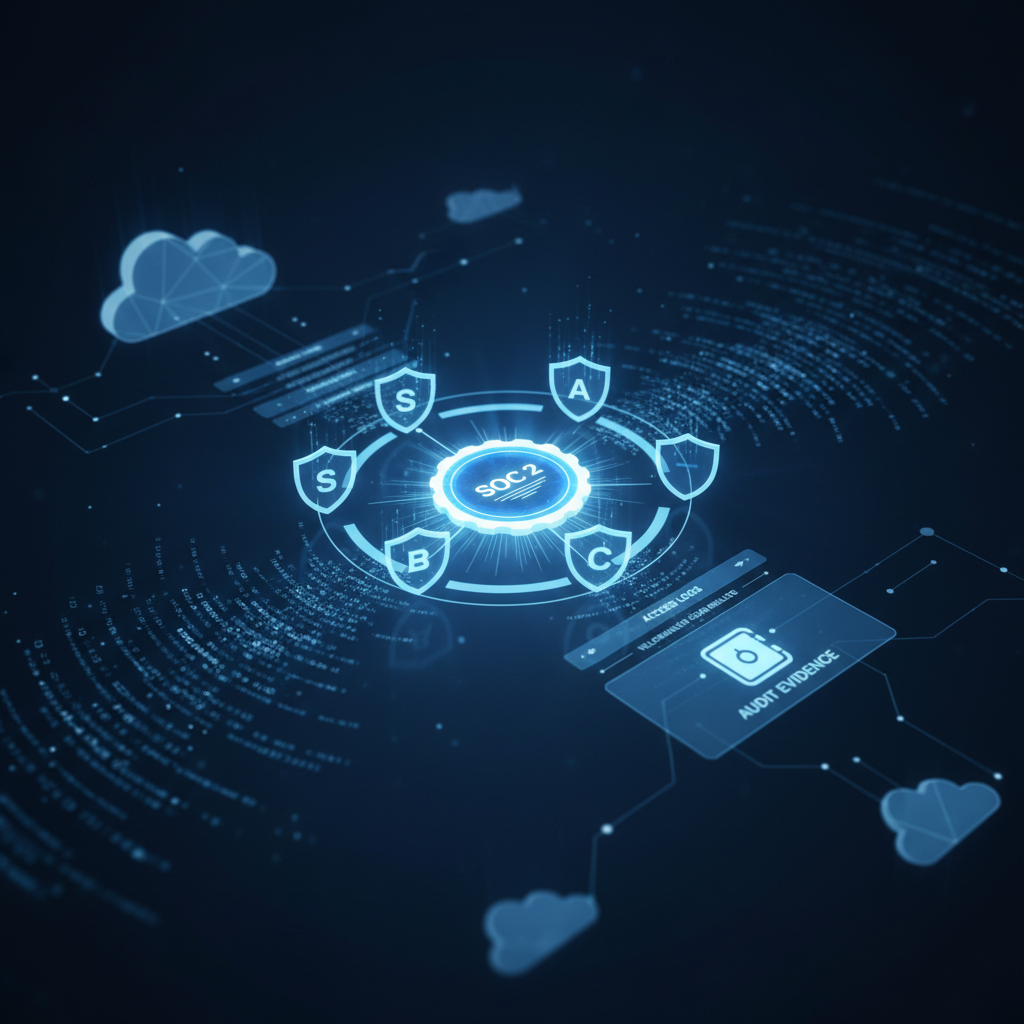
Roughly 65% of enterprise procurement teams in 2026 require a SOC 2 report before signing a SaaS contract. Not an ISO 27001 certificate, not a self-assessment questionnaire — a SOC 2 report from a licensed CPA firm. If your company processes customer data and you do not have one, you are losing deals. Quietly. Repeatedly.
SOC 2 compliance has become the de facto trust signal for cloud-native companies selling to mid-market and enterprise buyers. But the framework is widely misunderstood: what it covers, how the audit works, what it actually costs, and how to not fail one. This guide breaks all of it down in plain terms.
What Is SOC 2?
SOC 2 — System and Organization Controls 2 — is an auditing standard developed by the American Institute of Certified Public Accountants (AICPA). It defines criteria for how service organizations should manage customer data across five Trust Service Criteria (TSC): Security, Availability, Processing Integrity, Confidentiality, and Privacy.
Unlike PCI DSS or HIPAA, SOC 2 is not a regulatory requirement. No law mandates it. It is a voluntary framework — but the market has effectively made it mandatory for any SaaS, cloud infrastructure, or data processing company that wants enterprise contracts. Your customers' security teams will ask for it. Their legal teams will require it. Their procurement workflows will block your deal until they have it.
What is SOC 2 compliance, then? It is the formal process of designing, implementing, and validating the controls that satisfy the AICPA's TSC — and then having an independent auditor verify that those controls exist and work. The output is a SOC 2 report, not a certificate. This distinction matters: you cannot just claim to be SOC 2 certified. The report either exists or it does not.
SOC 2 Type 1 vs. Type 2: The Difference That Matters
This is where organizations consistently get confused. There are two report types, and they measure fundamentally different things.
SOC 2 Type 1
A Type 1 report assesses whether your controls are designed appropriately at a single point in time. An auditor reviews your policies, architecture, and control documentation and confirms those controls, as designed, would satisfy the relevant Trust Service Criteria as of that date. It does not test whether the controls actually worked over time. Preparation typically takes two to four months. Useful for early-stage companies that need something on paper quickly for a prospective enterprise customer.
SOC 2 Type 2
A Type 2 report covers an observation period — usually six to twelve months — and tests whether your controls operated effectively throughout that window. This is what enterprise buyers actually want. The auditor samples evidence: access logs, change tickets, incident records, vulnerability scan outputs, backup restoration test results. If your controls existed on day one but failed halfway through the period, that shows up in the report as an exception. What is SOC 2 Type 2 in practice? It is proof your security program runs continuously, not just on audit day.
Most mature organizations target Type 2. If you are starting from scratch, doing Type 1 first to establish a baseline — then moving to Type 2 six months later — is a reasonable path.
The Five AICPA Trust Service Criteria
The AICPA SOC 2 framework mandates Security as the only required criterion. The other four are optional, added based on what is relevant to your service.
Security (Common Criteria)
The mandatory baseline. This covers logical and physical access controls, risk assessment, incident response, change management, and monitoring. It maps closely to the NIST CSF 2.0 Protect and Detect functions. Every SOC 2 report includes this criterion. The Common Criteria are the most extensive — spanning everything from multi-factor authentication to board-level oversight. Your compliance posture lives or dies on how well these are implemented.
Availability
Relevant if your service has uptime commitments. Auditors examine infrastructure redundancy, disaster recovery plans, performance monitoring, and incident response SLAs. If you offer a platform with 99.9% uptime guarantees in contracts, this criterion should be in scope.
Processing Integrity
Applies to transaction processing systems — payment processors, data pipelines, ETL workflows. Controls here ensure data is processed completely, accurately, and with proper authorization. Rarely scoped for pure SaaS products unless they handle financial transactions.
Confidentiality
Covers how confidential information is identified, protected, and disposed of. Encryption at rest and in transit, access restrictions, and NDA enforcement with vendors. If your product handles sensitive business data such as contracts, financial models, or strategic documents, this criterion is worth including.
Privacy
Addresses collection, use, retention, and disposal of personal information — aligned with the AICPA's Generally Accepted Privacy Principles. Distinct from GDPR compliance, though there is significant overlap. Adding this criterion is increasingly common for companies with significant EU or US consumer data exposure.
SOC 2 Compliance Requirements: What Auditors Check
The 2026 AICPA Trust Services Criteria update tightened expectations around vendor risk management and supply chain security. Here is what auditors are checking today:
Access Control
Role-based access control with documented permissions. MFA enforced on all production systems. Privileged access management with quarterly access reviews. Off-boarding procedures with immediate revocation. Auditors will pull user access logs and cross-reference against HR termination records. Gaps here generate more exceptions than anything else. Pair your access controls with Policy-as-Code enforcement to prevent configuration drift from introducing unauthorized permissions.
Encryption
AES-256 at rest. TLS 1.2 or higher in transit with older protocol versions explicitly disabled. Key management with rotation schedules documented and enforced. Certificate inventory maintained and reviewed. Auditors regularly find misconfigurations in staging environments or legacy integrations where encryption was never enforced.
Vulnerability Management
Regular scanning — at minimum quarterly, ideally continuous — with a documented remediation SLA. Critical vulnerabilities patched within 30 days. High severity within 60 days. Evidence of scan outputs, ticket creation, and remediation confirmation is required. Vulnerability management tooling needs to integrate with your ticketing system so there is an auditable trail, not just scan results sitting in a CSV file.
Incident Response
A documented IR plan. Annual tabletop exercises with evidence including meeting notes and attendance records. Defined incident severity classifications. Post-incident review records. Communication templates. Auditors are increasingly asking for proof of testing, not just the plan document.
Change Management
Code changes peer-reviewed before merge. Infrastructure changes reviewed and approved. Separation of duties between development and production deployment. Rollback procedures documented. If developers can push directly to production without review, that is a finding.
Vendor Risk Management
Annual vendor assessments for critical subprocessors. Evidence of reviewing vendor SOC 2 reports or security questionnaires. Contract language requiring breach notification. The 2026 TSC update is explicit: your SOC 2 report covers your controls, but auditors expect you to have verified your critical vendors' controls as well.
Monitoring and Logging
Centralized log aggregation. Alerting on anomalous activity. Log retention policies with a minimum of twelve months being the common expectation. Evidence that security events are actively reviewed. Connect your Cloud Security Posture Management tooling to your SIEM for continuous evidence generation.
SOC 2 Compliance Checklist
Here is the practical sequence for organizations preparing for their first SOC 2 audit:
Phase 1 — Scoping (Weeks 1–3): Define which Trust Service Criteria apply to your service. Identify the systems and processes in scope. Map your data flows. Choose an audit period start date. Select a CPA firm early — good firms book out months in advance.
Phase 2 — Gap Assessment (Weeks 4–6): Compare current controls against TSC requirements. Document gaps. Prioritize remediation by audit risk. This phase often reveals that secret detection and code security controls are missing entirely — hardcoded credentials in source code repositories are a recurring SOC 2 exception that is entirely preventable.
Phase 3 — Remediation (Weeks 7–16): Implement missing controls. Write or update policies. Deploy tooling. Run your vulnerability management program. Establish your evidence collection cadence. Every control needs documented evidence, not just implementation. A control that exists but cannot be proven to an auditor effectively does not exist.
Phase 4 — Readiness Assessment (Weeks 17–18): Internal or third-party pre-audit review. Walk through every criterion. Identify lingering gaps. Fix them before the audit window opens. This step is far cheaper than discovering issues during fieldwork.
Phase 5 — Audit Period (Months 1–12 for Type 2): Your controls operate. Evidence accumulates. You document exceptions and remediations in real time. Do not attempt to reconstruct evidence retroactively — auditors can identify this, and it raises serious questions about your program's integrity.
Phase 6 — Auditor Fieldwork and Report (Weeks 1–6 post-period): Auditor samples evidence, interviews control owners, and tests systems. You respond to findings. Final report issued and delivered to customers under NDA.
SOC 2 Compliance Cost: What to Budget in 2026
Direct costs vary enormously based on company size, scope, and whether you use a compliance automation platform. Here is a realistic 2026 cost breakdown:
CPA audit fees: Type 1 runs $15,000 to $30,000 for a small company. Type 2 ranges from $25,000 to $75,000 or more for mid-sized organizations with complex environments. Large enterprise audits with multiple criteria can exceed $150,000.
Readiness consulting: If you engage a readiness consultant — separate from the auditor, since AICPA independence rules restrict the same firm from doing both — budget $20,000 to $50,000 for SMBs.
Compliance automation tooling: Purpose-built compliance platforms run $15,000 to $40,000 per year and dramatically reduce the manual evidence collection burden. Worth the investment if you are planning annual renewals.
Internal labor: Often the hidden cost. A first-time SOC 2 typically consumes 300 to 600 hours of engineering, security, and operations time across the organization. At blended rates, that represents $75,000 to $150,000 in internal cost even before paying the auditor a dollar.
Total SOC 2 compliance cost for a first-time Type 2 engagement at a 50-person SaaS company: realistically $80,000 to $200,000 all-in. Renewal audits are substantially cheaper — controls already exist, evidence collection is automated, and the audit firm already knows your environment.
Common SOC 2 Failure Points
Most first-time SOC 2 audits result in at least some exceptions. The most frequent findings in 2026 audits include: access reviews not completed on schedule, vendors not assessed annually, vulnerability scan evidence gaps where scans ran but findings were not tracked to remediation, security training completion rates below 100% before the audit period closes, background checks not documented for all personnel with production access, and encryption exceptions in legacy systems or non-production environments that were technically in scope.
The shift-left mentality applies to compliance as much as it does to security engineering. The earlier you embed controls into your engineering and operations workflows — rather than bolting them on pre-audit — the fewer exceptions you will have. Running continuous VM scans and maintaining a real-time asset inventory through Cloud Inventory means your evidence exists naturally rather than being manufactured retroactively for the auditor.
Automating SOC 2 Evidence Collection
Manual evidence collection for SOC 2 is genuinely painful. Pulling access logs, exporting vulnerability scan results, capturing change ticket closure dates, documenting backup test outcomes — if this is all manual, you are looking at hundreds of hours per audit cycle. Automation changes the math completely.
Modern compliance platforms integrate directly with your cloud providers, identity systems, ticketing tools, and security scanners. Evidence is captured continuously. When the audit period closes, you have a structured evidence library rather than a scattered collection of screenshots and spreadsheets. The auditor's fieldwork goes faster, exceptions are fewer, and your team is not buried in data requests during the sampling period.
The compliance solutions that work best in 2026 connect your security tooling — CSPM, SAST, secret detection, container scanning — to a unified evidence store that maps directly to SOC 2 control requirements. That is the difference between treating SOC 2 as an annual fire drill and running it as an always-on program that generates evidence as a byproduct of normal operations.
SOC 2 and Your Broader Security Posture
One thing worth stating plainly: SOC 2 compliance is not the same as being secure. It is a framework with defined criteria, and passing an audit means your controls satisfied those criteria during the observation period. A sophisticated attacker does not care about your SOC 2 report. Lateral movement through a misconfigured cloud environment, supply chain compromise through a vulnerable dependency, credential theft via an exposed secret in a public repository — none of these are blocked by having a clean SOC 2 report.
The strongest security programs use SOC 2 as a floor, not a ceiling. The Trust Service Criteria Common Controls get you to a defensible baseline. From there, layering in NIST CSF 2.0 controls, MITRE ATT&CK-informed detection engineering, and proactive vulnerability management based on exploitability scoring rather than raw CVSS severity — that is where real risk reduction happens.
At SECRAILS, we work with organizations across the full compliance lifecycle — from initial gap assessment through continuous evidence collection and audit support. The teams that pass SOC 2 audits cleanly, year after year, are the ones that treat compliance controls as engineering artifacts rather than paperwork exercises. Building that culture early makes every subsequent audit faster, cheaper, and cleaner.