

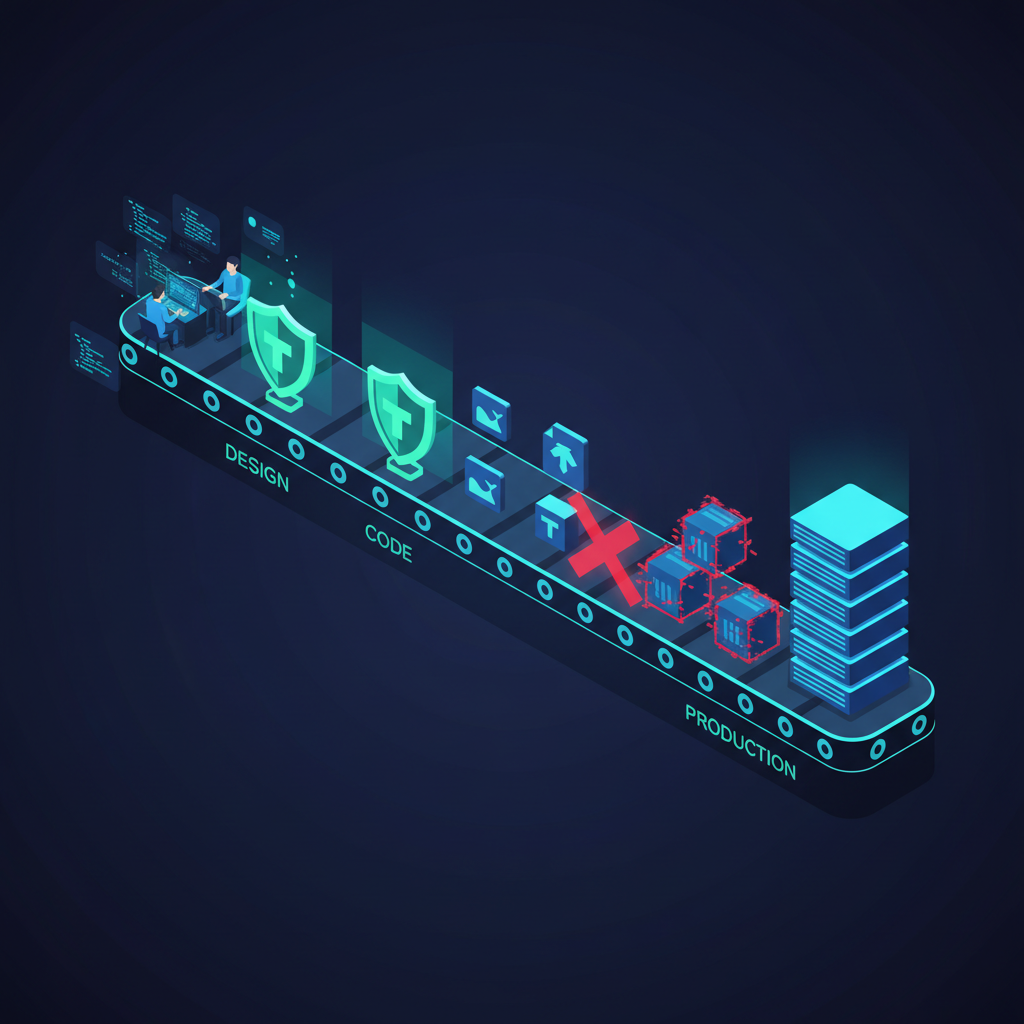
The Cost of Finding Bugs Late Is Astronomical
IBM's 2026 Cost of a Data Breach report puts the average breach price at $4.88 million. But here's the number that rarely gets enough attention: a vulnerability found in production costs roughly 30 times more to fix than one caught during the design phase. That's not a rounding error — that's a fundamental argument for rethinking where security fits in the software development lifecycle.
Shift left security is the practice of moving security testing, analysis, and enforcement earlier in the development pipeline — from the right side of the SDLC (production, post-deployment) to the left (design, coding, build). It sounds deceptively simple. In practice, it requires a genuine cultural shift, tooling realignment, and a willingness to let developers own security outcomes they've historically handed off to a separate team.
If you're running a DevSecOps program in 2026 and security is still primarily a gate before production, you're not running DevSecOps. You're running DevOps with a security audit bolted on at the end.
What Is Shift Left Security?
The term comes from visualizing a development timeline as a horizontal line — requirements and design on the left, deployment and operations on the right. Shifting left means pulling security activities toward that left side: threat modeling in the design phase, static analysis during coding, dependency scanning at build time, container image checks before the image ever hits a registry.
The goal isn't to eliminate post-deployment security (that's shift right's domain, and it's equally important). The goal is to change the economics. Catching a hardcoded AWS secret in a developer's commit takes seconds with the right tooling. Discovering that same secret six months later in a breach investigation costs orders of magnitude more — financially, reputationally, operationally.
At its core, shift left security is about feedback loops. Fast, accurate, contextual feedback given to the person who wrote the code while the code is still fresh in their head. That's fundamentally different from handing a 400-line SAST report to a developer three weeks after the sprint ended.
Shift Left vs Shift Right: Two Sides of the Same Coin
There's a false dichotomy that sometimes emerges in these discussions — the idea that shift left and shift right are competing philosophies. They're not. They're complementary, and mature security programs need both.
Shift right testing focuses on runtime security: chaos engineering, penetration testing in staging, behavioral anomaly detection in production, continuous compliance validation against live environments. Shift right is where you discover vulnerabilities that only manifest under real traffic patterns, integration edge cases that static analysis can't model, and supply chain compromises that slip through build-time scans.
Shift left security handles what shift right can't: finding issues before they're baked into deployable artifacts. SAST tools analyze source code for SQL injection patterns, insecure deserialization, hardcoded credentials. Secret detection tools catch API keys and tokens before they leave the developer's machine. Infrastructure-as-code scanners flag misconfigured S3 buckets in Terraform before the bucket is ever provisioned.
The practical split: shift left reduces the attack surface that reaches production. Shift right validates that the attack surface you couldn't catch at build time is being actively monitored. Together, they close the loop.
The Shift Left Security Approach in DevSecOps Pipelines
A real shift left security approach isn't a single tool — it's a layered set of controls embedded across the CI/CD pipeline. Here's how that typically breaks down in modern DevSecOps environments:
Pre-Commit: The First Line of Defense
Pre-commit hooks are the furthest-left you can push security. Tools like git-secrets, Gitleaks, or purpose-built platforms catch secrets and policy violations before a commit ever reaches the remote repository. This is non-negotiable in 2026. The volume of exposed credentials on public GitHub repositories alone — tens of thousands per day by some estimates — demonstrates that developers can't be relied on to manually audit their commits. The tooling needs to catch it automatically. Our Secret Detection capability is built precisely for this layer.
CI Pipeline: SAST, SCA, and IaC Scanning
Once code hits the CI pipeline, three categories of scanning become critical. Static application security testing (SAST) analyzes the code itself for vulnerability patterns without executing it. Software composition analysis (SCA) examines third-party libraries and open-source dependencies for known CVEs — critical given that the majority of modern application code is imported, not written. Infrastructure-as-code scanning validates Terraform, CloudFormation, Helm charts, and Kubernetes manifests against security benchmarks like CIS Controls before they're applied anywhere.
The SAST tooling embedded in a well-designed pipeline should be fast enough that developers don't bypass it. If a SAST scan takes 45 minutes, teams will find ways to skip it. Sub-5-minute scans on incremental changes are the benchmark to target.
Container Build: Image Scanning Before Push
Container images are artifacts that carry vulnerabilities forward indefinitely if not scanned. A base image pulled from Docker Hub six months ago may carry a dozen unpatched CVEs that have accumulated since. Container Image Scanning at build time — not just at deploy time — ensures vulnerable images never reach your registry in the first place. Tools like Trivy and Grype are popular open-source options; enterprise platforms integrate this directly into the pipeline with policy enforcement that blocks pushes on critical findings.
Policy as Code: Guardrails That Scale
Manual security reviews don't scale. Policy-as-code does. Defining security requirements as machine-readable policies — using OPA (Open Policy Agent), Rego, or similar frameworks — means the same security standards are enforced consistently across every pipeline run, every team, every cloud environment. No security engineer needs to manually review each deployment. The Policy-as-Code approach is foundational to scaling shift left without scaling headcount proportionally.
Shift Left Security Best Practices for 2026
Theory is easy. Implementation is where most programs stumble. These are the practices that actually move the needle:
1. Treat Security Findings as Developer Bugs, Not Security Team Tickets
When a SAST finding gets routed to a security team Jira board that developers never see, you've already failed. Shift left security only works when the feedback reaches the developer in their existing workflow — in the PR comment, in the IDE, in the CI check that blocks merge. Integrate findings into GitHub, GitLab, or Bitbucket pull requests directly. That's where developers live.
2. Define Clear Severity Thresholds for Pipeline Gates
Not every finding should block a deployment. Critical CVSS scores above 9.0? Block. Medium findings? Flag and track. This nuance matters enormously. Teams that gate on every low-severity finding generate so much noise that developers either ignore the tools entirely or spend all their time triaging irrelevant alerts. EPSS scores — which estimate the probability a CVE will be exploited in the next 30 days — are increasingly used alongside CVSS to prioritize what actually matters. Our Vulnerability Management platform incorporates this risk-based prioritization natively.
3. Shift Threat Modeling Left Too
SAST and secret detection are tactical. Threat modeling is strategic. Too many teams treat threat modeling as a once-a-year exercise done by the security team in isolation. In a mature shift left program, threat modeling happens at sprint planning — developers, architects, and security engineers identifying trust boundaries, data flows, and potential attack vectors before a line of code is written. STRIDE, PASTA, and OWASP's Threat Dragon are all viable frameworks here.
4. Build a Security Champions Program
You can't embed a security engineer in every squad. Security champions — developers who receive additional security training and serve as the security point of contact for their team — bridge that gap. They triage findings, mentor peers, and escalate genuinely critical issues. This is one of the highest-leverage investments a security program can make, and it's culturally aligned with how shift left actually needs to function.
5. Measure What Matters: MTTR, Not Just Coverage
Many programs measure shift left success by coverage — what percentage of repos have SAST enabled, how many pipelines have secret detection. Coverage matters, but mean time to remediate (MTTR) is the metric that tells you whether the program is actually working. A vulnerability sitting open for 90 days in a scanned repo is not better than a vulnerability sitting open for 90 days in an unscanned one. Track time-to-fix by severity, by team, by component. That data tells you where the friction is.
Common Pitfalls That Kill Shift Left Programs
Frankly, most shift left initiatives fail within 18 months — not because the tooling doesn't work, but because of implementation mistakes that are entirely preventable.
The first is tool sprawl. Teams adopt five different SAST tools, three secret scanners, two IaC validators, all producing findings in different formats that no one has the time to consolidate. Pick a platform that provides unified visibility. The Code Security platform at Secrails is built specifically to address this — consolidating findings from multiple scanning types into a single, prioritized view.
The second pitfall is alert fatigue. When a 500-line PR generates 200 security findings, developers stop reading them. Start with high-severity findings only, tune aggressively, and expand scope as trust builds between security and development teams.
The third is ignoring the cloud layer. Shift left in application code without addressing infrastructure misconfiguration is half a program. A perfectly secure application deployed into a misconfigured cloud environment — overly permissive IAM roles, unencrypted storage, public network exposure — is still exploitable. That's where CSPM and Cloud Security posture management close the gap between code-level security and runtime environment security.
Shift Left Security and Compliance: An Underrated Connection
Compliance frameworks including SOC 2, ISO 27001, and NIS2 increasingly demand evidence of security controls embedded in development processes — not just perimeter controls. Auditors in 2026 want to see pipeline scan outputs, policy-as-code enforcement logs, and remediation timelines. A well-implemented shift left program generates the audit evidence almost as a byproduct of normal operation.
For organizations pursuing compliance at scale, shift left security isn't just a security engineering concern — it's a compliance acceleration mechanism. Automated checks that run on every commit create a continuous, timestamped audit trail that manual processes can't replicate.
What Good Actually Looks Like
A mature shift left security posture in 2026 looks something like this: developers get secret detection and basic SAST feedback in their IDE before code is even committed. The CI pipeline runs SAST, SCA, and IaC scanning on every PR, with findings posted as PR comments and gates blocking merges on critical findings. Container images are scanned at build time with a policy that rejects images containing critical CVEs. Infrastructure changes go through policy-as-code validation before Terraform apply. A security champions network triages medium-severity findings within the sprint. And a unified platform provides security engineers with cross-team visibility into backlog trends, MTTR metrics, and systemic vulnerability patterns.
That's not a fantasy — teams running on platforms like SECRAILS are operating at this level today. The tooling exists. The frameworks are mature. The variable is organizational will and the discipline to implement consistently across every team and every pipeline.
Shift left security isn't a destination. It's an ongoing calibration of where in the development lifecycle you're catching risk — and a relentless push to catch it earlier, cheaper, and more accurately with each iteration.