

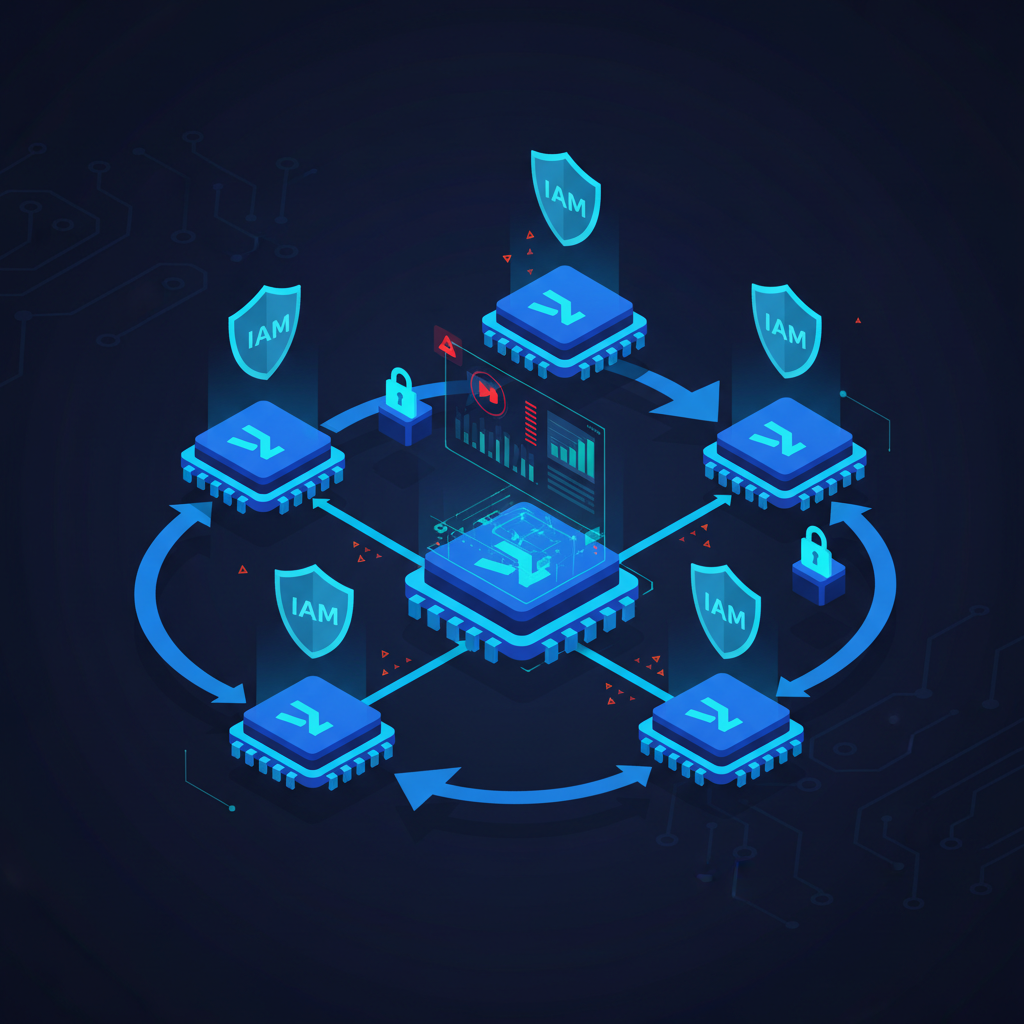
Serverless Doesn't Mean Securityless
Gartner estimates that by 2026, over 50% of global enterprises will be running production workloads on serverless platforms. That stat is impressive — and a little terrifying. Because in the rush to ship faster and ditch infrastructure overhead, most teams are skipping the security fundamentals that protect serverless environments from a whole new class of vulnerabilities.
Here's the uncomfortable truth: traditional perimeter security is almost irrelevant in a serverless model. You don't own the OS. You don't patch the runtime. You don't control the host. What you do own — and what attackers will exploit — are your function permissions, your event sources, your secrets in environment variables, and the blast radius created by an overly permissive IAM role. That's the battlefield in 2026.
What Serverless Architecture Actually Looks Like
Serverless computing is not magic. It's a managed execution model where your code runs in short-lived, stateless functions triggered by events — HTTP requests, queue messages, database changes, scheduled jobs. AWS Lambda, Azure Functions, and Google Cloud Functions are the dominant serverless computing services. Each abstracts away infrastructure but introduces its own security model with unique failure modes.
Take serverless architecture on AWS. Lambda functions run in isolated micro-VMs (Firecracker-based) with ephemeral execution environments. The function lifecycle is: trigger → cold start → execute → terminate. Security events can happen in every single phase. A poisoned event source, an exposed API Gateway endpoint with no auth, an over-scoped execution role — these are not hypothetical. The Datadog 2026 State of Serverless report found that 43% of Lambda functions in production had at least one critical misconfiguration.
Serverless computing on Azure follows similar patterns with Azure Functions, Durable Functions, and Logic Apps. The Azure-specific risks are compounded by the complexity of Managed Identity vs. Service Principal configurations. A developer grabs a connection string, stuffs it in an app setting, and forgets to rotate it. Six months later, it's in a GitHub repository. Classic.
The Unique Attack Surface of Serverless Functions
Serverless doesn't eliminate attack vectors. It redistributes them. Understanding the MITRE ATT&CK cloud matrix is essential here — specifically the techniques under Initial Access and Execution that map directly to serverless environments.
Event Injection
This is the serverless equivalent of SQL injection, and it's criminally underappreciated. When a Lambda function consumes an SQS message or processes an S3 event notification, the event payload becomes an attack vector if the function doesn't validate input strictly. An attacker who can write to your SQS queue — or who compromises an upstream service — can craft a malicious payload that exploits parsing logic inside your function. OWASP's Serverless Top 10 (revised 2025) lists injection flaws as the number one risk. Still number one. Some things don't change.
Overpermissive IAM Roles
This is where most serverless breaches actually originate. A Lambda function with s3:* and dynamodb:* permissions attached to it is not a principle of least privilege — it's an open invitation. If an attacker achieves code execution inside that function (through injection, dependency confusion, or a compromised third-party layer), they inherit every IAM permission attached to the execution role. That's lateral movement on a silver platter.
The fix is not complicated — scope execution roles to the minimum permissions required for that specific function. But it requires discipline and tooling. Static analysis against IAM policies, enforced through Policy-as-Code, catches these misconfigurations before they reach production.
Dependency and Supply Chain Risk
Serverless functions are compact by design, but they still pull in third-party dependencies. A single npm package with a malicious version, a Python library with an unpatched CVE, a Lambda Layer shared across teams — any of these can introduce vulnerabilities that you inherit without realizing it. SBOM (Software Bill of Materials) practices are non-negotiable here. Tools like Snyk, Trivy, and SAST scanning integrated into your CI/CD pipeline catch these before deployment. Running static analysis against serverless function code also surfaces hardcoded secrets, unsafe deserialization, and logic flaws that won't show up in runtime monitoring until it's too late.
Cold Start Timing and Session Security
Session security in serverless is genuinely weird. Functions are stateless by design — there's no persistent session store inside the function itself. Developers work around this by storing session tokens in environment variables, passing them through event payloads, or relying on upstream API Gateway authorizers. Each approach has distinct security implications. Environment variables in Lambda are encrypted at rest with AWS KMS, but they're visible in plaintext to anyone with IAM permissions to read the function configuration. That's a secret detection problem masquerading as a configuration problem.
Serverless Computing Examples: Real Breach Patterns
Theory is useful. Real incidents are more instructive.
The Exposed API Gateway Pattern
A fintech startup in 2025 left an API Gateway endpoint unauthenticated during a phased rollout. The endpoint triggered a Lambda that had read access to a DynamoDB table containing customer PII. An automated scanner found the open endpoint within 72 hours of deployment. No auth, no WAF, no CloudWatch anomaly detection. The blast radius: 180,000 customer records. Classic misconfiguration, entirely preventable.
Malicious Lambda Layer Injection
A supply chain attack vector unique to serverless: Lambda Layers. In 2025, researchers documented a pattern where public Lambda Layers published to the AWS Serverless Application Repository contained obfuscated code that exfiltrated environment variables on every invocation. Teams pulling in shared layers without scanning them are exposed. Container image scanning practices — applied to Lambda container images — and layer verification workflows close this gap.
Privilege Escalation via Step Functions
AWS Step Functions orchestrate complex workflows across multiple Lambda functions. If one function in the chain has elevated permissions and its input isn't validated, an attacker can craft state machine inputs that trigger privilege escalation paths. This is a MITRE ATT&CK T1098 variant applied to serverless orchestration. Not widely discussed, increasingly exploited.
Securing Serverless Architecture: The Practical Framework
Enough about what goes wrong. Here's how to build serverless security that actually holds up.
1. Enforce Least Privilege at the Function Level
Every Lambda, every Azure Function, every Cloud Run service gets its own execution identity with scoped permissions. No shared execution roles across functions with different data access patterns. Audit existing roles with tools like AWS IAM Access Analyzer or Azure's built-in RBAC analysis. Then automate enforcement through Policy-as-Code guardrails that fail deployments with overpermissive roles in CI/CD.
2. Treat the Event Source as Hostile
Every event payload is potentially attacker-controlled. Validate and sanitize all inputs before processing — yes, even from internal queues. Apply schema validation at the function entry point. If your function processes JSON, reject anything that doesn't match your expected schema. This eliminates the event injection class of attacks almost entirely.
3. Secret Management Done Right
Environment variables are not a secret store. Use AWS Secrets Manager, Azure Key Vault, or HashiCorp Vault. Rotate credentials automatically. Audit access to secrets with CloudTrail or Azure Monitor. Integrate Secret Detection into your pipeline to catch any credentials that accidentally land in function code or IaC templates.
4. Runtime Monitoring and Anomaly Detection
Falco extended to serverless workloads, AWS CloudWatch Insights, and Azure Application Insights all provide runtime telemetry. But most teams configure alerts reactively — after an incident. Build detection rules for anomalous invocation patterns: functions running longer than expected, unusual API calls in CloudTrail, IAM actions from function execution roles that weren't seen before. These behavioral patterns are your early warning system.
5. Continuous Cloud Posture Management
Serverless misconfigurations accumulate fast, especially in multi-account AWS environments or multi-subscription Azure setups. A dedicated CSPM solution continuously inventories your serverless resources, evaluates them against CIS Benchmarks and NIST CSF 2.0 controls, and surfaces drift before it becomes a breach. Static point-in-time audits don't cut it when functions deploy dozens of times per day.
6. Dependency Scanning in the Pipeline
Every function deployment pipeline should run dependency scanning against the function package. EPSS scores from FIRST.org help prioritize which CVEs to fix first — not every vulnerability is equally exploitable in a serverless context, but the ones with high EPSS scores in your runtime need immediate attention. Combine dependency scanning with static code analysis for full coverage.
Serverless Security on AWS vs. Azure: Key Differences
Serverless architecture AWS and serverless computing Azure share the same conceptual model but diverge significantly in implementation details that matter for security.
On AWS, the primary security controls are IAM execution roles, VPC integration for network isolation, Lambda resource policies (who can invoke the function), and KMS encryption of environment variables. The CIS AWS Foundations Benchmark v3.0 covers Lambda-specific controls. AWS Security Hub aggregates findings across accounts.
On Azure, the equivalent controls are Managed Identities, Virtual Network integration, App Service authentication/authorization (Easy Auth), and Azure Key Vault references. The CIS Microsoft Azure Foundations Benchmark v2.1 is your baseline. Microsoft Defender for Cloud — which integrates with security platforms like ours — provides unified posture management across Azure Functions and other serverless services.
One area where Azure has a clear advantage: Managed Identity eliminates the credential rotation problem for most service-to-service scenarios. On AWS, you're still managing IAM roles and policies manually in many cases, which is fertile ground for misconfiguration.
Compliance Implications for Serverless Workloads
GDPR, SOC 2, PCI DSS, and NIS2 don't have serverless-specific clauses — but they apply fully. Data processed by a Lambda function is still data under GDPR Article 32. Logging and monitoring requirements under SOC 2 CC7 apply to serverless functions. If your functions touch cardholder data, PCI DSS Requirement 6 (secure development) and Requirement 10 (logging) apply verbatim.
The challenge is demonstrating compliance for ephemeral, short-lived resources. Traditional audit trails assume persistent infrastructure. Serverless audit evidence comes from CloudTrail, CloudWatch Logs, and CSPM continuous monitoring outputs. Compliance teams need to adapt their evidence collection workflows — and security teams need to ensure that logging is comprehensive, tamper-evident, and retained per policy. Solutions covering compliance automation that understand serverless resource types are no longer optional for regulated industries.
Building a Serverless Security Culture
Tools matter. Process matters more. The teams that get serverless security right are the ones where developers understand the security model — not just the operational model. That means threat modeling for new serverless workloads before the first line of code is written. It means security champions embedded in squads that own Lambda/Azure Functions codebases. It means a cloud security program that treats serverless as a first-class citizen alongside VMs, containers, and managed services.
The NIST CSF 2.0 Govern function — introduced in the 2024 revision — explicitly covers security culture and organizational accountability. Apply it to your serverless program. Define who owns function security. Define what acceptable risk looks like for a publicly-invokable function. Document it. Enforce it.
Serverless computing examples from the real world — the breaches, the near-misses, the successful deployments — all point to the same conclusion: the underlying platform is increasingly secure. The attack surface has shifted decisively to application logic, permissions, and secrets. That's the layer your security program needs to own in 2026.