

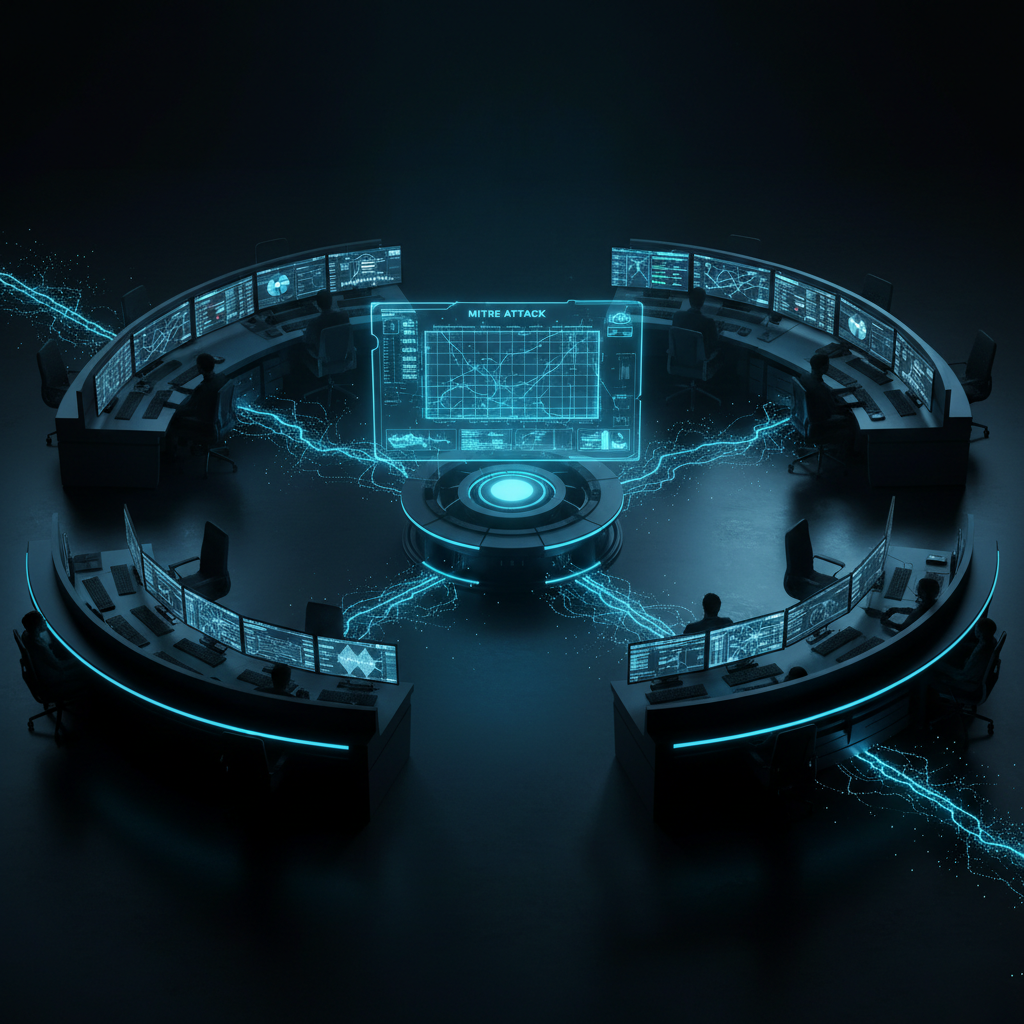
IBM's 2026 Cost of a Data Breach report puts the average breach cost at $4.88M. Organizations without a mature security operations function take an average of 287 days to identify and contain an incident. That gap is not a technology problem. It is an operational one. A Security Operations Center (SOC) exists precisely to close it.
Yet most articles about SOCs read like vendor brochures. Vague frameworks. Generic flowcharts. No real discussion of the hard operational challenges: alert fatigue drowning analysts, SIEM tuning that never quite works, or the brutal staffing economics of running 24/7 coverage. This guide cuts through that noise.
What Is a Security Operations Center?
A Security Operations Center is a centralized function where security analysts monitor, detect, investigate, and respond to cybersecurity threats in real time. It may be physical, virtual, or hybrid. The SOC is the nerve center of an organization's defensive posture. It aggregates telemetry from endpoints, networks, cloud environments, and applications into a unified operations picture, then acts on it.
What does SOC stand for in cybersecurity? Simply: Security Operations Center. But the acronym carries operational weight. A functional SOC is not just a room with screens. It is a combination of people, processes, and technology running continuously, usually 24/7/365, to detect threats before they become breaches and contain breaches before they become disasters.
The core mandate breaks down into three functions: continuous monitoring, detection and analysis, and response and remediation. Strip away the vendor buzzwords and that is still the job in 2026.
SOC vs. GSOC: What Is the Difference?
GSOC security, or Global Security Operations Center, is the enterprise-scale evolution of the traditional SOC. Where a standard SOC might serve a single region or business unit, a GSOC aggregates security operations across geographies, time zones, and business entities under one coordinated function.
A global security operations center typically handles the complexity of multinational regulatory environments including NIS2, DORA, GDPR, and regional data sovereignty laws. It coordinates incident response across distributed teams and maintains consistent threat intelligence feeds across all operating regions. The architecture challenge alone is significant: ensuring low-latency telemetry ingestion from data centers in Tokyo, Frankfurt, and Sao Paulo simultaneously is far from trivial.
Most large enterprises running a GSOC model use a tiered structure, a primary hub with regional spokes, to balance follow-the-sun coverage against the operational overhead of fully distributed teams. The coordination protocols between hub and spoke are where GSOC implementations most commonly fail.
SOC Team Structure and Roles
Security operations center jobs are organized into tiers that reflect escalating complexity and expertise. Understanding the tier model is essential both for organizations building a SOC and for professionals mapping a career path into security operations.
Tier 1: Triage Analyst
The front line. Tier 1 analysts monitor alert queues, perform initial triage, and escalate confirmed or suspected incidents. The role is high-volume and repetitive, which is exactly why automation is consuming it from below. Most mature SOCs use SOAR playbooks to handle 60 to 80 percent of what Tier 1 used to do manually: log enrichment, IP reputation lookups, basic containment actions like host isolation. What remains requires human judgment: ambiguous alerts, novel attack patterns, anything that does not fit a playbook.
Tier 2: Incident Responder
Tier 2 takes escalated incidents, performs deeper forensic analysis, and coordinates containment and remediation. This is where MITRE ATT&CK fluency matters: mapping observed attacker behavior to known techniques, assessing lateral movement risk, estimating blast radius. Tier 2 analysts are also responsible for threat hunting, proactively searching for indicators of compromise that have not yet triggered automated alerts.
Tier 3: Threat Intelligence and Senior Analyst
The top of the operational pyramid. Tier 3 handles the most complex incidents, develops detection content including custom SIEM rules and behavioral analytics, and drives the SOC's threat intelligence program. They also interface with executive leadership during significant incidents, translating technical findings into business risk language.
SOC Manager
Responsible for operational metrics, staffing, tooling strategy, and stakeholder communication. A good SOC manager understands both the technical depth needed to lead analysts and the business context needed to justify security investment. Mean time to detect and mean time to respond are the KPIs that matter most here.
Core SOC Technologies in 2026
The SOC technology stack has fragmented significantly over the past five years. What used to be a relatively simple SIEM-plus-endpoint architecture now encompasses a dozen or more distinct tool categories.
SIEM
Still the backbone. Microsoft Sentinel, Splunk, and IBM QRadar dominate the enterprise space. Chronicle from Google is gaining ground in cloud-native environments. The persistent challenge: SIEM effectiveness is almost entirely a function of the quality of your detection rules and data normalization. A poorly tuned SIEM generates tens of thousands of low-fidelity alerts per day. That is not detection. It is noise.
SOAR
Security Orchestration, Automation, and Response platforms automate repetitive SOC workflows. Good SOAR implementation requires disciplined playbook development and regular tuning. Bad SOAR implementation creates automated false-positive storms that are arguably worse than manual triage.
EDR and XDR
Endpoint Detection and Response platforms provide deep endpoint telemetry and automated response capability. Extended Detection and Response attempts to unify endpoint, network, email, and cloud telemetry with varying success depending on vendor and environment. Modern XDR tools integrate threat signals across the full security stack, giving analysts a more complete picture of attack chains.
Cloud Security Posture Management
Modern SOCs monitoring cloud environments need CSPM data in their operations workflow. Misconfigured storage buckets, overly permissive IAM roles, and exposed APIs generate exploitable attack surface that traditional perimeter monitoring misses entirely. Integrating cloud security posture management data into the SOC operations workflow gives analysts the cloud context they need to prioritize and respond effectively.
Vulnerability Management Integration
The SOC does not own vulnerability management, but it needs the data. Knowing that an externally triggered alert maps to a host with an unpatched critical CVE fundamentally changes incident priority. Tight integration between vulnerability management platforms and SIEM or SOAR tooling is a force multiplier for SOC effectiveness.
What Does SOC Stand For in Cyber Security vs. SOC 2?
A common point of confusion: SOC in cybersecurity, meaning Security Operations Center, is entirely different from SOC 2, which is an auditing framework. They share an acronym and nothing else.
SOC 2, developed by the American Institute of Certified Public Accountants, is a compliance framework evaluating how service organizations manage customer data across five Trust Services Criteria: Security, Availability, Processing Integrity, Confidentiality, and Privacy. It has no operational relationship to a Security Operations Center, despite the shared name. Organizations building a compliance program around the SOC 2 framework are doing audit preparation work, not security operations work.
The confusion trips up plenty of procurement conversations. When a CISO asks whether you have SOC capabilities, they mean a security operations function. When a vendor says they are SOC 2 Type II certified, they mean they have passed an audit. These are different things entirely.
Building vs. Buying: Managed SOC and MDR
Running an internal SOC at scale is expensive. The math is brutal: 24/7 coverage across three tiers requires a minimum of 10 to 15 full-time analysts when you factor in vacation, sick leave, and shift rotation. At 2026 market rates for senior security engineers, that is easily two to three million dollars annually in personnel costs alone, before tooling.
Managed Detection and Response vendors offer an alternative. MDR providers run the SOC function as a service, providing 24/7 monitoring, detection, and response against a defined SLA. The trade-off is always context: a managed provider will never know your environment as deeply as an internal team that lives in it daily.
The hybrid model, an internal SOC handling strategic threat hunting and incident command while an MDR handles tier 1 and tier 2 triage, is increasingly common. It trades some depth for coverage without the full overhead of a dedicated internal function.
Closing the Detection Gap with Code Security
One area traditional SOCs consistently underserve is code and supply chain threats. Runtime detection catches attacks after they have reached production. Shifting security earlier into the development pipeline fundamentally reduces the attack surface the SOC has to defend.
Integrating code security findings into the SOC risk picture means analysts can correlate suspicious runtime behavior with known vulnerable dependencies in an application's software bill of materials. That correlation closes detection gaps that pure runtime monitoring leaves open. Similarly, secret detection in CI/CD pipelines prevents credential exposure events from ever becoming SOC incidents. The best kind of detection is the one that eliminates the threat before it manifests.
Key SOC Metrics: What Actually Matters
Alert volume is not a metric. It is a symptom. The metrics a SOC manager should be tracking in 2026 are mean time to detect, mean time to respond, false positive rate by detection rule, escalation rate from Tier 1 to Tier 2, and containment success rate measured as the percentage of incidents contained before data exfiltration or lateral movement occurs.
Most SOC teams are measuring the wrong things, tracking ticket counts and SLA adherence rather than actual detection efficacy. A SOC that closes 500 false positive tickets per day faster than SLA is not a good SOC. It is an expensive alert processing function.
Benchmarking against NIST CSF 2.0 Detect and Respond functions is a useful starting point for capability maturity assessment. Mapping SOC capabilities against MITRE ATT&CK coverage matrices shows exactly which attack techniques you can detect and which blind spots attackers will exploit.
The Future of SOC Operations
AI-augmented SOC operations are the near-term reality in 2026, not a distant aspiration. LLM-powered alert triage, AI-assisted threat hunting, and automated case summarization are already deployed in production at leading SOC operations. The productivity gains are real. Analysts spend less time on mechanical enrichment and more time on adversary reasoning.
The risk is over-reliance. AI-generated triage summaries can be wrong. Models trained on historical attack patterns miss novel techniques. The SOC of the near future is not a lights-out AI operation. It is AI-amplified human analysts, better equipped to handle scale and complexity than either could alone.
At SECRAILS, the approach to security operations integrates cloud posture, vulnerability data, code security signals, and AI-driven risk context into a unified platform, giving security teams the full operational picture rather than isolated tool outputs. The goal is reducing the gap between detection and response, which is still where most security failures occur.
Building a SOC is not just a technology investment. It is an operational commitment. Get the foundations right: detection engineering, process discipline, and the right tooling integrations. Get them wrong, and no amount of budget will make it work.