

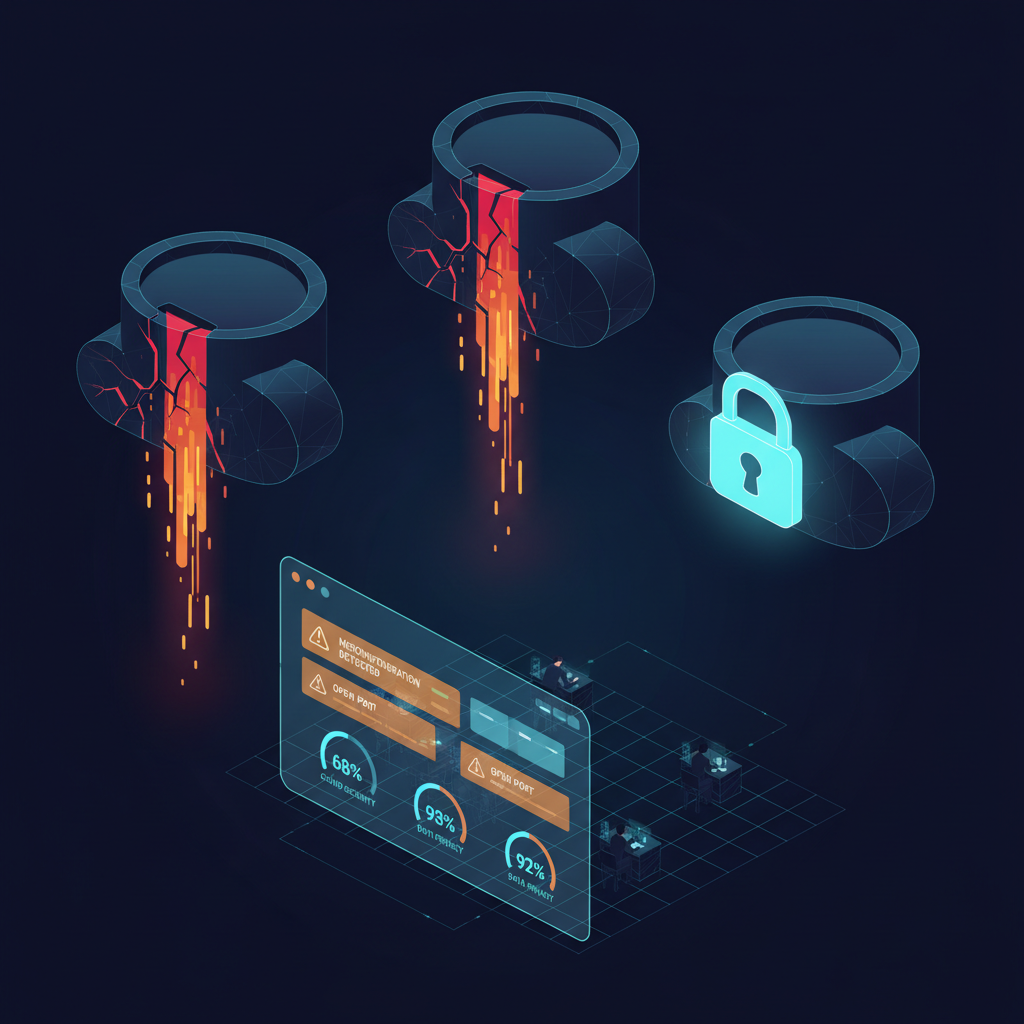
Misconfiguration Is Still the Number-One Cloud Risk in 2026
Gartner estimated that through 2025, 99% of cloud security failures would be the customer's fault — and that prediction has aged remarkably well. IBM's 2026 Cost of a Data Breach report pegged the average breach cost at $4.88M, with cloud misconfigurations consistently ranking as a top root cause. Not sophisticated zero-days. Not nation-state APTs chaining novel exploits. Just an S3 bucket left public, an IAM role with wildcard permissions, or a Kubernetes API server exposed to the internet.
Security misconfiguration is exactly what it sounds like: a system, service, or cloud resource set up in a way that violates security best practices. The misconfiguration meaning extends beyond simple human error — it encompasses default credentials left unchanged, overly permissive policies applied at scale, and infrastructure-as-code templates that bake in risky settings from day one. A misconfiguration synonym you'll hear in threat modeling circles is insecure default, because many of these issues exist simply because someone accepted the out-of-the-box state of a service without hardening it.
This post covers concrete security misconfiguration examples drawn from real incidents, explains what cloud misconfiguration actually looks like in practice, and gives you actionable remediation paths — not generic advice.
What Is Cloud Misconfiguration? A Working Definition
When people ask what is cloud misconfiguration, they're usually asking about one of three failure modes. First: access control failures, where permissions are broader than required. Second: network exposure failures, where services bind to public interfaces unnecessarily. Third: logging and monitoring gaps, where audit trails are disabled or incomplete, leaving attackers room to operate undetected.
Cloud misconfiguration differs from on-premise misconfiguration in one critical way: the blast radius. A single IAM policy misconfiguration in AWS can cascade across hundreds of resources in seconds. Multi-account environments amplify this further. When you're running 400 AWS accounts behind an AWS Organizations setup, one shared misconfiguration in a Service Control Policy propagates everywhere. That's why CSPM tooling exists — to continuously evaluate cloud configurations against frameworks like CIS Benchmarks, NIST CSF 2.0, and SOC 2 controls before misconfigurations become breach headlines.
Real Security Misconfiguration Examples from Notable Incidents
1. Publicly Accessible S3 Buckets — The Classic That Won't Die
The Capital One breach of 2019 is still the canonical cloud misconfiguration case study. A misconfigured WAF allowed an SSRF attack that retrieved AWS credentials, which then accessed over 100 million customer records stored in S3. But you don't need an SSRF chain. In 2023 and into 2026, researchers keep finding S3 buckets with Block Public Access turned off and bucket policies granting s3:GetObject to *. Full stop. No credentials required.
The fix isn't complicated: enforce S3 Block Public Access at the AWS Organizations level via Service Control Policies, and use AWS Config rules or a Cloud Security platform to continuously audit bucket ACLs. The hard part is organizational — making sure developers can't override these settings in their own accounts without a formal exception process.
2. Overpermissive IAM Roles — The Lateral Movement Highway
A security misconfiguration example that gets less press than exposed buckets: IAM roles attached to EC2 instances or Lambda functions with AdministratorAccess or iam:PassRole to *. Attackers who gain code execution on a single Lambda — via a dependency confusion attack, a vulnerable third-party package, or a simple SSRF — can immediately escalate to full account takeover by calling the instance metadata service.
MITRE ATT&CK maps this under T1078 (Valid Accounts) and T1548 (Abuse Elevation Control Mechanism). The principle of least privilege isn't a platitude here; it's the actual control that limits lateral movement. AWS IAM Access Analyzer, combined with tools like AI-SPM that model permission graphs, can surface these overpermissive paths before they're exploited.
3. Kubernetes API Server Exposed Without Authentication
Shodan regularly indexes Kubernetes API servers listening on 6443 or 8080 without TLS and with anonymous auth enabled. This is a direct misconfiguration of the --anonymous-auth flag, which defaults to true in some distributions. Attackers scan for these constantly. Once they hit an unauthenticated API server, they can create privileged pods, mount the host filesystem, and achieve node-level compromise in under 60 seconds.
CIS Kubernetes Benchmark v1.8 explicitly covers this: disable anonymous authentication, enforce RBAC, and never expose the API server to 0.0.0.0 without network-level controls. If you're running containers at scale, pairing your cluster hardening with Container Image Scanning ensures misconfigurations in both the runtime environment and the images themselves are caught early.
4. Default Credentials on Cloud-Managed Databases
RDS instances, MongoDB Atlas clusters, Elasticsearch deployments — all have been breached because someone spun up a managed database, left the default admin username and password unchanged, and either exposed the port publicly or placed it in a subnet with overly permissive security groups. The Meow attacks of 2020 wiped thousands of exposed Elasticsearch and MongoDB instances. Similar campaigns resurface every year.
Default credentials are a textbook security misconfiguration example under OWASP Top 10 A05:2021 (Security Misconfiguration). Rotating credentials at provision time, enforcing password complexity via secrets management (HashiCorp Vault, AWS Secrets Manager), and using Secret Detection in your CI/CD pipeline to prevent credentials from ever reaching version control — these are table-stakes controls that many teams still skip.
5. Disabled Logging and Monitoring — Giving Attackers a Free Pass
CloudTrail disabled. VPC Flow Logs off. Azure Monitor Diagnostic Settings not configured. These aren't exotic misconfigurations — they're shockingly common, especially in accounts spun up quickly for a proof-of-concept that somehow made it to production. Without logging, you have no forensic capability. You can't reconstruct the attack chain, you can't determine the scope of exfiltration, and you almost certainly fail your SOC 2 or ISO 27001 audit.
The SolarWinds fallout made this painfully clear: organizations without comprehensive cloud logging had no idea whether Sunburst-related activity had touched their Azure tenant. Enforce mandatory logging via Policy-as-Code — Policy-as-Code frameworks like Open Policy Agent (OPA) can gate deployments that don't have logging configurations attached.
6. Unrestricted Outbound Traffic — Exfiltration on a Silver Platter
Security groups and network ACLs that allow all outbound traffic (0.0.0.0/0 on all ports) are another common security misconfiguration example. Attackers who compromise a workload can exfiltrate data, phone home to C2 infrastructure, and download additional tooling without any network-level friction. Egress filtering is unglamorous, but it's a meaningful control layer.
Frankly, most organizations focus so heavily on ingress rules that egress becomes an afterthought. CIS AWS Foundations Benchmark 5.x addresses this directly. Pair network segmentation with DNS-layer monitoring to catch data exfiltration attempts that use seemingly benign outbound connections.
Cloud Breaches Rooted in Misconfiguration: The 2023–2026 Pattern
Cloud breaches 2023 through 2026 show a consistent pattern: misconfiguration attacks rarely require sophisticated tooling. The 2023 Microsoft Azure SAS token incident exposed internal Microsoft data because a researcher accidentally shared an Azure Blob Storage URL with an overly permissive SAS token scoped to an entire storage account — not just the intended container. The token had write and delete permissions, not just read. One misconfigured URL, terabytes of data at risk.
The MOVEit Transfer exploitation in 2023 is technically a vulnerability, but the organizations that suffered the worst impact had compounding misconfigurations: unnecessary internet exposure of the MOVEit service, no egress controls to limit exfiltration, and insufficient logging to understand breach scope. Misconfigurations amplified a known vulnerability's impact by an order of magnitude.
Cloud misconfiguration doesn't exist in isolation from software vulnerabilities. The two interact. A vulnerability in application code running on an overpermissive cloud role is catastrophically worse than the same vulnerability on a least-privilege role. Addressing misconfigurations reduces the exploitability and impact of every vulnerability in your environment. That's why Vulnerability Management programs that don't account for cloud configuration context are fundamentally incomplete.
How Misconfiguration Attacks Actually Work
Misconfiguration attacks follow a recognizable kill chain. Reconnaissance first — attackers use tools like ScoutSuite, Prowler, or simple cloud provider CLI enumeration to identify exposed resources. Then access: hit the public endpoint, use stolen credentials, or exploit an SSRF to reach the metadata service. Then escalation: abuse overpermissive IAM to expand access. Then persistence: create new IAM users, access keys, or backdoor Lambda functions. Finally, objectives: exfiltrate data, deploy cryptominers, or establish long-term access.
The entire chain relies on misconfigurations at multiple stages. Fix the network exposure, and reconnaissance is harder. Enforce least privilege, and escalation fails. Enable CloudTrail and GuardDuty, and persistence becomes detectable. No single control stops everything, but stacking them shrinks the attack surface dramatically.
Fixing Misconfigurations at Scale: What Actually Works
Shift-Left Configuration Checks in IaC
The most effective place to catch misconfigurations is before they deploy. Static analysis of Terraform, CloudFormation, and Pulumi templates using tools like Checkov, tfsec, or SAST-integrated pipelines catches issues at the pull request stage. A developer sees the misconfiguration as a PR comment, not as a production incident three months later. This is shift-left applied to cloud configuration — and it works.
Continuous Posture Management
Even with IaC scanning, drift happens. Someone logs into the console and makes a manual change. A third-party integration modifies a security group. Continuous cloud posture management — using CSPM that maps your live environment against CIS Benchmarks, NIST CSF 2.0, and your custom policies — provides the ongoing visibility that point-in-time audits miss. Real-time alerting on critical misconfigurations (public S3 bucket, root account usage, MFA disabled) should be table stakes.
Policy-as-Code for Guardrails
Reactive detection isn't enough. Preventive controls via Service Control Policies in AWS, Azure Policy, and GCP Organization Policies enforce configuration constraints at the infrastructure level — no application can override them. Combined with Policy-as-Code in your CI/CD pipeline, you get both prevention and detection working in concert.
Cloud Inventory Visibility
You can't secure what you can't see. Shadow IT in cloud environments — teams spinning up resources outside the standard provisioning process — is a persistent source of misconfigured, unmonitored assets. Maintaining a complete, accurate Cloud Inventory is the foundation everything else builds on. If your inventory is stale or incomplete, your misconfiguration detection is guaranteed to have blind spots.
The OWASP Top 10 and CIS Benchmark Alignment
Security misconfiguration has held its position in the OWASP Top 10 for years — it's A05:2021 and continues to be a leading finding in web application and cloud security assessments. CIS Benchmarks for AWS, Azure, GCP, and Kubernetes provide prescriptive controls mapped to specific misconfiguration categories. NIST CSF 2.0's Identify and Protect functions both call out configuration management as a core capability.
If you're building a misconfiguration remediation program, start with CIS Level 1 controls — they're the high-confidence, low-disruption fixes that address the most common attack vectors. Level 2 controls add depth for environments with stricter compliance requirements like FedRAMP or PCI DSS. Map your findings to these frameworks and you'll also have the audit evidence your compliance team needs, which feeds directly into your Compliance posture.
Final Thoughts: Misconfiguration Is a Process Problem, Not Just a Technical One
Every security misconfiguration example in this post has a technical fix. But the recurring theme across cloud breaches 2023–2026 is organizational: teams moving fast, skipping security reviews, deploying IaC templates inherited from Stack Overflow, and treating cloud configuration as a one-time setup task rather than a continuous security discipline.
The technical controls are well-understood. CIS Benchmarks, CSPM tooling, Policy-as-Code, shift-left IaC scanning — the industry knows what to do. The challenge is operationalizing these controls at the pace cloud environments actually change. That requires tooling that integrates with developer workflows, not security gates that slow teams down to a crawl. Get that balance right, and misconfiguration stops being your biggest cloud risk.