

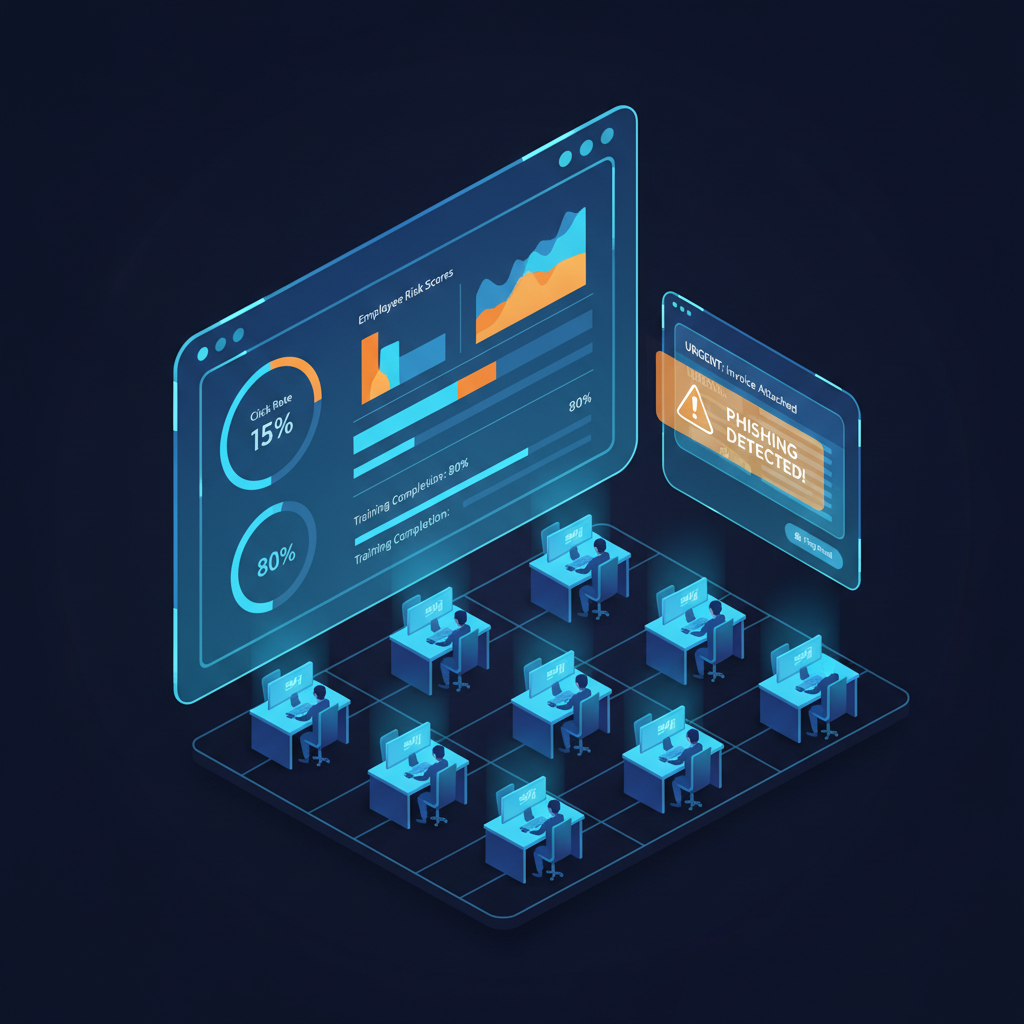
Ninety-five percent of cybersecurity incidents involve human error. Not misconfigured firewalls, not unpatched CVEs — humans. That single statistic from IBM's 2026 Cost of a Data Breach report should end every argument about whether security awareness training is worth the investment. It is. The real question is whether what your organization calls a training program is actually changing behavior, or just generating completion certificates that satisfy an auditor.
This guide covers the full picture: what effective security awareness training looks like in 2026, what regulatory requirements apply (including sector-specific mandates like cyber awareness training for Army personnel and DCF 45-hour requirements), how to measure impact, and how technical controls need to sit alongside human training — not replace it.
Why Security Awareness Training Fails (And How to Fix It)
Most corporate security awareness programs are broken by design. A 20-minute annual click-through module on password hygiene isn't training — it's a compliance checkbox. The research backs this up: the Ebbinghaus forgetting curve shows people lose roughly 70% of new information within 24 hours without reinforcement. Annual training doesn't stand a chance against that biology.
Effective programs treat awareness training as a continuous process, not an event. That means monthly micro-modules (under 5 minutes), live phishing simulations with immediate feedback, role-specific content for high-risk groups like finance and IT administrators, and metric tracking that goes beyond completion rates. Behavior change is the goal. Metrics like click rates on simulated phishing, password reset frequencies, and incident reporting rates are your actual signal.
The Anatomy of a Modern Training Program
A well-structured 2026 security awareness program typically layers several components. At the foundation, there's baseline assessment — testing employees' current knowledge and susceptibility before any training begins. This gives you real data on where the risk is concentrated. In a typical mid-sized organization, you'll find that roughly 15-20% of employees are consistently high-risk clickers, and that same group tends to reuse passwords and ignore MFA prompts.
On top of the baseline, you layer continuous microlearning content: short, scenario-based modules that map to current threat patterns. MITRE ATT&CK is useful here — you can align training scenarios to real techniques like T1566 (Phishing), T1078 (Valid Accounts), and T1190 (Exploit Public-Facing Application) to make the content feel operationally relevant rather than theoretical. Simulated social engineering attacks — phishing emails, vishing campaigns, USB drop tests — run monthly or quarterly, and every failed simulation immediately triggers a targeted training intervention rather than a mass email blast.
Regulatory Requirements: What You Actually Need to Know
Compliance requirements for security awareness training vary significantly by sector, jurisdiction, and organization type. Let's break down the major frameworks.
NIST CSF 2.0 and General Federal Guidance
Under NIST CSF 2.0, the Govern (GV) and Protect (PR) functions both address workforce training. PR.AT (Awareness and Training) specifically requires that personnel understand their cybersecurity responsibilities. For organizations asking what requirements apply when transmitting secret information, NIST SP 800-53 Rev 5 Control AT-2 (Literacy Training and Awareness) mandates training that includes handling of sensitive data, proper transmission controls, and acceptable use policies. If you're in a federal contractor environment, CMMC Level 2 and above codify these training requirements into scored assessment objectives with documented evidence.
Cyber Awareness Training for Army Personnel
The U.S. Army's cyber awareness training requirements are governed by the DoD Cyber Awareness Challenge, which is mandatory annual training for all personnel with access to DoD information systems. The 2026 version of the challenge covers social engineering, safe browsing, mobile device security, and classified information handling. Beyond the annual challenge, Army units follow AR 25-2 (Information Assurance) and DoD Directive 8570.01-M/8140.01 for role-based training tied to specific IT positions — Information Assurance Technical (IAT), Management (IAM), and System Architecture and Engineering (IASAE) categories each have distinct baseline certification requirements.
Failure to complete the DoD Cyber Awareness Challenge results in account suspension and network access revocation. That's not a suggestion — it's enforced at the system level through CAC authentication and account lifecycle management.
DCF Training: The 45-Hour Requirement
The DCF 45-hour training requirement applies to child welfare professionals, foster care providers, and others working within state Department of Children and Families frameworks. While this sits outside traditional cybersecurity domains, it intersects with data security: DCF workers handle extraordinarily sensitive PII — child health records, family court documents, placement histories — and are subject to HIPAA, state privacy laws, and federal child welfare data requirements. The dcf training 45 hours requirement for licensing renewal or initial certification includes modules on data privacy, secure communication of case information, and mandatory reporting procedures. Many states now deliver this through online portals — if you're looking for my dcf training online login or dcf 45 hours training login access, those are managed through individual state DCF portals, not a unified federal system. Florida, for instance, uses the Florida Safe Families Network (FSFN) and associated eLearning systems; Texas uses the DFPS Learning Portal.
The security relevance here is direct: DCF workers who don't understand secure transmission requirements are a real data breach vector. Sending case files via personal email, using unsecured file-sharing services, or accessing portals on public Wi-Fi without VPN are all documented incidents in state breach reports.
NIS2 and European Requirements
For European organizations, NIS2 Directive (effective since October 2024) mandates that cybersecurity risk management measures include security awareness training as an explicit requirement. Article 21 covers training for management bodies — not just technical staff, but board-level executives are now legally required to have cybersecurity training and accountability. This is a significant shift. Pair this with ISO 27001:2022 Control A.6.3 (Information Security Awareness, Education and Training), and you have a robust framework for building and documenting your program.
Cyber Security Awareness Training for Employees: What Good Looks Like
The difference between a compliance-driven program and an effective one comes down to specificity, frequency, and feedback loops. Here's what the evidence supports.
Role-Based Content Stratification
A developer's threat model is different from an executive assistant's. Generic training ignores this. High-privilege users — IT admins, finance personnel, executives, HR — need more frequent, more rigorous training with scenarios specific to their access levels. Developers need secure coding awareness integrated into their workflow (shift-left security), not just annual compliance modules. Pair developer training with tools like SAST scanning in CI/CD pipelines, and you create a reinforcing feedback loop where the tooling and the training tell the same story.
Phishing Simulation Best Practices
Phishing simulations are only useful if they're realistic and the follow-up is immediate. Using last year's template with obvious red flags doesn't tell you much. Modern simulations should leverage current lure themes — in 2026, this means AI-generated voice phishing (vishing), QR code phishing (quishing), and OAuth consent phishing targeting SaaS credentials. Track click rates, credential submission rates, and report rates separately. The report rate is particularly valuable — it measures whether your culture is moving toward active defense rather than passive victimhood.
Measuring Program Effectiveness
Completion rates are a vanity metric. The metrics that actually matter: phishing click rate trend over time (target under 5%), mean time to report a suspicious email, reduction in password-related incidents, and number of self-reported near-misses. Security teams that instrument these metrics and share them with leadership quarterly build the business case for continued investment. Those that don't find their training budgets cut first when belt-tightening starts.
Technical Controls Don't Replace Training — They Complement It
A common mistake is treating security awareness training as a substitute for technical controls, or vice versa. Neither approach works. An employee who clicks a phishing link should encounter layers of technical defense: email security gateways, browser isolation, endpoint detection and response (EDR), and network segmentation that limits lateral movement even after initial compromise. But those controls have finite effectiveness against targeted social engineering, credential phishing on legitimate domains, and insider threats. Human judgment, trained and tested regularly, fills the gaps.
This is why security-mature organizations invest simultaneously in both. The Vulnerability Management processes that patch CVEs reduce technical attack surface; the awareness training reduces the human attack surface. They're not competing priorities — they're complementary layers. Similarly, Secret Detection in code repositories prevents developers from accidentally exposing credentials, while training teaches them why they shouldn't hard-code secrets in the first place.
Building a Program: Practical Steps for 2026
If you're starting from scratch or rebuilding a broken program, here's a practical sequence. First, conduct a baseline phishing simulation before announcing any new training program — you need honest data. Second, map your training requirements to your regulatory obligations (NIST, NIS2, ISO 27001, sector-specific). Third, select a platform that supports microlearning, phishing simulation, and metric reporting — KnowBe4, Proofpoint Security Awareness, and Cofense are the established players; newer entrants like Hoxhunt are gaining ground with gamification approaches. Fourth, build a governance structure: a named security awareness program owner, quarterly review cadence with leadership, and integration with HR onboarding and offboarding processes.
Don't underestimate the culture component. Security awareness training in organizations with toxic security cultures — where employees fear punishment for reporting mistakes — consistently underperforms. Psychological safety for reporting near-misses is a prerequisite for any meaningful program. Anonymous reporting channels help.
Integration with Broader Security Posture
Awareness training doesn't exist in isolation. It should connect to your Compliance program documentation, your incident response playbooks, and your cloud security posture. When a user reports a suspicious email and that email turns out to be part of a targeted campaign, your SOC should be correlating that report with CSPM alerts and threat intelligence feeds. The training program generates signal; your security operations need to act on it.
Organizations using Cloud Security platforms can also use access logs and anomaly detection to identify whether trained behaviors are translating to changed access patterns — a useful proxy metric that most awareness program managers never think to pull.
The Honest Assessment: Where Most Organizations Stand
Frankly, most mid-market organizations are still running annual compliance theater. Large enterprises often have better tooling but struggle with engagement — completion rates are high because training is mandatory, but behavior change metrics are rarely tracked. The organizations doing this well — and there are some — treat security awareness as a product with real users, iterating based on data, testing continuously, and making the training genuinely useful rather than a corporate obligation.
The 2026 threat landscape demands better. AI-generated spear phishing, deepfake voice calls impersonating executives, and sophisticated OAuth phishing campaigns targeting cloud SaaS environments are all in the wild and accelerating. Your employees will encounter these. Whether they recognize them depends on whether your training program is worth more than the time it takes to click through it.
For a deeper look at how SECRAILS integrates technical security controls with the human layer of your defense posture, explore the platform capabilities designed to reduce your organization's actual blast radius — not just its audit findings.