

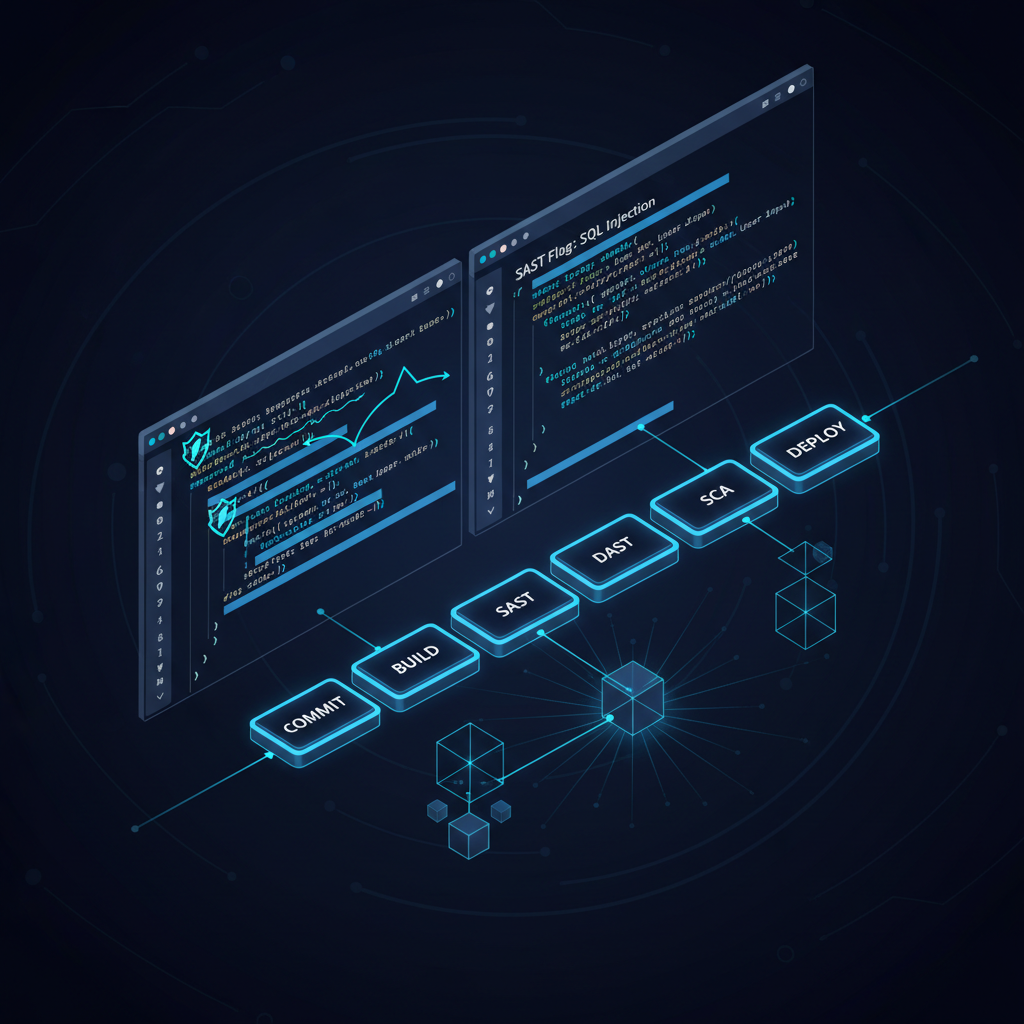
Why SAST Tools Are Non-Negotiable in 2026
Veracode's 2026 State of Software Security report found that 76% of applications contain at least one security flaw at first scan — and the median time to fix a high-severity vulnerability is still north of 200 days. That gap between introduction and remediation is where breaches live. Static application security testing (SAST) closes that gap by catching vulnerabilities in source code before a single line ships to production.
But here is the problem most security teams run into: they deploy a SAST tool, watch it generate 4,000 findings per sprint, and then watch developers ignore every single one of them. False positive rates above 30% are common with poorly tuned scanners. The tool becomes shelfware. The pipeline slows down. Engineers complain. Management questions ROI. Sound familiar?
The answer is not to ditch SAST — it is to understand what SAST actually does well, where it falls short, and how to layer it with DAST and SCA to get meaningful signal. That is what this guide covers: the mechanics, the tooling landscape, the trade-offs, and the architecture decisions that matter.
What SAST Actually Does (and Where It Breaks Down)
SAST analyzes source code, bytecode, or binary code without executing the application. Taint analysis, data flow analysis, control flow graphs — the scanner traces how untrusted input moves through the codebase to find injection points, unsafe deserialization, hardcoded credentials, and logic flaws like broken access control. It works at the code level, not the runtime level.
The power of SAST is that it runs early — in the IDE, in a pre-commit hook, or in a CI/CD stage — before the application ever touches a test environment. Shift-left security at its most literal. You can scan a pull request and flag an SQL injection before the code merges. That is genuinely valuable.
The limitations are just as real. SAST tools are notorious for false positives because they reason about code statically — they cannot know the runtime context. A parameterized query that SAST flags as a potential SQL injection might be perfectly safe in context, but the scanner does not know that without semantic understanding. Language support varies wildly too: most enterprise SAST tools handle Java and C# well, Rust and Go support is still maturing in several products, and infrastructure-as-code scanning is a different beast entirely.
SAST also cannot find vulnerabilities that only manifest at runtime — authentication bypass, insecure direct object references that depend on session state, race conditions, or server-side request forgery triggered by specific API sequences. For that, you need dynamic testing.
SAST vs DAST: Two Different Threat Models
The SAST vs DAST debate is mostly a false dichotomy — you need both, but they answer different questions. SAST asks: does this code contain insecure patterns? DAST asks: can an attacker exploit this running application?
DAST tools like OWASP ZAP, Burp Suite Enterprise, or StackHawk fire requests at a running application and observe the responses. They find vulnerabilities that require execution context: reflected XSS, authentication weaknesses, misconfigured HTTP headers, broken session management. What they cannot do is tell you which line of code caused the issue. DAST gives you a finding; SAST gives you a location.
In a mature DevSecOps pipeline, SAST runs in CI on every pull request, giving developers immediate feedback during the code review cycle. DAST runs against a staging or pre-production environment, validating that what passed static analysis is also safe under real-world conditions. They are complementary, not competing.
The practical challenge with DAST is that it requires a deployed, running application. That means it cannot run until late in the pipeline — and in a microservices architecture with dozens of services, standing up a full integration environment for every commit is expensive. SAST does not have that constraint, which is why it runs earlier and more frequently in most teams' workflows.
SAST vs SCA: First-Party vs Third-Party Code Risk
SCA (Software Composition Analysis) tools scan your dependency tree — the open-source libraries and packages your application pulls in — and match them against vulnerability databases like the NVD, OSV, and vendor advisories. Tools like Snyk, Mend (formerly WhiteSource), and FOSSA operate in this space.
The distinction matters: SAST finds bugs in your code. SCA finds known CVEs in other people's code that you are using. Both are critical. The Log4Shell vulnerability in 2021 was an SCA problem — teams that had SAST deployed but no SCA had zero visibility into whether they were running a vulnerable version of log4j.
In 2026, SCA has expanded beyond dependency scanning into SBOM generation and license compliance. If you are shipping software to regulated industries or government customers, producing a software bill of materials is not optional anymore — it is a procurement requirement in many jurisdictions. The code security posture of any modern application now has to account for both first-party and third-party risk simultaneously.
The SAST vs SCA decision is not really a decision — it is a sequencing question. SCA is fast and low-noise because the NVD knows whether a CVE exists or not; it is not probabilistic. Run SCA on dependency manifests first, break on critical CVEs, then run SAST on source code for logic flaws. Do not let a slow SAST scan block a build when the issue is a vulnerable version of lodash that SCA would catch in 30 seconds.
The Best SAST Tools in 2026: What Is Worth Using
The SAST market has consolidated significantly. Here is an honest take on the main players:
Semgrep
Semgrep is the open-source SAST tool that has eaten a significant chunk of the enterprise market. The rule syntax is clean, the community registry has thousands of rules, and the false positive rate with tuned rulesets is dramatically lower than legacy tools. Semgrep Pro adds cross-file taint analysis and secrets scanning. For teams with the engineering bandwidth to manage rules, it is genuinely excellent. The limitation is that rule quality varies widely — the built-in ruleset catches obvious issues but misses complex data flow vulnerabilities that commercial tools find with their proprietary AST analysis engines.
Checkmarx One
The incumbent enterprise player. Strong on Java, .NET, and JavaScript. The correlation engine has improved significantly — it now groups related findings into an attack path view rather than dumping raw findings. Expensive. Integration with Jira and Azure DevOps is solid. If you are in a large enterprise with centralized AppSec governance, Checkmarx still makes sense. The UI has modernized noticeably since 2024.
Veracode Static Analysis
Veracode's strength is its training pipeline — findings are linked to eLearning modules, which actually moves the needle on developer awareness. The platform is primarily SaaS, which reduces operational overhead. The code upload model rather than agent-based scanning is a trade-off: it adds latency and requires you to send source code to a third party, which some regulated organizations will not allow.
Snyk Code
Snyk's SAST module benefits from Snyk's strong developer experience focus. The IDE plugin is polished, the scan times are fast, and it integrates naturally if you are already using Snyk for SCA. The AI-powered fix suggestions have improved to the point where developers actually use them rather than dismissing them. Coverage for newer languages like Kotlin and Swift has improved in 2026.
SonarQube and SonarCloud
SonarQube remains ubiquitous in CI pipelines. It is less of a pure SAST tool and more of a code quality plus security scanner hybrid. The security rules cover OWASP Top 10 categories reasonably well. Where it underperforms: deep taint analysis and cross-file data flow. It catches the obvious stuff — SQL injection patterns, hardcoded secrets, unsafe function calls — but misses more subtle logic vulnerabilities that dedicated SAST engines find. Still worth running for quality gates.
Secrails SAST
For teams that want SAST integrated directly into a broader cloud-native security platform — alongside Secret Detection, Container Image Scanning, and Policy-as-Code — SAST on the Secrails platform provides unified findings correlation. Instead of triaging alerts across five separate tools, you get a single risk view that spans code, container, and cloud layers. That integration matters when you are trying to understand blast radius: a hardcoded credential in source code that also has access to a cloud service is a different severity than a credential with no cloud permissions.
Integrating SAST Into Your CI/CD Pipeline Without Breaking Velocity
The biggest implementation mistake: running full SAST on every commit and failing builds on every finding. That approach destroys developer trust immediately. Start with a triage-first model.
First, establish a baseline. Run SAST on your current codebase, export all findings, and mark them as existing debt. Do not fail builds on existing issues — that is a backlog problem to tackle separately. Second, configure the pipeline to only fail on new high-severity findings introduced in the current PR. This is the incremental gate model, and it is the only approach that works at scale without creating adversarial relationships between security and engineering.
Third, tune aggressively. Most SAST tools ship with hundreds of rules enabled by default, many of which are low-value for your specific tech stack. A Java microservices team does not need PHP injection rules firing. Suppressing entire rule categories for your stack reduces noise by 40 to 60 percent in most implementations. Map your enabled rules to the OWASP Top 10 2026 and CIS Benchmarks for your frameworks — anything outside that scope should earn its place based on your threat model.
Fourth, integrate findings into the developer workflow, not the security team's dashboard. A finding that goes to a SIEM that a developer never checks is worse than no finding at all. GitHub Advanced Security, GitLab's security dashboards, and Jira Security are the right surfaces — where the code lives, where the fix needs to happen. The vulnerability management workflow has to close the loop: ticket created, assigned to the right team, tracked to resolution.
SAST, DAST, and SCA Together: A Realistic Pipeline Architecture
Here is what a production-grade AppSec pipeline looks like in 2026:
Pre-commit hooks run secret detection and lightweight SCA on changed manifests. Fast. Sub-30-second feedback. Blocks commits with hardcoded credentials or newly introduced critical CVEs in dependencies.
CI on PR open and update runs full SCA, SAST with incremental gating, and container image scanning if the PR touches Dockerfiles. Target: under 10 minutes total. Developers get inline comments in the code review before they have context-switched away from the change.
CI on merge to main runs a full SAST scan, generates SBOM artifacts, and runs IaC scanning against Terraform or Helm changes. Policy-as-code enforcement happens here, blocking infrastructure changes that violate hardened baseline configurations.
Staging deployment triggers DAST — automated crawling and active scanning against the deployed application. Findings feed back into the vulnerability management queue with severity scores. Critical DAST findings can gate production promotion.
Production runs continuous cloud posture monitoring via CSPM and runtime security. The pipeline does not end at deployment.
Reducing SAST False Positives: The Techniques That Actually Work
False positives are the SAST problem that never fully goes away, but you can manage it to a workable level. Three techniques that consistently deliver results:
Contextual suppression with justification audit trails. When a developer suppresses a finding, require a comment explaining why. Most SAST tools support inline suppression comments — enforce that they include a ticket reference or a technical reason. This creates an audit trail and reduces casual suppression while still giving developers the escape valve they need.
Rule confidence tiers. Tag rules as HIGH, MEDIUM, or LOW confidence based on your historical false positive rate for that rule. Only HIGH-confidence rules break builds. MEDIUM-confidence findings go to a security review queue. LOW-confidence findings go to a separate informational view. This three-tier model reduces alert fatigue without losing signal.
AI-assisted triage. Several SAST vendors including Snyk, Checkmarx, and Semgrep Pro now ship AI models that predict whether a finding is a true positive based on code context. In early 2026 benchmarks, these models achieve roughly 85 percent precision — not perfect, but enough to filter the worst noise before it hits developer inboxes.
What to Look for When Evaluating SAST Tools
When evaluating SAST and DAST tools for your organization, cut through the marketing with these criteria: language coverage for your actual stack, CI/CD integration quality, incremental scanning capability, false positive benchmarks on codebases similar to yours, and the quality of the developer experience — because a tool developers hate will be circumvented.
Also evaluate total cost of ownership honestly. A free open-source SAST tool still costs engineering time to deploy, tune, and maintain. A commercial tool with managed rules and dedicated support may be cheaper than two engineer-months per year maintaining a DIY stack.
For a complete, integrated approach to application and cloud security — without stitching together five separate tools — Secrails provides SAST, secret detection, container scanning, and cloud posture management on a single platform built for DevSecOps teams.