

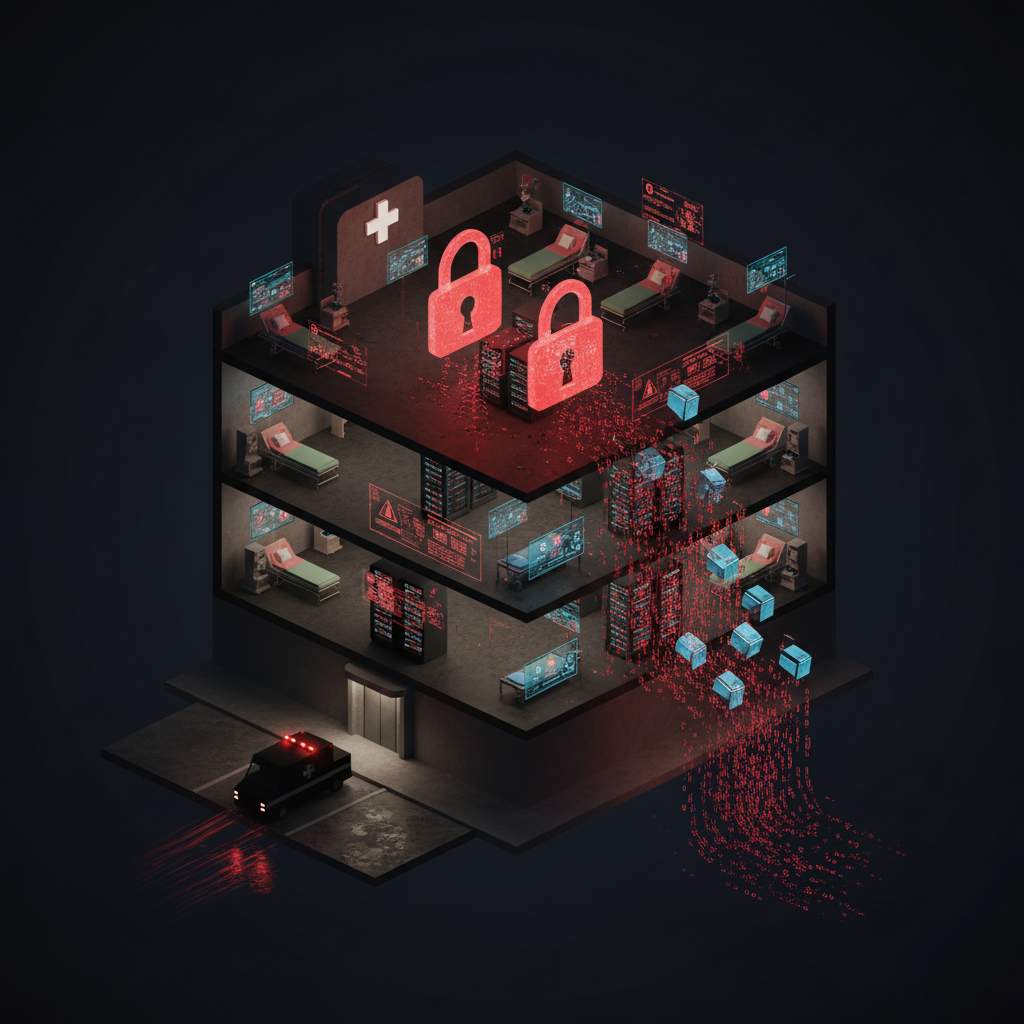
Healthcare Is the Highest-Value Target in Ransomware
The average ransom payment in healthcare crossed $1.5 million in 2026, according to Sophos's annual ransomware survey. That is not the worst part. The average downtime following a successful attack now exceeds 22 days. When a hospital's EHR system goes dark for three weeks, patients get rerouted, surgeries get postponed, and in documented cases, mortality rates tick up. This is not abstract risk. It is a public health problem wearing a cybersecurity mask.
Ransomware in healthcare is uniquely damaging because the sector combines three dangerous properties: critical infrastructure status, notoriously underfunded IT security budgets, and massive troves of highly monetizable patient data. Medical records sell for roughly 10 to 40 times the price of financial data on dark web markets. That asymmetry makes hospitals, clinics, and health insurers perpetual targets.
So what is actually driving these attacks, how do they unfold technically, and what does a credible defense look like in 2026? That is what this post covers.
What Is the Primary Purpose of Ransomware and Why Healthcare Is Different
Ransomware's primary purpose is extortion. An attacker encrypts critical data or systems, then demands payment in cryptocurrency in exchange for the decryption key. In recent years, operators have layered in double and triple extortion: exfiltrate data first, encrypt second, then threaten to publish the data or notify patients and regulators if the ransom is not paid.
For healthcare specifically, the calculus is brutal. A manufacturing plant can absorb downtime. A hospital cannot. The urgency to restore operations creates enormous leverage for attackers. Healthcare organizations are statistically more likely to pay ransoms than companies in other sectors. LockBit 3.0, BlackCat/ALPHV, and Rhysida have all explicitly targeted healthcare providers in the last two years, with Rhysida responsible for several high-profile hospital chain breaches in 2025 and continuing into 2026.
The Anatomy of a Healthcare Ransomware Attack
Most ransomware intrusions follow the MITRE ATT&CK kill chain with predictable fidelity. Initial access commonly comes via spear phishing, exploitation of unpatched VPN appliances, or compromised remote desktop protocol endpoints. Once inside, attackers move laterally using living-off-the-land techniques like PowerShell and WMI to avoid detection, and spend an average of 8 to 12 days in the environment before deploying the ransomware payload.
That dwell time matters enormously. It is when attackers map the network, identify backup systems to destroy or corrupt, exfiltrate patient data, and escalate privileges to domain admin. By the time the encryption event fires, the damage is already done in terms of data theft. The visible ransomware event is really just the final act of a multi-week compromise.
Healthcare Ransomware Attacks in 2026: The Threat Landscape
The healthcare sector logged 389 confirmed ransomware incidents in the first half of 2026, a 34 percent increase over the same period last year. Regional hospital systems and community health centers are disproportionately represented. They lack the enterprise security teams of academic medical centers but hold equally sensitive data.
The attack vectors have shifted somewhat. While phishing remains dominant, vulnerability exploitation against edge devices like Citrix NetScaler, Cisco ASA, and Fortinet appliances accounted for 28 percent of initial access vectors in the first quarter of 2026. These are the same CVEs that CISA flags in its Known Exploited Vulnerabilities catalog, which means organizations that maintain a functioning vulnerability management program could theoretically have patched these before attackers weaponized them. Many did not.
Third-party vendor compromise is another growing vector. Healthcare organizations rely on dozens of SaaS platforms and managed service providers. A single compromised vendor credential can provide attackers with access to multiple health systems simultaneously, which is exactly how the 2026 MedLink MSP breach unfolded, affecting 47 affiliated clinics.
The HIPAA Ransomware Problem
Under HIPAA, a ransomware attack is presumed to be a breach unless the organization can demonstrate a low probability that protected health information was accessed or exfiltrated. That is a high bar to clear when attackers spent 10 days in your network before deploying ransomware. The Office for Civil Rights has intensified enforcement actions following ransomware incidents, and several healthcare organizations faced combined regulatory penalties and ransom payments exceeding $5 million in 2026. Continuous compliance monitoring can flag misconfigurations before they become breach evidence.
CISA Ransomware Guide: What the Federal Guidance Actually Says
CISA's ransomware guidance, particularly the joint CISA-FBI-HHS alerts specifically targeting healthcare, provides actionable technical recommendations. The core framework breaks down into three phases: before, during, and after an attack.
Before an attack: CISA's pre-incident recommendations center on reducing the attack surface. That means maintaining an up-to-date asset inventory, patching known exploited vulnerabilities within defined SLAs, implementing multi-factor authentication on all remote access points, and segmenting networks so that a compromised workstation cannot directly reach clinical systems. CISA also explicitly recommends offline, encrypted, tested backups. The word tested is doing a lot of work here, because many organizations discover their backups are corrupted or incomplete only when they need them.
During an attack: Isolate affected systems immediately, preserve forensic artifacts before wiping, notify CISA and the FBI, and engage a ransomware-experienced incident response firm. Do not pay without legal counsel. There are OFAC sanctions implications when the ransomware group is on a designated list.
After an attack: Root cause analysis, credential rotation across all systems, implementation of the mitigations that would have prevented the initial access vector. CISA recommends organizations document lessons learned and update their incident response playbooks accordingly.
Ransomware Prevention Best Practices: A Technical Checklist
Generic advice like patching your systems is necessary but not sufficient. Here is what a serious ransomware prevention checklist looks like for healthcare organizations in 2026.
Identity and Access Controls
Enforce MFA everywhere including VPN, RDP, cloud consoles, and EHR platforms. Implement privileged access workstations for admin tasks. Review and prune service accounts quarterly. Attackers love over-privileged service accounts because they rarely trigger alerts. Implement just-in-time access for administrative functions. Use LAPS for local admin password management on Windows endpoints.
Network Segmentation and Zero Trust Architecture
Clinical networks, administrative networks, and IoT and biomedical device networks should not share the same VLAN. Micro-segmentation reduces the blast radius when a single endpoint is compromised. Zero trust principles enforce that every request is verified and breach is assumed. Restrict SMB traffic between workstations. Block RDP laterally so it only traverses through a privileged jump server.
Vulnerability Management and Patch Cadence
Track CISA's KEV catalog and treat those CVEs as critical priority regardless of CVSS score. EPSS scores help prioritize which vulnerabilities are actively being exploited in the wild. A VM program that relies solely on CVSS 7.0 thresholds will miss weaponized low-severity CVEs. Running VM scans across your entire environment including cloud workloads gives you the visibility needed to prioritize remediation before attackers exploit the gap.
Email and Endpoint Security
Phishing simulation programs reduce click rates measurably. Sandboxing inbound attachments, disabling macros in Office documents by default, and implementing DMARC, DKIM, and SPF reduce spear phishing success rates. On endpoints, behavioral EDR rather than just signature-based antivirus is the baseline expectation. Disable PowerShell for users who do not need it and use constrained language mode for everyone else.
Backup Hygiene
Follow the 3-2-1-1 rule: three copies of data, two different media types, one offsite, one offline or air-gapped. Test restores monthly, not annually. Ransomware operators specifically hunt for and destroy backup systems during dwell time, so ensure backup credentials are not stored on production domain controllers.
Cloud Security Posture
Healthcare workloads increasingly live in AWS, Azure, and GCP. Misconfigured storage buckets with patient data, over-permissive IAM roles, and publicly exposed storage accounts have all been initial access vectors or data exfiltration paths in ransomware incidents. A robust cloud security posture management solution continuously monitors your cloud environment for these misconfigurations and alerts before attackers exploit them.
Code and Infrastructure Security
If your healthcare organization develops internal applications or uses CI/CD pipelines to deploy infrastructure, shift-left security matters. Hardcoded credentials in code repositories have been used to pivot into cloud environments in several documented ransomware chains. Secret detection in your pipelines catches these before they reach production. Similarly, SAST identifies vulnerable code patterns that attackers exploit for initial access through web application vulnerabilities.
How to Prevent Ransomware Attacks in Healthcare: The Strategic Layer
Controls are necessary but not sufficient without a coherent strategy. A ransomware defense strategy for healthcare needs to account for the sector's unique operational constraints: 24/7 uptime requirements, legacy medical devices that cannot be patched, heavily regulated data environments, and staff who are clinicians first and security users second.
That means any defense strategy must balance friction with effectiveness. Forcing nurses to complete a lengthy authentication process to access an EHR in an emergency creates workarounds that are worse than the original problem. Context-aware access policies that are stricter on external access but streamlined within secured clinical zones reflect operational reality.
Tabletop exercises specifically simulating ransomware scenarios are underutilized in healthcare. Running a quarterly exercise that tests the incident response playbook, validates backup restoration procedures, and identifies who has authority to authorize a system shutdown builds muscle memory that pays off when a real event occurs.
Finally, the supply chain. Healthcare organizations need to assess the security posture of every vendor with network access or patient data access. Third-party risk management programs should include ransomware-specific questionnaires and contractual requirements around incident notification timelines. The cloud security posture of your vendors matters as much as your own.
Building Ransomware Resilience: What Good Looks Like
Mature healthcare organizations approaching ransomware defense are moving from reactive to proactive. That means threat intelligence subscriptions covering healthcare threat actor activity, purple team exercises that test detection logic against real ransomware tactics from MITRE ATT&CK, and continuous attack surface monitoring that identifies new exposures as they emerge.
NIST CSF 2.0's Govern function adds organizational accountability to the technical controls. Executive leadership and board-level oversight of cybersecurity risk is not optional anymore. It is a regulatory expectation under HIPAA, HITECH, and increasingly under state-level healthcare cybersecurity regulations enacted in 2025 and 2026.
The organizations that weather ransomware incidents best are not necessarily the ones with the biggest budgets. They are the ones that made deliberate architectural decisions, tested their assumptions, and built recovery capability alongside their prevention controls. Prevention will eventually fail. Recovery capability is what determines whether a ransomware incident is a catastrophe or a manageable operational disruption.
If you are evaluating your current posture, the SECRAILS platform provides continuous visibility across cloud infrastructure, code pipelines, and runtime environments, the three layers where modern ransomware attacks play out. That kind of unified visibility is what makes the difference between detecting an intrusion during dwell time and discovering it after encryption.