

PII Meaning: What Exactly Are We Talking About?
Over 422 million individuals had their personal data compromised in reported breaches during 2023 alone — and the pace has not slowed. By mid-2026, regulators across the US, EU, and Asia actively pursue organizations that fail to properly classify and protect personally identifiable information. Yet many engineering and security teams still operate without a precise, actionable definition of what PII actually means in their specific context.
PII — personally identifiable information — refers to any data that can be used, alone or combined with other data, to identify a specific individual. That definition sounds straightforward. It is not. The real complexity lies in the word combined. A name by itself might not pinpoint anyone. But a name paired with an employer, zip code, and date of birth? That is a fingerprint.
NIST Special Publication 800-122 defines PII as any information about an individual maintained by an agency, including any information that can be used to distinguish or trace an individual's identity, whether directly or indirectly. The EU's GDPR broadens this further to include online identifiers, IP addresses, and cookie data. Two frameworks, two slightly different blast radii. Security engineers need to understand both.
The stakes are no longer theoretical. Average GDPR fines exceeded 2.1 million euros in 2025, and enforcement in 2026 has accelerated significantly, particularly against mid-market SaaS companies that assumed they were under the radar. The question for every organization is not whether they hold PII — they do — but whether they know where it is, how it is classified, and whether the controls protecting it are actually working.
Is a Name PII? Breaking Down the Spectrum
Short answer: it depends. Longer answer: almost certainly yes in combination, sometimes yes on its own. A common name like John Smith in isolation is weak PII. A unique name like a specific executive's full name published alongside their employer and salary range is strong PII. Context determines classification.
Regulators increasingly reject the argument that individual data points are harmless. The FTC's 2026 enforcement actions reinforce that even seemingly non-sensitive data — job titles, browsing patterns, general location — can constitute PII when aggregated. This aggregation problem is exactly why data minimization principles exist in GDPR Article 5 and the CCPA, and why your data inventory needs to track not just what fields you store, but how they can be correlated.
Direct vs. Indirect Identifiers
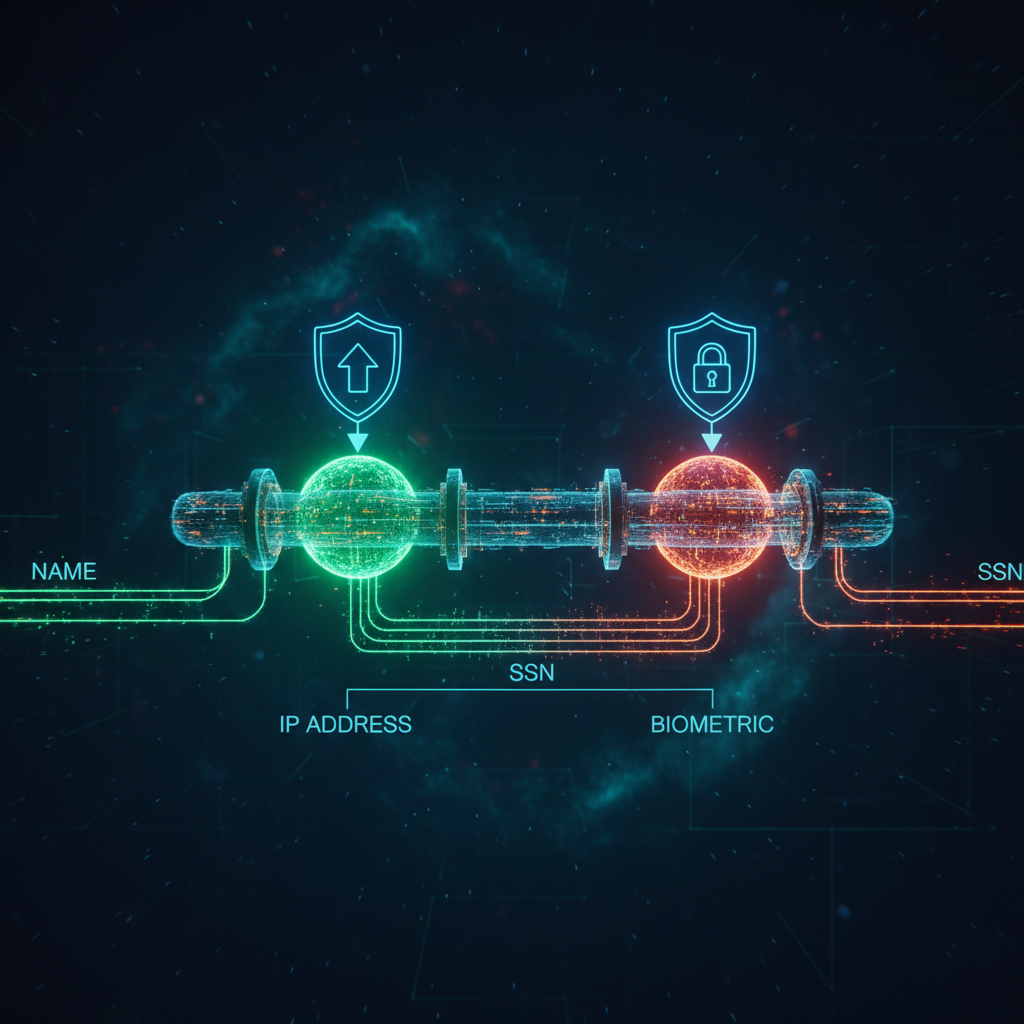
Direct identifiers link unambiguously to an individual: full name, Social Security Number, passport number, biometric data, email address, phone number, and driver's license number. Indirect identifiers require combination or inference: date of birth, gender, ZIP code, employer, IP address, device fingerprint, and behavioral patterns.
Neither category is inherently safe to ignore. A dataset containing only indirect identifiers has been successfully re-identified in academic research even after supposedly robust anonymization. If you are building data pipelines and assuming that stripping names makes data non-PII, you are taking on regulatory and legal risk that your legal team has almost certainly not priced in.
Types of PII: The Full Taxonomy
Not all PII carries the same weight. Security and compliance teams often work with a tiered model that separates standard PII from sensitive PII based on the potential harm exposure could cause.
Standard PII
This tier includes information that identifies an individual but whose exposure, while problematic, typically causes moderate harm. The standard list of PII includes: full name, email address, home address, phone number, date of birth, place of birth, employer information, job title, IP address in many jurisdictions, vehicle registration number, and general geographic data. Most CRM systems, marketing databases, and customer support platforms hold enormous volumes of this tier.
Sensitive PII
Sensitive PII carries a higher risk profile because its exposure is more likely to cause significant harm — financial fraud, discrimination, identity theft, or physical danger. Categories include: Social Security Numbers and national ID numbers, financial account numbers and payment card data, medical and health records, biometric data such as fingerprints and facial recognition templates, genetic data, sexual orientation and gender identity, immigration status, criminal history, precise geolocation data, and account credentials.
Under GDPR, most of these fall under Article 9 special categories of data, requiring explicit consent and stricter processing controls. Sensitive PII demands encryption at rest and in transit, strict access controls preferably zero-trust with just-in-time access, and audit logging of every access event. If you are running workloads that process sensitive PII in cloud environments, your cloud security posture management configuration needs policies specifically targeting data stores holding this classification — misconfigured S3 buckets and publicly exposed databases remain the leading cause of large-scale PII exposure incidents.
A Practical List of PII for Engineers and Security Teams
Rather than another abstract overview, here is a concrete reference organized by system type, because that is how engineers actually encounter PII in practice.
Identity and Authentication Systems
Username and password pairs, authentication tokens, session IDs, security questions and answers, biometric templates, device fingerprints, and multi-factor authentication seeds all qualify. Session tokens and auth credentials sit in a grey zone — they do not directly name an individual, but they grant access to their account and therefore their identity. Treat them as PII. Tools like secret detection can catch hardcoded credentials and tokens before they ship to production, preventing a class of exposure that accounts for a disproportionate share of breach incidents.
Financial Systems
Credit and debit card numbers subject to PCI DSS in addition to privacy law, bank account numbers and routing numbers, tax identification numbers, credit scores, transaction histories, and salary data. PCI DSS scope and GDPR or CCPA scope overlap significantly here, creating compliance complexity that organizations routinely underestimate. A single financial record may trigger obligations under three separate regulatory frameworks simultaneously.
Healthcare Applications
Patient names combined with any health condition, diagnosis codes, prescription records, appointment histories, insurance member IDs, and any data covered under HIPAA's definition of Protected Health Information. In the US, PHI and PII have overlapping but not identical definitions — a detail that trips up many security teams operating at the intersection of healthcare IT and general enterprise software.
Web and Application Telemetry
IP addresses, cookie identifiers, advertising IDs, clickstream data linked to user accounts, precise GPS coordinates, and device serial numbers. Many organizations collect this data at massive scale without realizing that GDPR, CPRA, and a growing number of state laws classify it as PII. Your analytics pipeline is almost certainly holding PII. Has it been inventoried? Extending cloud inventory visibility to data classifications is the logical next step for any organization that has achieved basic asset discovery.
Who Is Responsible for Protecting PII?
Everyone. That is the honest, if unsatisfying, answer. But let us be more precise about how responsibility distributes across an organization.
Data Controllers and Data Processors
GDPR introduced a formal distinction now adopted or mirrored in legislation globally. A data controller determines the purposes and means of processing personal data — typically the company that collects data from customers. A data processor processes data on behalf of the controller — typically cloud providers, SaaS vendors, or third-party analytics tools. Controllers bear primary legal liability. Processors carry contractual obligations through Data Processing Agreements. Both can be fined. Both can be sued.
Internal Ownership
Within an organization, PII protection does not belong exclusively to the security team or the legal team. Engineering teams own the implementation of privacy controls in code — if a developer ships a logging function that writes email addresses to plain-text logs, that is an engineering problem before it is a security incident. Product managers own feature decisions that affect data collection scope. The Data Protection Officer owns regulatory compliance and serves as the interface with supervisory authorities.
Most organizations still treat PII protection as a legal and compliance exercise rather than a security engineering discipline. That is changing as regulators issue larger fines and as private rights of action create class action exposure on top of regulatory penalties. The organizations that get this right are not necessarily the largest or the most resourced — they are the ones that engineer privacy controls into their systems rather than auditing for compliance after the fact.
The American Data Privacy and Protection Act: What Changed
The American Data Privacy and Protection Act represents the most significant shift in US federal privacy law in decades. As of 2026, its progression has created a layered framework that security teams must navigate carefully. Unlike GDPR's single supervisory structure, US privacy law involves federal baseline requirements layered with state laws including California's CPRA, Virginia's CDPA, and now more than a dozen additional state-level frameworks.
Key ADPPA concepts security teams need to understand include data minimization obligations to collect only what is needed for the stated purpose, purpose limitation to prevent undisclosed secondary uses, affirmative express consent requirements for sensitive data, and a private right of action that allows individuals to sue organizations directly for violations. That last point is significant — it expands legal exposure beyond regulatory fines to class action litigation, which historically produces far larger financial outcomes.
For organizations operating cloud-native environments, compliance with these frameworks is not just a policy exercise. It requires technical controls: data discovery to know where PII lives, classification to distinguish sensitive from standard PII, access controls to enforce least privilege, and audit trails to demonstrate compliance. Your compliance posture across these frameworks needs to be continuously validated, not assessed once at an annual audit.
PII Protection: Technical Controls That Actually Work
Policies and frameworks tell you what to protect. The harder question is how. Here are the technical controls that meaningfully reduce PII exposure risk in 2026.
Data Discovery and Classification
You cannot protect data you do not know exists. Automated data discovery — scanning databases, object storage, code repositories, and log pipelines for PII — is the mandatory first step. This means scanning for patterns matching Social Security Numbers, credit card numbers, email addresses, and phone numbers, but also training classifiers to recognize PII in less structured contexts like support ticket free text or unstructured document stores. Discovery without classification is just inventory; classification without enforcement is just documentation.
Encryption and Tokenization
Sensitive PII must be encrypted at rest with AES-256 minimum and in transit with TLS 1.2 or higher, ideally 1.3. Tokenization replaces PII with a surrogate value that preserves format without exposing the original data — critical for payment processing and systems where PII needs to flow through multiple components. Field-level encryption for database columns containing sensitive PII provides an additional layer, ensuring that even privileged database access does not expose plaintext data.
Access Controls and Least Privilege
Who can query your customer PII table? If the answer is anyone with database access or your entire engineering team, you have a problem. Role-based access control scoped to data sensitivity level, combined with just-in-time access provisioning, reduces the blast radius of both insider threats and compromised credentials. Regular access reviews — continuous rather than quarterly — catch privilege accumulation before it becomes a breach vector. Integrating policy-as-code into your infrastructure provisioning ensures that access control policies are enforced consistently across all environments, not just production.
Code-Level Controls
PII exposure frequently originates in application code — logging libraries that capture request bodies, error handlers that serialize full user objects, API responses that return more fields than the client needs. Static analysis of code for PII handling patterns catches these issues before deployment. Static application security testing configured with PII-specific rulesets can flag functions writing personal data to insecure sinks, overly permissive serialization, and missing data masking in test environments.
Incident Response for PII Breaches
GDPR Article 33 requires notification to supervisory authorities within 72 hours of discovering a breach involving personal data. CCPA, ADPPA, and virtually every state-level law has a parallel notification requirement, and they are not identical. Your incident response playbook needs PII-specific procedures: classification of what data was exposed, affected individual count, legal notification triggers, and communication templates pre-approved by legal. Organizations that treat a PII breach as a generic security incident and miss notification windows face compounding penalties.
PII in Cloud and AI Environments: The 2026 Reality
Cloud environments exponentially expand the PII attack surface. Data replicates across regions for redundancy, lands in development and staging environments without being sanitized, gets ingested by third-party analytics tools under broad API scopes, and flows into AI training pipelines where its presence is often entirely undocumented.
The AI dimension is particularly acute in 2026. Organizations are fine-tuning large language models on customer data, feeding retrieval-augmented generation pipelines with support tickets and user documents, and embedding customer context directly into AI agent memory. If that data includes PII — and it almost certainly does — new categories of risk emerge: model memorization where an LLM can be prompted to regurgitate training data, vector database exposure, and inference attacks that reconstruct personal information from model outputs.
AI security posture management tooling specifically addresses these risks, providing visibility into what data AI systems can access and where personal information might be persisting in model artifacts or pipeline caches. Several EU member state data protection authorities have already issued enforcement actions against organizations using customer PII in AI training without explicit consent or adequate legal basis. The gap between what AI teams build and what privacy teams have reviewed is, in most organizations, enormous.
The approach that works is treating PII like any other critical asset: inventory it, classify it, monitor access to it, and build automated enforcement that does not depend on humans remembering to follow a policy. This is the foundation of a serious cloud security program in 2026.
Summary: PII Protection Is an Engineering Discipline
PII meaning is not just a legal definition to be memorized — it is an operational reality that touches every system that handles user data. Understanding the difference between standard and sensitive PII, knowing who bears responsibility at each layer of the stack, and implementing technical controls that are continuously enforced rather than periodically checked: that is what separates organizations that manage PII risk from those that discover they have a problem via a regulatory notice or a breach headline.
The frameworks — GDPR, ADPPA, CCPA, HIPAA — all point in the same direction: know your data, minimize what you collect, protect what you keep, and be able to prove it. In 2026, that proof increasingly needs to be technical and auditable, not just documented in a policy PDF that nobody reads. The organizations that treat privacy as an engineering problem rather than a compliance checkbox are the ones that will be ready when regulators come knocking.