

IBM's 2026 Cost of a Data Breach report pegged the average breach cost at $4.88M — and organizations with mature NIST-aligned risk management frameworks cut that figure by nearly 30%. That is not a coincidence. It is the compounding effect of systematic risk identification, continuous monitoring, and structured response playbooks working together. Yet most security teams still treat NIST as a checkbox exercise rather than an operational backbone.
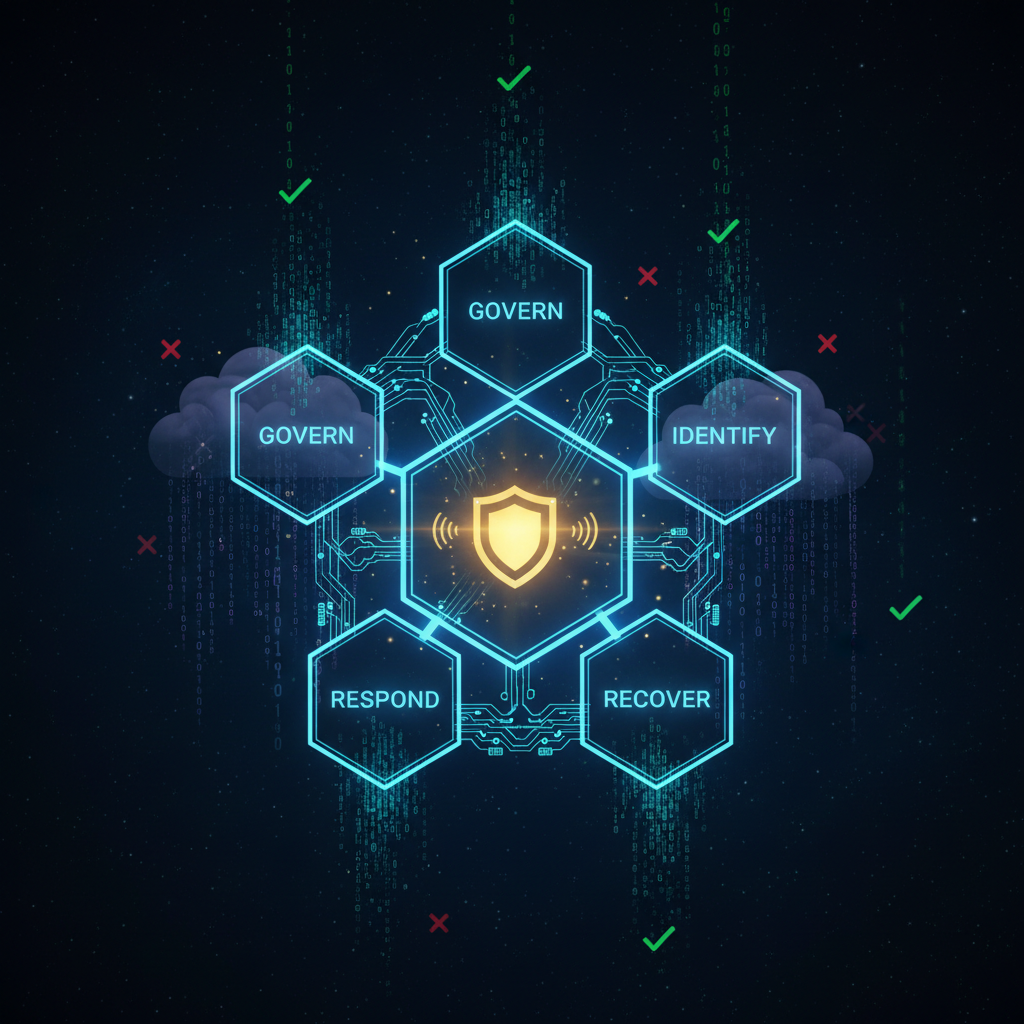
NIST CSF 2.0, released in February 2024, is not the same beast as the original 2014 framework. It added a sixth function — Govern — which sits above everything else and forces organizations to treat cybersecurity as a board-level risk decision, not just an IT problem. That structural change alone reshapes how you build a risk assessment process.
This guide breaks down the full NIST Cybersecurity Framework in practical terms: what the functions actually mean operationally, how to run a compliant risk assessment, which templates work, and how to integrate the framework into modern cloud-native environments where the attack surface changes daily.
What Is the NIST Cybersecurity Framework?
The NIST Cybersecurity Framework is a voluntary set of guidelines, best practices, and standards published by the National Institute of Standards and Technology. It was originally designed for critical infrastructure sectors but has become the de facto risk management framework across industries — from healthcare and finance to SaaS startups handling regulated data.
CSF 2.0 organizes cybersecurity activities into six core functions: Govern, Identify, Protect, Detect, Respond, and Recover. Each function contains categories and subcategories that map to specific outcomes. The framework does not prescribe tools — it prescribes outcomes, which is why it integrates cleanly with CIS Benchmarks, ISO 27001, MITRE ATT&CK, and NIST SP 800-53.
What separates CSF from a simple checklist is its tier model. Tiers 1 through 4 describe organizational cybersecurity maturity: from Partial (Tier 1, reactive, ad-hoc) to Adaptive (Tier 4, risk-informed, continuously improving). Most regulated enterprises target Tier 3 — Repeatable — where processes are formally documented and consistently applied. Tier 4 is aspirational for most, but achievable for security-mature organizations with automated tooling.
The Govern Function: What Changed in CSF 2.0
The original CSF had five functions. CSF 2.0's addition of Govern is not cosmetic. It explicitly requires organizations to establish cybersecurity policies, define roles and responsibilities, integrate cyber risk into enterprise risk management, and maintain supply chain risk oversight. In practical terms, that means your CISO now needs documented evidence of board-level cybersecurity risk discussions — not just technical controls.
The Govern function also forces you to maintain an organizational understanding of your risk appetite. That sounds abstract until you realize that without defined risk tolerance thresholds, every risk assessment devolves into a subjective ranking exercise. Organizations that get this right have quantified risk thresholds: they accept risks below a defined expected annual loss threshold, and anything above requires executive sign-off.
What Is a Risk Management Framework Under NIST?
The NIST Risk Management Framework (RMF), defined in NIST SP 800-37, is a seven-step process for managing information security risk in federal systems — but its applicability extends well beyond government. The seven steps are: Prepare, Categorize, Select, Implement, Assess, Authorize, and Monitor.
The critical insight is that RMF and CSF are complementary, not competing. CSF gives you the outcome-oriented view; RMF gives you the procedural sequence. A mature program uses both: CSF to define what good looks like across functions, RMF to structure how you get there for each system in scope.
For cloud-native teams, the Categorize and Monitor steps deserve the most attention. Categorization under FIPS 199 assigns confidentiality, integrity, and availability impact levels (Low, Moderate, High) to each system. That classification determines which NIST SP 800-53 controls apply. Get categorization wrong and you will either over-control low-risk workloads or — worse — under-control systems processing sensitive data.
Continuous monitoring is where most programs fall apart. The RMF Monitor step is not annual — it is ongoing. In cloud environments where infrastructure changes daily, that requires automated tooling. Solutions like cloud security posture management platforms can continuously assess cloud configurations against NIST controls, flagging drift in near-real-time rather than waiting for the next audit cycle.
The NIST Risk Assessment Process: SP 800-30 in Practice
NIST SP 800-30 Rev 1 is the definitive guide for conducting risk assessments under the NIST framework. It defines a four-step process: Prepare for the assessment, Conduct the assessment, Communicate results, and Maintain the assessment.
Step 1: Prepare for the Assessment
Preparation means establishing context before you start identifying threats. Define the purpose of the assessment, the scope (which systems, which data flows), the assumptions you are operating under, and the risk model you will use. Who are the threat actors relevant to your sector? What is your existing security posture? Without this context, you end up with risk assessments that are technically complete but strategically useless.
This is also where you build your threat and vulnerability taxonomy. MITRE ATT&CK is invaluable here — it gives you a structured, adversary-behavior-aligned catalog of tactics and techniques that maps directly to detection and response controls. Building your threat library before conducting the assessment prevents scope creep and ensures consistency across assessments over time.
Step 2: Conduct the Assessment
The core of any NIST risk assessment involves four sub-tasks: identifying threat sources and events, identifying vulnerabilities and predisposing conditions, determining the likelihood of threat exploitation, and determining the impact if exploitation occurs.
Likelihood and impact scoring is where most teams get inconsistent. SP 800-30 recommends qualitative scales (Very Low to Very High) but allows quantitative approaches. Pure qualitative scoring without calibration produces noise. The better approach is semi-quantitative: assign numerical proxies to your qualitative ratings and use EPSS scores from FIRST.org to ground your vulnerability exploitation likelihood in real-world data.
For vulnerability identification specifically, automated scanning is non-negotiable. Manual review of a modern cloud environment covering hundreds of resources is not feasible. The vulnerability management capabilities that feed your risk assessment need to cover infrastructure, code, containers, and cloud configurations — not just network-layer CVEs.
Step 3: Communicate Results
A risk assessment that sits in a shared drive is a compliance artifact, not a risk management tool. SP 800-30 emphasizes sharing results with decision-makers in formats they can act on. That means executive risk registers with business-language impact descriptions alongside technical remediation guidance for engineering teams. The audience split matters enormously — a single undifferentiated document serves neither audience well.
Effective communication also means defining clear risk response options: accept, avoid, mitigate, or transfer. Each finding in your risk register should map to one of these dispositions, with an owner, a timeline, and measurable acceptance criteria. Without that structure, risk findings accumulate without driving remediation.
Step 4: Maintain the Assessment
Risk assessments decay. A cloud environment that gets re-architected, a new SaaS integration added, or a new threat actor targeting your sector — all of these change your risk profile. NIST explicitly requires you to update assessments when significant changes occur and to monitor risk factors continuously. In practice, this means tying your risk register to your vulnerability management pipeline so new critical findings automatically trigger risk reassessment for affected systems.
Risk Assessment Templates: Excel vs. Purpose-Built Tools
The infamous risk assessment template spreadsheet. Every security team has one. Many teams still use them. For small-scope assessments covering a handful of systems, a well-structured spreadsheet can work. The HSE (Health and Safety Executive) risk assessment template format — likelihood times severity matrix — translates reasonably well to information security contexts, though you will need to adapt consequence categories to reflect data breach impact, operational disruption, and regulatory penalty exposure.
Where Excel breaks down is scale and integration. A risk register tracking 200+ assets across multiple cloud accounts, with live vulnerability data feeding likelihood scores, cannot be effectively maintained in a spreadsheet. The pivot tables get unwieldy, version control becomes a nightmare, and you lose the ability to correlate risk findings across systems.
Purpose-built GRC platforms handle this better, but they are expensive and often overkill for teams below 50 engineers. A pragmatic middle ground: use a structured NIST SP 800-30 template in a database-backed tool (Notion, Airtable, or a proper GRC module) that can accept automated inputs from your scanning infrastructure. Your vulnerability scan outputs should feed directly into risk likelihood scores — not require a manual data export every quarter.
Mapping NIST CSF 2.0 to Cloud-Native Environments
The original CSF was written for traditional IT environments. Cloud-native deployments — microservices, containers, serverless functions, infrastructure-as-code — introduce risk surfaces the original framework did not anticipate. CSF 2.0 handles this better, but mapping still requires deliberate effort.
The Identify function's asset management category becomes dramatically more complex in cloud environments where resources spin up and down dynamically. Static asset inventories are immediately stale. You need continuous cloud asset discovery — exactly what cloud inventory tooling provides — to maintain the asset visibility the framework requires. Without accurate asset inventory, every downstream risk assessment step is built on a foundation of incomplete information.
Under the Protect function, supply chain risk is a first-class concern in CSF 2.0. That means your software supply chain — container base images, third-party dependencies, open-source packages — needs the same risk treatment as your infrastructure. Container image scanning and static analysis are not optional add-ons; they are how you operationalize NIST supply chain risk management requirements at code velocity.
The Detect function maps directly to your threat detection and monitoring capabilities. MITRE ATT&CK coverage gaps translate to detection blind spots. Most organizations running cloud workloads have significant gaps in lateral movement detection — an attacker who has compromised one workload can pivot to others without triggering any alerts. Closing those gaps requires intentional mapping of your detection rules to ATT&CK techniques, not just deploying a SIEM and hoping for the best.
AI Systems and the Emerging NIST AI RMF
NIST published the AI Risk Management Framework (AI RMF 1.0) in 2023, and in 2026 it is increasingly relevant as organizations deploy ML models in security-sensitive workflows. If your environment includes AI-powered applications — and most enterprise cloud environments now do — you need to consider AI-specific risk vectors: model poisoning, data exfiltration through model outputs, and adversarial inputs. Traditional NIST CSF controls do not explicitly cover these risks, making AI security posture management a necessary complement to standard framework implementation.
Implementing NIST in Practice: Where Teams Actually Struggle
Theory is clean. Implementation is messy. The areas where NIST implementations most commonly fail:
Scope creep in the initial assessment. Teams try to assess everything simultaneously and end up with a sprawling, low-depth risk register that nobody trusts. Start with your highest-criticality systems. Get depth on those before breadth across everything.
Disconnected remediation workflows. Risk findings that do not automatically generate tickets with SLA expectations create organizational inertia. Your risk assessment process needs to be connected to your issue tracking system, not exist as a parallel documentation exercise.
Treating Respond and Recover as theoretical. Most teams document incident response plans but never test them. NIST CSF's Respond function requires actual exercises — tabletops, simulations, post-incident reviews. The plan is only as good as the last time you ran through it under pressure.
Ignoring the supply chain. The CSF 2.0 Govern function's supply chain risk management requirements catch many organizations flat-footed. Third-party vendor assessments, software bill of materials (SBOM) generation, and secrets exposure in code repositories are all in scope. Secret detection in CI/CD pipelines is one concrete control that directly addresses this requirement and prevents credential leakage from becoming an entry point for supply chain attacks.
The teams that get NIST right treat it as an operating model, not a documentation exercise. They instrument their environment to continuously measure against framework outcomes, automate evidence collection, and use risk tier ratings to prioritize engineering effort. At compliance automation scale, that layer is what separates organizations that pass audits from organizations that are actually secure.