

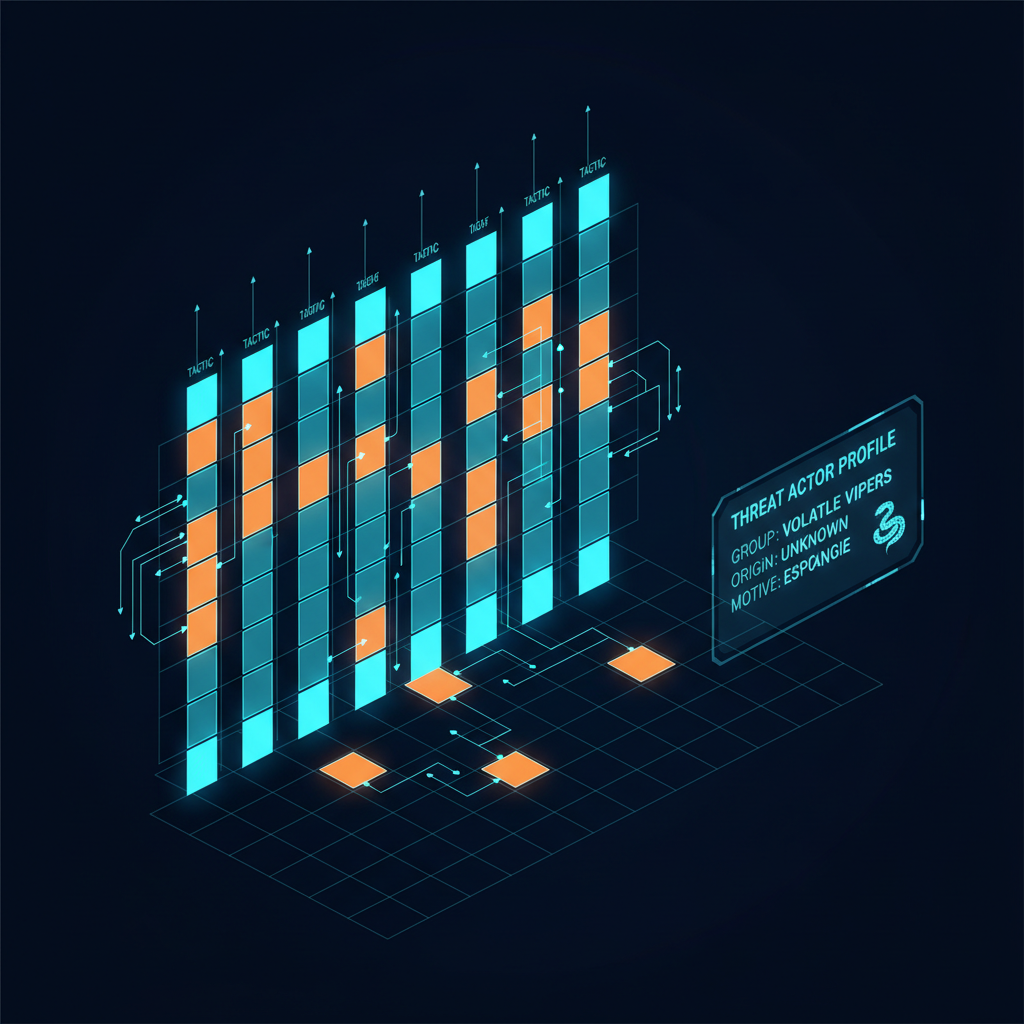
What Is the MITRE ATT&CK Framework — and Why Should You Actually Care?
Over 90% of enterprise security teams claim to use the MITRE ATT&CK framework. Far fewer actually operationalize it. That gap — between referencing a framework and deploying it with precision — is where breaches live.
ATT&CK stands for Adversarial Tactics, Techniques, and Common Knowledge. That's the MITRE ATT&CK full form. It was developed by MITRE Corporation starting around 2013, born from an internal research project called FMX that observed real adversary behavior against Windows enterprise environments. Today it covers Enterprise (Windows, macOS, Linux, cloud, containers, network), Mobile, and ICS — over 600 techniques across 14 tactics as of the 2026 ATT&CK v16 release.
This isn't a compliance checkbox. It's a living knowledge base built on observed threat actor behavior, indexed by real-world intrusion campaigns. Think of it as a periodic table for attacker tradecraft.
MITRE ATT&CK Full Form and the Core Concepts
Before mapping detections or building red team exercises, get the vocabulary right. The framework organizes adversary behavior into three tiers:
- Tactics — The adversary's goal at a given phase. Reconnaissance, Initial Access, Execution, Persistence, Privilege Escalation, Defense Evasion, Credential Access, Discovery, Lateral Movement, Collection, Command and Control, Exfiltration, Impact. Fourteen of them in Enterprise ATT&CK.
- Techniques — How the adversary achieves the tactic. Spearphishing Attachment (T1566.001) under Initial Access is a technique. There are hundreds of them.
- Sub-techniques — Granular variants of a technique. OS Credential Dumping (T1003) breaks into LSASS Memory, SAM, DCSync, and more. Sub-techniques let you get specific about what tooling and detection logic applies.
Each technique entry includes a description, procedure examples from named threat groups, detection guidance, and mitigation recommendations. That procedural data — pulled from CTI reports, malware analysis, and incident response findings — is what separates ATT&CK from generic best-practice frameworks.
The MITRE ATT&CK Techniques List: Navigating 600+ Entries
The sheer volume of MITRE ATT&CK techniques intimidates teams. That's understandable. But coverage depth isn't the goal — detection fidelity is.
Start with the techniques most relevant to your threat model. If you're a financial services firm, groups like FIN7, Lazarus, and Scattered Spider should be your reference point. ATT&CK's Groups section maps known APTs and cybercriminal groups to the specific techniques they use. Filter by group, and you immediately get a prioritized subset of the full MITRE ATT&CK techniques list.
Some techniques are disproportionately dangerous because they appear across multiple threat groups and attack stages. A handful to know cold in 2026:
- T1059 — Command and Scripting Interpreter: PowerShell, Bash, Python abuse. Still the most observed execution technique across enterprise environments.
- T1078 — Valid Accounts: Credential theft enabling attackers to blend into legitimate traffic. Extremely hard to detect without behavioral baselines.
- T1190 — Exploit Public-Facing Application: VPN appliances, firewalls, and edge devices remain primary initial access vectors in 2026.
- T1071 — Application Layer Protocol: C2 over HTTP/S, DNS, and cloud services. Defenders who only watch network perimeters miss this constantly.
- T1055 — Process Injection: A core defense evasion and privilege escalation technique used by virtually every advanced threat actor.
The full MITRE ATT&CK techniques list in PDF format is available directly from attack.mitre.org, and the mitre att&ck framework pdf can be exported from the Navigator. But static PDFs are snapshots — the live matrix should be your primary reference since ATT&CK updates twice yearly.
Using the MITRE ATT&CK Navigator Effectively
The MITRE ATT&CK Navigator is a web-based tool for annotating, layering, and filtering the ATT&CK matrix. It's free, open-source, and genuinely useful — if you know how to use it beyond coloring boxes.
What Navigator actually enables:
- Coverage mapping: Color-code techniques your current controls detect. Immediately shows coverage gaps. Run this against your SIEM detection rules, your EDR capabilities, and your cloud security tooling separately — gaps compound quickly.
- Threat-actor overlays: Load a pre-built layer for a known threat group (say, APT29) and see exactly which of their techniques you can and can't detect. This is how red team planning should start.
- Scoring layers: Assign confidence or priority scores per technique. Export as JSON for programmatic use or for feeding into your SOAR workflows.
- Comparison layers: Stack two layers to show delta — useful after a tooling change or a new detection rule deployment to visualize what changed.
One practical workflow: export your SIEM's alert taxonomy as a Navigator layer. Then overlay a threat group relevant to your sector. The uncovered intersections are your detection backlog. That's not theoretical — it's operationalizing ATT&CK in a way that produces a concrete sprint backlog for your detection engineering team.
At Vulnerability Management scale, Navigator layers become especially powerful when combined with EPSS scoring to prioritize which CVEs are being actively exploited via techniques in your gap zones.
Cyber Kill Chain vs MITRE ATT&CK: What's the Actual Difference?
Security professionals still ask which framework to use. The honest answer: they're complementary, not competitive. But they solve different problems.
The Cyber Kill Chain, developed by Lockheed Martin in 2011, describes an attack in seven linear phases: Reconnaissance, Weaponization, Delivery, Exploitation, Installation, Command & Control, Actions on Objectives. It's a campaign-level model. It tells you where in the attack lifecycle you are. It does not tell you what the attacker actually did.
ATT&CK tells you what they did. The 14 tactics roughly map to kill chain phases, but ATT&CK is non-linear, technique-granular, and evidence-backed. An adversary can loop between Lateral Movement and Privilege Escalation multiple times before reaching their objective. The kill chain's linearity doesn't capture that.
Where kill chain wins: executive communication and incident timeline reconstruction at a high level. Where ATT&CK wins: detection engineering, threat hunting, red team scoping, and gap analysis. The best security programs use both — kill chain for narrative, ATT&CK for engineering.
Teams building Cloud Security programs should note that ATT&CK's cloud matrix (covering AWS, Azure, GCP, SaaS, Office 365) has matured significantly. The kill chain wasn't designed for cloud-native attack paths — it predates them entirely.
How Security Teams Actually Use ATT&CK in 2026
Let's be direct: most organizations use ATT&CK as a reporting taxonomy and nothing more. That's leaving significant defensive value on the table.
Detection Engineering
Map every detection rule in your SIEM to an ATT&CK technique ID. This creates a measurable coverage matrix. Tools like Sigma rules often carry ATT&CK tags natively. When a new technique gains prominence — say, a novel cloud-specific sub-technique from the v16 update — you can immediately identify whether your existing rules cover it or not.
Pairing this with VM Scans gives you a bidirectional view: what vulnerabilities exist in your environment, and which ATT&CK techniques could exploit them. That's the convergence of vulnerability management and threat intelligence that most teams pursue but few achieve cleanly.
Red Team and Purple Team Exercises
ATT&CK is the lingua franca of adversary simulation. Tools like Atomic Red Team, CALDERA, and Prelude Operator execute ATT&CK-mapped test cases. Run T1059.001 (PowerShell execution) against your endpoint stack — does your EDR catch it? Does your SIEM alert? Does your SOC respond within SLA?
Purple teaming with ATT&CK turns these exercises from one-off assessments into a continuous improvement loop. Map findings back to Navigator. Update coverage scores. Prioritize the next detection engineering sprint.
Threat Intelligence Integration
Every CTI report worth reading in 2026 references ATT&CK technique IDs. ISAC feeds, CISA advisories, vendor threat reports — they all tag behaviors to T-codes now. Your TIP (Threat Intelligence Platform) should ingest these automatically and surface relevant coverage gaps.
For teams using SAST and Secret Detection in their pipelines, ATT&CK provides the adversarial context for why certain code patterns are dangerous — T1552 (Unsecured Credentials) directly maps to hardcoded secrets and credential exposure in source code.
Cloud and Container Security
ATT&CK's cloud matrix is increasingly relevant as organizations push more workloads to AWS, Azure, and GCP. Techniques like T1537 (Transfer Data to Cloud Account), T1530 (Data from Cloud Storage), and T1619 (Cloud Storage Object Discovery) are now first-class entries — not afterthoughts.
If your team runs Container Image Scanning, map discovered vulnerabilities to the ATT&CK techniques they enable. A misconfigured container with excessive privileges doesn't just fail a CIS benchmark — it enables T1611 (Escape to Host) and T1078.004 (Valid Cloud Accounts). That framing changes the conversation from compliance failure to active threat enablement.
Compliance and Regulatory Alignment
NIST CSF 2.0 explicitly references ATT&CK as a supporting framework for the Detect and Respond functions. CISA's Known Exploited Vulnerabilities catalog increasingly cross-references ATT&CK technique IDs. SOC 2 and ISO 27001 auditors are starting to ask for ATT&CK coverage matrices as evidence of threat management programs.
For teams managing Compliance across multiple frameworks simultaneously, ATT&CK becomes the unifying technical layer — one set of detections mapped to one matrix, feeding evidence into multiple compliance reports.
Getting the MITRE ATT&CK Framework PDF and Offline Resources
The official mitre att&ck framework pdf export comes directly from Navigator. Open a matrix, select all techniques, and export as a layer or as a printable view. MITRE also publishes ATT&CK as STIX/TAXII feeds for programmatic consumption — this is the right way to integrate ATT&CK data into your TIP or SOAR.
For teams that prefer structured documentation, the ATT&CK website generates per-technique pages with full procedure examples and detection notes. These pages are more valuable than any PDF because they update when the framework does.
The SECRAILS platform maps discovered vulnerabilities and misconfigurations to ATT&CK technique IDs by default, giving security teams immediate context on how findings translate to adversary capability — without requiring manual cross-referencing.
Common Mistakes Teams Make with ATT&CK
Chasing 100% technique coverage is the most common mistake. You cannot detect every ATT&CK technique — some require telemetry you don't have, some have false-positive rates that make them unusable in production. Coverage breadth without detection fidelity is noise.
Treating ATT&CK as static is the second mistake. Version 16 added new cloud sub-techniques and revised detection guidance for several core techniques. Teams that mapped coverage against v13 and never updated are working with stale data.
Ignoring the procedural examples is arguably the biggest missed opportunity. Each technique entry lists how specific named threat groups actually executed that technique — the tools they used, the command-line patterns they generated, the artifacts they left. That procedural context is what turns an abstract T-code into a concrete Sigma rule.
ATT&CK isn't a framework you implement once. It's a program you run continuously — updating coverage maps, ingesting new threat intelligence, validating detections, and closing gaps before adversaries find them. Teams that treat it that way outperform those that treat it as documentation.