

Why Most CI/CD Pipelines Are Still Security Disasters Waiting to Happen
Sixty-one percent of organizations experienced a software supply chain attack in 2025, according to the Sonatype State of the Software Supply Chain report. Most of those attacks did not exploit zero-days. They walked right through unguarded CI/CD pipelines, untrusted dependencies, and plaintext secrets committed to version control. If your pipeline is just running unit tests and deploying artifacts, you are not running a DevSecOps pipeline. You are running a conveyor belt that ships vulnerabilities faster.
The shift to DevSecOps is not a cultural rebranding exercise. It is an architectural commitment to embedding security controls at every stage of the software development lifecycle, from the first git commit to the final container running in production. Done right, it compresses the time-to-detect and time-to-remediate vulnerabilities from weeks down to minutes. Done wrong, it becomes security theater: a checkmark on a compliance form while actual risk accumulates in your artifact registry.
This guide covers what a production-grade DevSecOps pipeline actually looks like in 2026, including the tools, the gate logic, the SBOM strategy, the secret scanning posture, and the supply chain controls that separate serious engineering teams from everyone else.
The Architecture of a Modern DevSecOps Pipeline
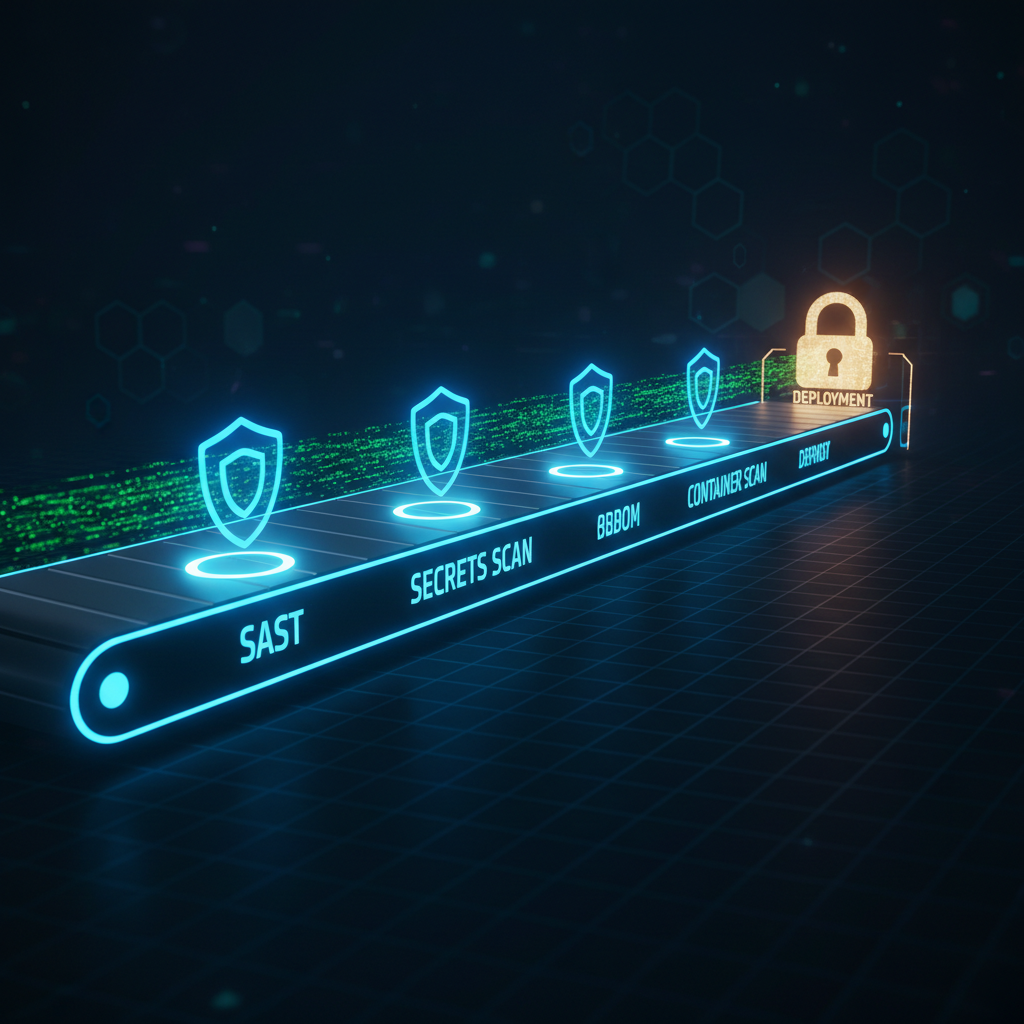
Think of a DevSecOps pipeline as a series of security gates layered over your existing CI/CD workflow. Each gate has a defined failure condition, a defined severity threshold, and a clearly owned remediation path. The moment a gate becomes optional or routinely bypassed, the pipeline integrity collapses.
A production-grade pipeline in 2026 typically spans these stages: pre-commit hooks, pull request analysis, CI build-time scanning, artifact signing and SBOM generation, staging environment dynamic testing, and post-deployment runtime monitoring. That is not a suggestion. That is the minimum viable security surface for any team handling sensitive data or operating in a regulated environment.
Pre-Commit and IDE-Level Controls
Shift-left security starts before code ever reaches a repository. Pre-commit hooks using tools like the pre-commit framework or Husky enforce baseline checks locally: secret detection, license compliance flags, and basic linting for obvious misconfigurations. The cost of catching a hardcoded AWS access key in a pre-commit hook is essentially zero. The cost of catching it after it has been pushed to a public repository and scraped by a credential harvesting bot is, historically, catastrophic.
IDE plugins from vendors like Snyk, Semgrep, and SonarQube bring SAST feedback directly into the developer editor. This is not just convenience. It closes the feedback loop to the point where secure coding practices become the path of least resistance. Developers are not context-switching to a separate security portal. They are seeing inline warnings as they type. That is the behavioral change that actually moves the needle on security outcomes.
SAST and DAST: Getting the Tooling Right
Static Application Security Testing lives in the CI build phase. Your SAST tool analyzes source code or compiled bytecode for vulnerability patterns, including injection flaws, insecure deserialization, improper error handling, and the rest of the OWASP Top 10 and CWE Top 25. The key decision is not which SAST tool to use. It is how you configure your quality gates.
A SAST scan that blocks the pipeline on every low-severity finding will be disabled by a frustrated developer within a week. Gate on Critical and High findings with a CVSS score above 7.0 or an EPSS score above 0.5. Let Medium findings generate tickets and trend reports without blocking merges. Low findings belong in a separate backlog reviewed quarterly. This triage logic is what separates a functional security program from alert fatigue.
Semgrep, CodeQL, and Checkmarx dominate the enterprise SAST space in 2026. For teams using SAST capabilities within the Secrails platform, the advantage is tight integration with the rest of the security posture. Findings from static analysis correlate directly with runtime observations and infrastructure misconfigurations, giving you actual exploitability context rather than just raw vulnerability counts.
Dynamic Application Security Testing runs against a live application, typically in a staging environment. DAST tools like OWASP ZAP, Burp Suite Enterprise, and Invicti probe running services for authentication bypasses, injection endpoints, misconfigured CORS policies, and business logic flaws that static analysis fundamentally cannot detect. DAST is also where API security testing becomes critical. REST and GraphQL APIs are the attack surface most teams underinvest in scanning, and they are where attackers are spending their time in 2026.
Integrating DAST Without Destroying Pipeline Velocity
Full DAST scans can take hours. Running them on every commit is impractical. The pragmatic approach is to run a fast, targeted DAST scan on every PR merge to the main branch, focusing on changed endpoints and taking fifteen to twenty minutes, then run a full deep scan nightly or before every release candidate. This keeps the feedback loop tight without making developers wait half a day for a green light.
Secret Scanning: The Non-Negotiable Gate
Secrets, including API keys, database credentials, OAuth tokens, and private certificates, have no business being in source code, ever. Yet Gitguardian's State of Secrets Sprawl report found over twelve million new secrets exposed in public repositories in a single year. The majority were from developers who simply did not think the repository would ever be public, or who committed a .env file by accident.
Secret scanning must run at three points: pre-commit to stop secrets leaving the workstation, at CI time to catch anything that slipped through, and continuously against your entire repository history because secrets committed years ago and then deleted are still in your git history and still valid. Tools like TruffleHog, Gitleaks, and the Secret Detection capabilities in Secrails handle both real-time and historical scanning with low false-positive rates when properly configured with allowlist patterns.
Secret scanning is one of those controls where the operational overhead of a false positive is far lower than the operational overhead of a missed detection. Tune aggressively toward recall, not precision. You can tolerate a few false alerts. You cannot tolerate a leaked production database credential.
Software Supply Chain Security and SBOM Generation
The SolarWinds breach taught enterprises that the supply chain is the attack surface. Log4Shell reinforced it. The XZ Utils backdoor in 2024 made it viscerally real for Linux infrastructure teams. In 2026, software supply chain security is not optional for any organization that handles customer data or operates critical infrastructure.
A Software Bill of Materials is the foundation. Your SBOM is a machine-readable inventory of every component in your software artifact, including direct dependencies, transitive dependencies, their versions, their licenses, and their known vulnerabilities. SPDX and CycloneDX are the two dominant formats. CycloneDX has broader tooling support for security use cases. Tools like Syft, Trivy, and cdxgen can generate SBOMs as part of your CI pipeline in under sixty seconds for most projects.
But generating an SBOM is just the beginning. You need to consume it, correlating component versions against the NVD, OSV, and GitHub Advisory Database, mapping CVEs to EPSS scores to prioritize what actually needs patching versus what is theoretical risk, and feeding high-severity findings back into the development workflow with actionable remediation guidance. This is what dependency vulnerability management looks like when done properly.
Dependency Pinning and Provenance Verification
Pin your dependencies. Not to major versions. To exact commit SHAs or cryptographic hashes. A dependency pinned to ^4.2.0 is a dependency that can be silently upgraded to include a malicious patch between your CI run and your production deployment. Tools like Renovate and Dependabot can automate the process of keeping pinned dependencies current while still going through a review gate.
Provenance verification, which means confirming that an artifact was built from a specific source commit by a specific pipeline, is increasingly mandatory. SLSA, or Supply chain Levels for Software Artifacts, provides the framework. SLSA Level 3 requires that builds run in a hardened ephemeral build environment, that the build process is fully scripted, and that the provenance attestation is signed. For teams operating in regulated environments, SLSA Level 3 is quickly becoming the baseline expectation from enterprise customers and regulators alike.
Infrastructure as Code Security
Your Terraform, Pulumi, Helm charts, and Kubernetes manifests are code. They have the same vulnerability surface as your application code, including misconfigured S3 buckets, overly permissive IAM roles, unencrypted storage volumes, and containers running as root. IaC security scanning must be part of the same pipeline that scans your application code.
Checkov, KICS, and Terrascan are the three tools most commonly deployed for IaC security scanning. They map findings to CIS Benchmarks, NIST CSF 2.0 controls, and SOC 2 requirements, which means IaC scan results can feed directly into compliance reporting. Policy-as-Code enforcement through Secrails takes this further by letting security teams define custom policies that enforce organizational standards, for example blocking any Terraform plan that provisions a public-facing storage bucket without server-side encryption enabled.
GitOps teams face a specific challenge here. When your infrastructure state is managed through Git, a misconfigured manifest committed to the repository can be reconciled into production automatically. This means IaC security gates on pull requests are not just about catching bugs early. They are literally preventing production incidents before they occur.
Container Image Scanning
Container images are layered artifacts with potentially hundreds of OS packages, language runtimes, and application dependencies. A base image pulled from Docker Hub six months ago is likely carrying dozens of CVEs that have been patched in newer versions. Scanning at build time is not sufficient on its own because images in your registry age, and new CVEs are published daily against components that were clean when you last scanned them.
The Container Image Scanning in Secrails addresses both the build-time and registry-continuous scanning problem, with policy gates that can block deployment of images with Critical vulnerabilities above a defined EPSS threshold. Trivy and Grype are solid open-source options for teams building their own pipeline integration. The critical configuration decision is to scan the final production image, not just the base image, and include both OS packages and application dependencies in the scan scope.
Beyond CVE scanning, container security requires checking for hardening baseline violations: images running as root, writable root filesystems, containers with host network access, and missing seccomp profiles. Tools like Dockle and docker scout surface these misconfigurations alongside vulnerability findings so you have a complete picture of image risk before deployment.
GitOps Security: Protecting the Control Plane
GitOps has become the dominant deployment model for Kubernetes-native organizations, and it has introduced a new attack surface that many teams have not fully internalized. Your Git repository is now your infrastructure control plane. Unauthorized write access to the main branch, a compromised CI service account, or a malicious pull request that passes inadequate review can directly modify production infrastructure without anyone touching the cluster directly.
GitOps security requires branch protection rules with required reviewer counts, signed commits enforced via Sigstore or GPG, CI service accounts scoped to minimum necessary permissions, and audit logging on repository access events. CODEOWNERS files ensure that changes to security-critical paths require review from the security team, not just any developer with merge permissions.
For teams running ArgoCD or Flux, securing the GitOps operator itself is equally important. This means strict RBAC policies, network policies restricting its egress, and regular rotation of the credentials it uses to access the cluster and the repository. A compromised GitOps operator with cluster-admin privileges is a complete infrastructure takeover, and it is one of the highest-value targets in a Kubernetes environment.
Putting It All Together: The Security Gate Matrix
A DevSecOps pipeline that actually works in production needs a gate matrix: a clear specification of what each gate checks, what severity threshold triggers a pipeline block, and who owns remediation. Without this, security controls become negotiable, and negotiable security controls get negotiated away under release pressure every single time.
Here is the gate logic that works at scale. Pre-commit blocks on secrets and credentials. CI SAST blocks on Critical and High findings with EPSS above 0.3. Dependency scanning blocks on Critical CVEs with a known exploit. Container scanning blocks on Critical OS vulnerabilities in the final image. IaC scanning blocks on CIS Benchmark Level 1 failures. SBOM generation runs on every build and is attached to the artifact. DAST runs on every release candidate against the full application surface. This is not a burden. This is what a mature code security posture looks like operationally.
The teams that execute this well share one trait: they have invested in reducing the signal-to-noise ratio of their security tooling. Every finding that gets surfaced is actionable. Every gate that blocks a pipeline has a clear remediation path. Developers trust the security controls because they are calibrated correctly, and that trust is what makes the shift-left model actually work at scale rather than collapsing under developer frustration.
If you are still building out your security posture, the Vulnerability Management solutions at Secrails provide a unified view across pipeline findings, runtime vulnerabilities, and infrastructure misconfigurations, which is exactly the consolidated visibility you need to prioritize remediation efforts effectively. For organizations navigating compliance requirements alongside DevSecOps maturity, the Compliance solutions map pipeline security controls directly to regulatory frameworks like NIS2, SOC 2, and ISO 27001, so your engineering work generates compliance evidence automatically rather than through manual documentation efforts.
Building a hardened DevSecOps pipeline is not a one-sprint project. It is an iterative program of adding gates, tuning thresholds, improving developer experience, and continuously expanding your threat model as your architecture evolves. Start with secrets scanning and SAST. Those two controls alone will eliminate the majority of the most common vulnerability classes. Then layer in dependency scanning, IaC checks, container hardening, and supply chain controls systematically. The pipeline you build today is the foundation of every secure deployment you ship tomorrow.