

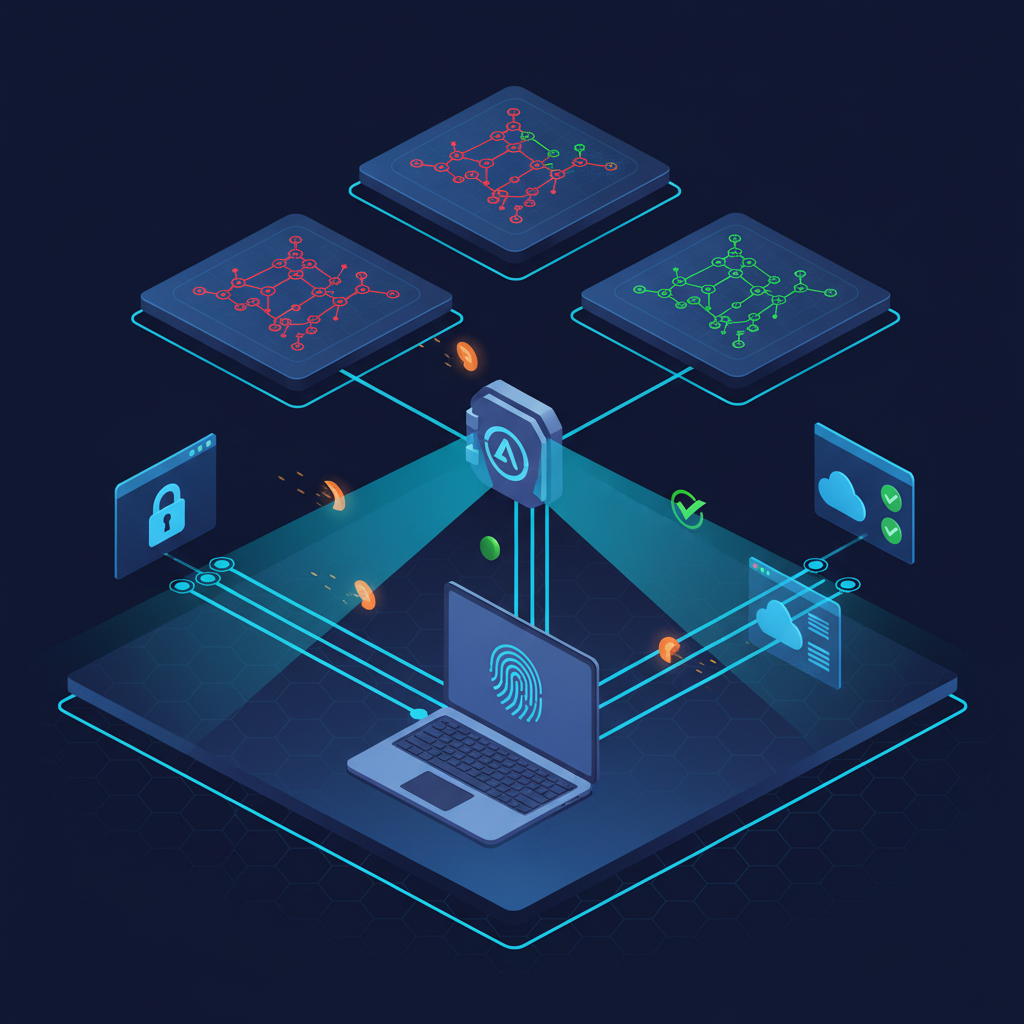
Privilege Abuse Is Still the #1 Attack Vector — And Most Teams Are Under-Protected
Eighty percent of breaches in 2026 involve some form of credential or privilege abuse. That's not a new headline — it's been true for years — but the attack surface has fundamentally changed. Endpoints now talk directly to cloud APIs. Developers hold standing privileges on production workloads. Non-human identities — service accounts, CI/CD tokens, Lambda execution roles — outnumber human ones by a factor of 45:1 in most enterprises. Against that backdrop, CyberArk's Endpoint Privilege Manager (EPM) has become one of the most operationally relevant tools in the PAM space.
This post breaks down what CyberArk EPM actually does, how it fits alongside CyberArk Secrets Hub, CyberArk Secure Cloud Access, and the broader CIEM security conversation. It also covers where EPM's limits are and how complementary tooling — including Secret Detection — fills the gaps that pure PAM vendors leave open.
What Is CyberArk EPM?
CyberArk Endpoint Privilege Manager is an agent-based solution that enforces least-privilege on Windows and macOS endpoints without removing the local admin account entirely. The core value proposition: you can strip standing local admin rights, elevate specific applications on demand with just-in-time (JIT) approval workflows, and block ransomware-class behaviors — all from a single policy engine.
EPM sits in the broader CyberArk Identity Security Platform alongside the Privileged Access Manager (PAM) vault, the CyberArk password manager capabilities in Conjur and CCP, and newer services like Secrets Hub. The CyberArk marketplace also surfaces a growing catalog of integrations — SIEM connectors, ITSM ticketing systems, and MDM platforms — that extend EPM's reach into existing SOC workflows.
Key Capabilities Worth Knowing
Application Control: EPM's allowlisting engine goes beyond simple hash matching. It understands publisher certificates, file reputation (integrated with threat intel feeds), and behavioral patterns. An attacker who drops a renamed PowerShell binary still triggers behavioral detection even if the hash is unknown.
Credential Theft Protection: EPM can block LSASS memory reads — the core technique behind Mimikatz and similar credential dumpers. MITRE ATT&CK T1003 (OS Credential Dumping) is one of the most abused techniques in post-exploitation chains, and blocking it at the endpoint before lateral movement starts is fundamentally better than detecting it in SIEM after the fact.
Ransomware Protection: EPM monitors for behavioral indicators like mass file encryption, shadow copy deletion (vssadmin delete shadows), and abnormal child process spawning from Office applications. Not foolproof, but it raises the cost of execution significantly.
Just-in-Time Elevation: Instead of permanent local admin, users can request time-limited elevation for specific tasks. These requests route through approval workflows or can be auto-approved based on policy conditions (device compliance state, user risk score, time of day). This is the operational model CIS Benchmark v8 expects when it calls for least-privilege enforcement on workstations.
CyberArk Login and the Identity Security Platform Architecture
Understanding CyberArk's login and authentication model matters more than it sounds. CyberArk has been consolidating its product lines under a unified identity fabric. The CyberArk login experience now routes through Identity Security Intelligence — a risk-based engine that correlates behavioral signals across EPM, PAM, and workforce identity to flag anomalous sessions.
In practice, this means a developer whose endpoint EPM agent flagged an unusual elevation at 2 AM will face stepped-up authentication challenges when they attempt CyberArk login to access vault credentials an hour later. It's a meaningful improvement over siloed tools that don't share signals. Though, frankly, the integration is only as good as your policy configuration — default CyberArk tenants ship with permissive baselines you should harden immediately against NIST SP 800-53 AC-6 controls.
CIEM Security: The Problem CyberArk Secure Cloud Access Is Trying to Solve
Cloud Infrastructure Entitlement Management (CIEM) is the practice of continuously discovering, analyzing, and right-sizing permissions across cloud environments — AWS IAM roles, Azure RBAC assignments, GCP service accounts, and the explosion of third-party SaaS OAuth grants. The problem is real: the average AWS account has over 35,000 effective permissions, and fewer than 5% are ever exercised.
That gap — between granted and used permissions — is what attackers exploit. An over-privileged Lambda execution role that can write to an S3 bucket and call STS:AssumeRole becomes a pivot point. A compromised developer token with AdministratorAccess because someone never scoped it down after a proof-of-concept is a full-account-takeover waiting to happen.
CyberArk Secure Cloud Access addresses this by providing JIT access to cloud consoles and CLI sessions — brokering temporary, scoped credentials rather than storing long-lived IAM access keys. This aligns with the NIST CSF 2.0 Govern and Protect functions, specifically around identity management and access control minimization.
How CIEM Integrates With EPM
Here's where it gets architecturally interesting. EPM secures the endpoint. Secure Cloud Access secures the cloud console session. But what happens between them — the developer's laptop generating cloud API calls through locally cached credentials or a secrets manager integration — is often the weakest link.
If EPM detects a credential dumping attempt on a developer's workstation, that signal should immediately suspend the associated cloud access session. CyberArk has wired these signals together in their unified platform, but organizations running hybrid environments with both CyberArk and non-CyberArk tooling need to build those integrations themselves. That's a non-trivial engineering effort. It's also exactly the kind of gap that a solid Cloud Security posture program needs to account for.
CyberArk Secrets Hub: Centralizing Secrets Governance Without Ripping Out Existing Tooling
One of the more practically useful recent additions to the CyberArk portfolio is Secrets Hub. The premise: enterprises already have HashiCorp Vault, AWS Secrets Manager, Azure Key Vault, and GCP Secret Manager deployed across different teams. Getting everyone onto a single vault is a multi-year migration that almost never finishes. Secrets Hub instead acts as a synchronization and governance layer — it syncs secrets from CyberArk PAM into developer-native secret stores so that application teams keep using their preferred tooling while security teams maintain a single audit trail and rotation policy.
This is a pragmatic approach. It doesn't solve the underlying fragmentation problem, but it reduces the risk surface by ensuring that secrets in peripheral stores are derivatives of a governed source of truth. Combined with automated rotation policies, it significantly shortens the window of exposure when a credential is compromised.
That said, Secrets Hub doesn't catch secrets that were never put into a vault in the first place — hardcoded credentials in source code, API keys committed to Git, tokens baked into container images. For that problem, you need static analysis and Secret Detection scanning in your pipeline. Tools like TruffleHog, Gitleaks, and CyberArk's own integrations can flag exposed secrets before they reach production, but only if they're part of your CI/CD gates.
CyberArk Marketplace and Integration Ecosystem
The CyberArk marketplace has expanded significantly. As of 2026, it lists over 400 certified integrations — spanning SIEM platforms (Splunk, Microsoft Sentinel), ITSM tools (ServiceNow, Jira), EDR solutions (CrowdStrike, SentinelOne), and cloud providers. The marketplace model lets organizations extend EPM policy enforcement into their existing workflows rather than rebuilding processes around CyberArk.
Practically, the most valuable integrations are the EDR connectors. When CrowdStrike Falcon detects a malicious process on an endpoint and CyberArk EPM simultaneously sees a privilege escalation attempt, the combined signal is far more actionable than either alone. Building those SIEM correlation rules is grunt work, but it pays dividends in reducing mean time to detect (MTTD).
For teams using infrastructure-as-code, CyberArk's Terraform provider and Ansible modules in the marketplace enable Policy-as-Code approaches to privilege management — defining EPM policies in version-controlled YAML rather than clicking through a GUI. This is how mature security engineering teams operate. GitOps for security policy isn't optional anymore.
Where CyberArk EPM Fits in a Layered Cloud Security Architecture
EPM is an endpoint control. It's not a substitute for cloud posture management, vulnerability management, or runtime detection. Organizations that deploy EPM and consider their privilege problem solved are setting themselves up for a painful incident. The modern attack chain rarely stays on the endpoint — it pivots from endpoint to cloud, from cloud to SaaS, from SaaS back to on-prem identity.
A defense-in-depth approach in 2026 looks something like this: EPM on endpoints enforcing least-privilege and blocking credential theft techniques. A CIEM solution continuously right-sizing IAM permissions and detecting privilege escalation paths in cloud environments. A CSPM layer continuously scanning for misconfigurations — public S3 buckets, over-permissive security groups, unencrypted EBS volumes. Secrets management handling both human and non-human credential lifecycle. And vulnerability scanning covering both VM Scans and Container Image Scanning to close the exploit windows that privilege controls can't address.
These layers aren't redundant — each one catches a class of threats the others miss. EPM stops a local admin from dumping credentials. CSPM catches the over-permissive IAM role that would have been exploited next. CIEM detects the lateral movement attempt through cloud API calls. This is defense-in-depth, not product sprawl.
Integration With Compliance Frameworks
For teams working toward SOC 2 Type II, ISO 27001:2022, or DORA compliance, CyberArk EPM maps directly to several control families. The access control requirements in SOC 2 CC6.1 through CC6.3 are substantially addressed by EPM's least-privilege enforcement and audit logging. ISO 27001:2022 Annex A control A.8.2 (Privileged Access Rights) maps cleanly to EPM's JIT elevation model.
CIS Benchmark v8 IG2 specifically calls for removing local administrative privileges from end-user accounts — EPM's primary use case. Running EPM without aligning its policy to a framework like CIS or NIST SP 800-53 is a missed opportunity. Your audit evidence becomes dramatically stronger when you can demonstrate policy-to-control traceability, not just tool deployment. Pair this with a broader Compliance automation strategy and you cut audit prep time substantially.
Practical Deployment Considerations
Rolling out EPM at scale isn't trivial. A few things bite teams consistently:
Policy precedence conflicts: EPM policies evaluate top-to-bottom, and misconfigured precedence creates gaps where expected blocks don't fire or unexpected elevations slip through. Build your policy hierarchy in a staging environment first. Test against actual developer workflows before production rollout.
Agent performance on developer machines: EPM's agent consumes resources during policy evaluation, especially on machines running Docker Desktop or heavy IDE toolchains. Tune the agent exclusion lists carefully — but audit every exclusion, because exclusions are attack surface. Attackers actively look for application control exclusion paths.
macOS complexity: CyberArk EPM on macOS requires multiple System Extensions and Privacy & Access approvals. Apple's hardened runtime and SIP create constraints that don't exist on Windows. Budget extra time for macOS deployment and testing. The EPM macOS agent has improved significantly in 2026 builds, but it's still more operationally complex than the Windows equivalent.
SIEM integration latency: EPM audit events hitting your SIEM with a 15-minute delay make real-time correlation impossible. Push for sub-minute event forwarding through the Syslog or API connectors, and validate the data pipeline under load before you depend on it for detection.
Final Assessment
CyberArk EPM is one of the most mature endpoint privilege management tools on the market. When deployed correctly — with EPM policies aligned to CIS or NIST controls, Secrets Hub governing credential sprawl, Secure Cloud Access brokering JIT cloud sessions, and CIEM continuously right-sizing entitlements — it closes a significant portion of the attack surface that pure EDR or CASB tools can't address.
The gaps are real too. Source code secrets, container image vulnerabilities, and cloud configuration drift all require complementary tooling. At SECRAILS, the approach we advocate combines identity security controls like EPM with continuous posture management, secrets scanning, and code security — because no single vendor's platform covers the full attack surface in 2026's multi-cloud, multi-pipeline reality. Build the layers deliberately, measure the coverage, and revisit quarterly. That's the only sustainable model.