

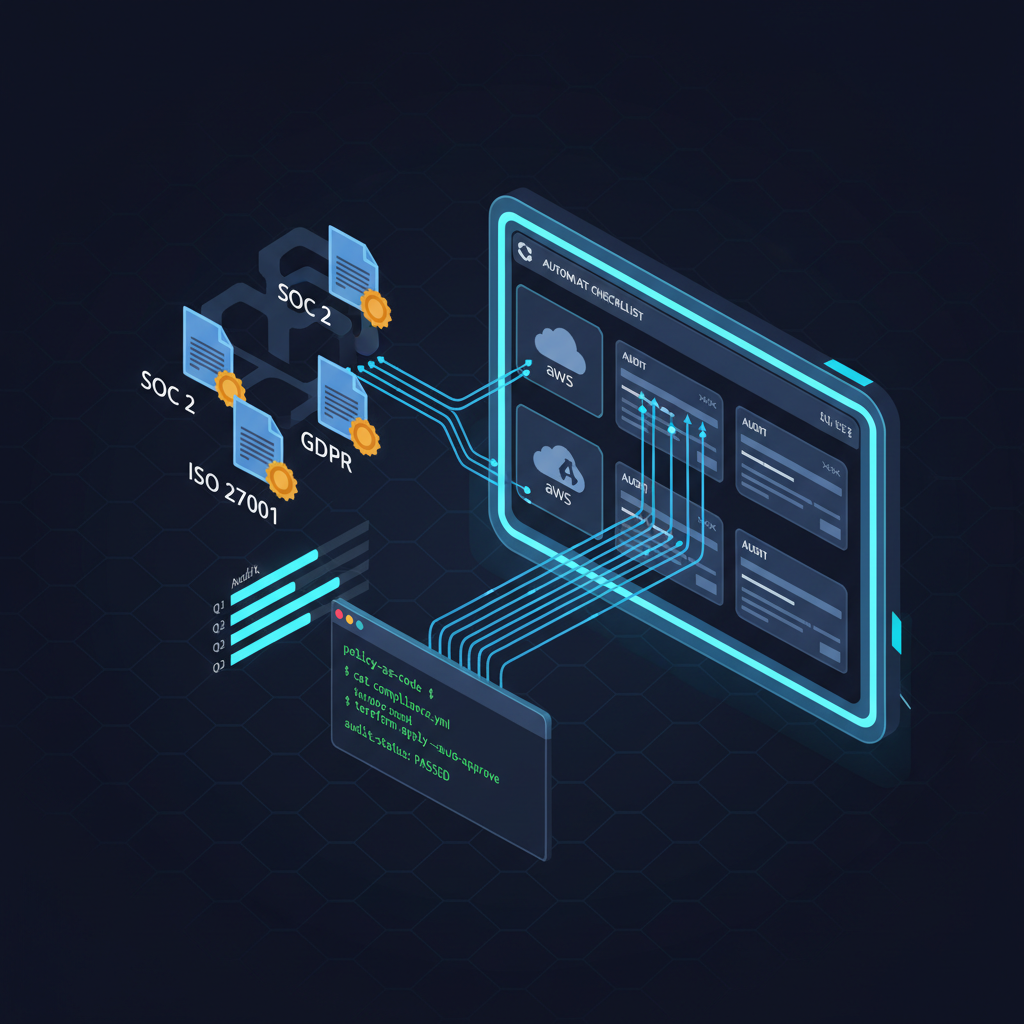
Roughly 60% of organizations facing a regulatory action in 2026 had a compliance program in place — it just was not automated. That is the uncomfortable truth that keeps security and GRC teams up at night: you can have documentation, policies, and a team dedicated to compliance and still get burned because you are running on spreadsheets and manual evidence collection. Compliance management systems exist precisely to close that gap. But choosing the wrong one — or deploying the right one badly — is expensive in time, money, and trust.
This guide cuts through the vendor noise. We will cover what compliance management systems actually do, where the real complexity lives, how compliance automation changes the risk calculus, what to look for in compliance software tools, and how platforms like SECRAILS Compliance fit into a modern security stack.
What a Compliance Management System Actually Does
Strip away the marketing language and a compliance management system (CMS) is fundamentally a control-evidence-remediation loop. It maps your technical and organizational controls to regulatory requirements — GDPR, SOC 2, ISO 27001, NIS2, HIPAA, PCI DSS — continuously collects evidence that those controls are operating, surfaces gaps, and tracks remediation. That is the core loop.
The reason this sounds simple but rarely is: frameworks overlap in confusing ways, evidence sources are scattered across cloud providers, code repositories, HR systems, and ticketing tools, and the gap between a control being documented and actually being enforced can be enormous. A policy that says all production secrets must be rotated every 90 days is meaningless if nobody is verifying rotation actually happened.
Good compliance management software closes that verification gap by connecting directly to the systems where controls live — cloud APIs, CI/CD pipelines, identity providers — and generating evidence automatically rather than asking engineers to export screenshots on a quarterly basis.
The Compliance Automation Imperative
Manual compliance is a staffing problem masquerading as a process problem. A mid-sized SaaS company pursuing SOC 2 Type II certification while maintaining ISO 27001 and keeping up with GDPR obligations might be looking at thousands of evidence artifacts per audit cycle. Doing that by hand requires dedicated personnel and still produces inconsistent results. Miss one artifact, one timestamp, one change in a control owner, and you are either failing the audit or going into it with gaps you have not documented.
Compliance automation does not replace auditors or the judgment calls that come with interpreting regulations. What it does replace is the mechanical, repetitive evidence collection work — and that is where the real time drain is. Automated compliance tools connect to your AWS, Azure, or GCP environments, pull configuration snapshots, check them against CIS Benchmarks or your internal policy baselines, and produce timestamped, auditor-ready evidence without a human in the loop for each artifact.
The shift-left principle applies here just as much as it does in application security. When compliance checks run in your CI/CD pipeline — flagging a new Terraform module that enables public S3 bucket access before it ever reaches production — you are preventing findings rather than remediating them post-audit. That is a fundamentally different cost structure.
SECRAILS takes this approach with Policy-as-Code, where compliance requirements are expressed as version-controlled, testable policies that run against infrastructure definitions at deploy time. Not a checkbox on a spreadsheet. An enforceable gate.
Compliance Software Tools: What the Market Actually Looks Like
The compliance software companies space has fragmented into a few distinct categories, and mixing them up is a common mistake.
Standalone GRC Platforms
Tools like Vanta, Drata, Secureframe, and Tugboat Logic sit in the automated compliance tier. They are strong at framework mapping, questionnaire management, vendor risk, and audit prep. They connect to cloud providers and SaaS tools via API to pull evidence. For a startup chasing SOC 2 or ISO 27001 for the first time, these are often the right starting point — the onboarding is quick, the framework templates are solid, and the auditor-friendly reporting is genuinely useful.
The limitation: most of them are miles behind on actual technical depth. They will tell you an S3 bucket is public, but they will not correlate that finding with a running workload, a data classification tag, and a threat model to tell you whether that finding is a P1 or noise. They are compliance dashboards, not security platforms.
CSPM with Compliance Overlays
Cloud Security Posture Management tools — Wiz, Prisma Cloud, and SECRAILS own CSPM — approach compliance from the security posture side. They continuously assess your cloud configurations against frameworks like CIS Benchmarks, NIST CSF 2.0, and SOC 2 CC controls, and they surface findings with remediation context. The compliance reporting comes as a byproduct of doing real security work, which means the findings actually matter.
The tradeoff here is that CSPM-native compliance tends to be stronger on the infrastructure side and weaker on the organizational controls side — things like access reviews, security awareness training completion rates, and vendor contract reviews. Those still need a GRC layer or manual process.
Integrated Security Platforms
The direction the market is moving: unified platforms that handle vulnerability management, code security, cloud posture, and compliance evidence generation in a single pane. This reduces the number of integrations you maintain, eliminates the reconciliation problem of having different tools report different findings for the same control, and gives you a consistent risk language across your whole program. Cloud Security and compliance stop being separate conversations.
Key Capabilities to Evaluate in Regulatory Compliance Software Vendors
When you are evaluating compliance management software, the demo will always look good. Here is what to pressure-test.
Framework Coverage and Customization
Out-of-the-box support for SOC 2, ISO 27001, GDPR, NIS2, HIPAA, and PCI DSS is table stakes. What matters more is whether you can customize control mappings — because your environment will never map cleanly to any framework default control set — and whether you can create your own internal policy frameworks that run alongside the regulatory ones. Vendors who lock you into their control library are a red flag.
Evidence Collection Depth
Ask exactly which evidence artifacts are collected automatically versus which require manual uploads. A vendor claiming 90% automation might mean 90% of framework line items have a connected check, but that check might only be a binary yes or no with no artifact attached. Auditors want timestamped configuration exports, log samples, and access review records — not a green checkbox in a dashboard.
Continuous Monitoring vs. Point-in-Time
Annual audits create the illusion that compliance is a once-a-year activity. It is not. A misconfigured security group that opens port 22 to 0.0.0.0/0 on December 15th is a compliance failure even if your SOC 2 audit ran in October and everything was clean. Continuous monitoring with alerting on drift — not just scheduled scans — is the difference between a compliance program and a compliance theater program.
SECRAILS VM Scans and continuous configuration assessment are built on this principle: drift happens between audit cycles, and your tooling needs to catch it in hours, not months.
Remediation Workflow Integration
Finding a gap is worthless if the remediation workflow dumps a PDF into someone inbox. Best-in-class compliance tools integrate with Jira, ServiceNow, or your ticketing system of choice, assign findings to control owners, track remediation SLAs, and update the compliance posture automatically when a finding is resolved. The evidence trail for that remediation — who fixed it, when, how — is itself a compliance artifact.
Multi-Framework Deduplication
If you are running SOC 2 and ISO 27001 simultaneously — which most mature companies do — a single technical control like MFA enforced for all privileged accounts maps to requirements in both frameworks. A good compliance management system surfaces that finding once and maps it to all applicable requirements simultaneously, rather than generating duplicate findings that waste your team time triaging the same issue twice.
Where Compliance Automation Tools Fall Short
Frankly, even the best compliance automation tools have blind spots. They are excellent at surface-level configuration checks. They struggle with controls that require human judgment: does your incident response plan actually work? Is your security awareness training actually changing behavior? Is your vendor risk assessment process actually rigorous?
They also struggle with ephemeral infrastructure. Containerized workloads, serverless functions, and spot instances that spin up and down within minutes can fly completely under the radar of tools that rely on periodic scans. Container Image Scanning integrated at the registry level addresses part of this — finding vulnerable or misconfigured images before they are deployed — but runtime drift in orchestrated environments is a harder problem.
Secret sprawl is another gap. Hardcoded credentials in source code, exposed API keys in environment variables, tokens in container images — these are compliance failures under virtually every framework access control requirements, and most GRC platforms will not catch them. You need Secret Detection running at the code level to surface these before they become audit findings or, worse, breach vectors.
Building a Compliance Program That Does Not Break Under Scale
The teams that do compliance well share a few characteristics. They treat compliance as a byproduct of good security, not a separate program. They automate evidence collection so engineers are not spending cycles on audit prep. They use policy-as-code so controls are enforced at deployment time rather than checked retroactively. And they pick compliance tools that integrate with their existing security stack rather than creating another silo.
Scale matters here. A 50-person startup can manage SOC 2 with a standalone GRC tool and quarterly manual reviews. A 500-person company with multi-cloud infrastructure, a continuous deployment pipeline, and obligations under GDPR, NIS2, and SOC 2 simultaneously needs automation that runs continuously and integrates with every layer of the stack — from SAST in the CI pipeline catching insecure code patterns, to CSPM monitoring cloud posture, to policy-as-code enforcing infrastructure standards at deploy time.
The cost of getting this wrong is not just a failed audit. IBM 2026 Cost of a Data Breach report put the average breach cost at $4.88M, and organizations with mature compliance programs had measurably lower breach costs than those running ad-hoc programs. Compliance is not overhead — it is a loss prevention mechanism with a measurable ROI.
Choosing Between Compliance Software Companies: A Framework
When comparing regulatory compliance software vendors, map them against three axes: technical depth, framework coverage, and integration fit. Do not optimize for the prettiest dashboard or the fastest demo. Optimize for the tool your security engineers will actually trust the output of — because if the findings are noisy, inaccurate, or disconnected from real risk, your team will route around them, and you will be back to spreadsheets.
SECRAILS is built specifically for teams that need compliance to be a function of their security posture, not a separate reporting exercise. If you are evaluating where modern compliance management fits in your program, it is worth understanding how the pieces — cloud inventory, posture management, vulnerability data, and policy enforcement — connect into a coherent evidence trail rather than a collection of disconnected dashboards.