

Why CI/CD Pipelines Became the Attacker's Favorite Target
The SolarWinds breach didn't start with a phishing email or a misconfigured S3 bucket. It started inside a build pipeline. Attackers injected malicious code into the software build process itself, and it shipped to 18,000+ customers without a single security alert firing. That was 2020. By 2026, supply chain attacks targeting CI/CD infrastructure have more than tripled in frequency, according to CISA's 2026 Software Supply Chain Threat Report.
Here's the uncomfortable truth: most engineering teams have invested heavily in application security — SAST scans, DAST testing, dependency audits — but left the pipeline that runs all of those checks almost entirely unprotected. If an attacker compromises your CI/CD system, they don't need to bypass your controls. They just disable them, or worse, make them appear to pass.
This guide covers what CI/CD security actually means in practice, which OWASP risks matter most, which tools belong in your pipeline, and how to implement best practices without grinding your deployment velocity to a halt.
What Is CI/CD Security?
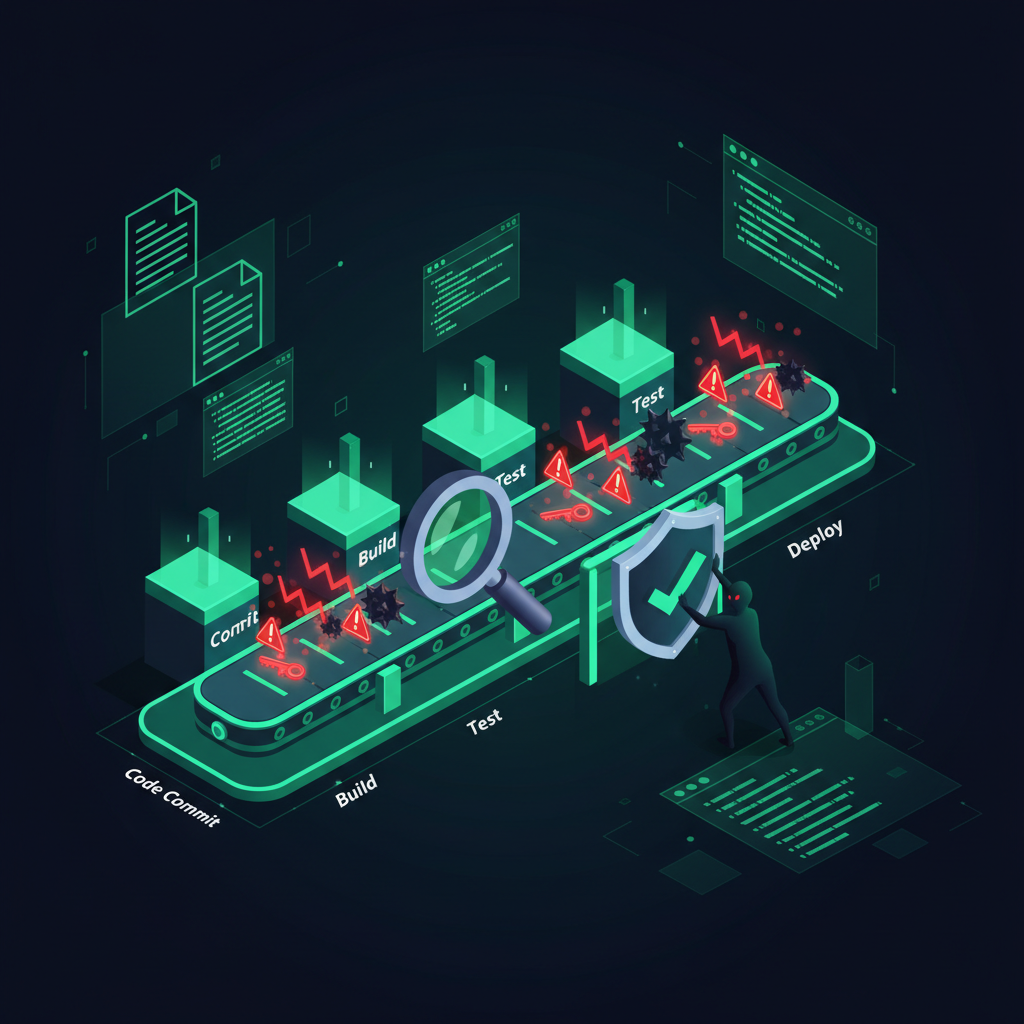
CI/CD security is the discipline of protecting the continuous integration and continuous delivery pipeline — every stage from code commit through build, test, artifact storage, and deployment — from tampering, unauthorized access, secret leakage, and malicious package injection. It sits at the intersection of application security, infrastructure security, and supply chain integrity.
The pipeline is essentially a privileged execution environment. Your CI runner has credentials to your cloud provider, your container registry, your production Kubernetes cluster, and often your secrets manager. Compromise that runner, and you have the blast radius of a senior SRE with admin rights across every environment. That's not hyperbole — that's the documented attack path in the GitHub Actions token-hijacking class of vulnerabilities that CISA flagged as a high-priority pattern in early 2026.
Thinking about CI/CD security means thinking about identity, least privilege, artifact integrity, secrets management, and code review gates — all at the same time. The teams who treat it as an afterthought are the ones who end up in incident post-mortems.
OWASP Top 10 CI/CD Security Risks: What You Actually Need to Worry About
OWASP published its CI/CD Security Risks framework (maintained and updated through 2026) as a standalone taxonomy separate from the classic Web Application Top 10. Here are the risks that consistently cause the most real-world damage:
CICD-SEC-1: Insufficient Flow Control Mechanisms
Code flows from a feature branch to production with zero human review gates, or gates that can be bypassed by anyone with write access to the repo. Attackers — or malicious insiders — push directly to trunk. Enforce branch protection rules, required reviewers, and status checks that cannot be overridden by the committer.
CICD-SEC-2: Inadequate Identity and Access Management
Shared service accounts, long-lived API keys passed as environment variables, CI tokens with org-wide scope. This is still the most common misconfiguration seen in pipeline audits. Every pipeline job should use short-lived, scoped credentials — ideally OIDC federation with your cloud provider, not static keys baked into CI variables.
CICD-SEC-3: Dependency Chain Abuse
Your application pulls from npm, PyPI, Maven — that's expected. But does your pipeline itself also pull unchecked dependencies during build? Dependency confusion attacks, typosquatting, and compromised maintainer accounts all hit here. Lock your dependency files, use a private artifact proxy, and scan every package with an SCA tool before it enters the build.
CICD-SEC-4: Poisoned Pipeline Execution (PPE)
An attacker with write access to a repository — even a fork — triggers a CI workflow that executes in the context of the target organization's runner, exfiltrating secrets or deploying malicious artifacts. This is the attack class that made GitHub Actions a major concern in 2024-2026. Restrict which workflows can trigger on pull requests from forks, and never expose production secrets to PR builds from untrusted contributors.
CICD-SEC-5: Insufficient PBAC (Pipeline-Based Access Controls)
The pipeline can deploy to dev, staging, and production using the same credential set. Separate environments should use separate identity principals with separate approval gates. Promotion between environments should require explicit sign-off, not just a passing test suite.
CICD-SEC-6: Inadequate Credential Hygiene
Hardcoded secrets in Dockerfiles, .env files committed to the repo, API keys in CI logs. Tools like Secret Detection scan every commit and every build log for credential patterns. This is non-negotiable in 2026 — secrets leaking from public CI logs are a top-5 initial access vector according to the CISA advisory corpus.
CICD-SEC-7: Insecure System Configuration
Default CI runner configurations often allow network egress to any destination, run as root, and persist workspace data across jobs. Harden runner configurations: drop privileges, use ephemeral runners, restrict egress to known endpoints, and mount secrets as in-memory volumes, not disk files.
CICD-SEC-8 through CICD-SEC-10: Logging, Artifact Integrity, Ungoverned Third-Party Services
These three are increasingly weaponized. Build artifacts should be signed (Sigstore/cosign is now the de facto standard). Pipeline logs should ship to a SIEM with tamper-evident storage. And every third-party action, orb, or plugin in your pipeline is an attack surface — treat them like production dependencies.
CI/CD Pipeline Security Best Practices
Frameworks like NIST SP 800-204D (2025 revision) and the CIS Software Supply Chain Security Guide give solid structural guidance. Here's how that translates to engineering practice:
Shift Left — But Don't Stop There
Running SAST on every pull request is table stakes. But shift-left only addresses source code. You also need scanning at the build stage (container image scanning, SCA), at the artifact stage (signing and SBOM generation), and at the deploy stage (policy enforcement). Security gates at every transition point, not just at commit.
SBOM Generation Is Now Expected
The US Executive Order on Cybersecurity (2021) and the follow-on CISA guidance have made Software Bill of Materials a procurement requirement for federal suppliers and a de facto best practice everywhere else. Generate an SBOM (CycloneDX or SPDX format) for every build artifact. Your Vulnerability Management platform should consume these SBOMs and correlate them against the NVD and EPSS scores to surface what actually needs patching versus what can wait.
Immutable Artifacts and Signed Builds
Use cosign to sign container images at build time. Verify signatures at deploy time using admission controllers (Kyverno or OPA Gatekeeper). This closes the tampering window between your CI system and your Kubernetes cluster. Container Image Scanning should run against every image before it's pushed to the registry, not just periodically post-deployment.
Least Privilege for Every Stage
Your build stage doesn't need deploy permissions. Your test stage doesn't need write access to the artifact registry. Map out what credentials each stage actually requires and provision exactly that — nothing more. Use OIDC tokens for cloud provider auth (AWS IAM OIDC, GCP Workload Identity Federation) and rotate any remaining static secrets on a 90-day maximum cycle.
Policy as Code for Pipeline Enforcement
Policy-as-Code lets you define pipeline security requirements as machine-readable rules — block builds that produce images running as root, reject artifacts without a valid signature, fail deployments to production without a change ticket reference. These policies live in version control alongside your application code and get reviewed the same way.
Audit Every Runner and Every Action
Know what CI actions, orbs, and plugins you're consuming. Pin them to specific commit SHAs, not mutable version tags. An attacker who compromises the maintainer of a popular GitHub Action can push a malicious update that runs in thousands of pipelines within hours. SHA pinning doesn't prevent the compromise, but it prevents your pipeline from automatically picking it up.
Top CI/CD Security Tools in 2026
The tooling landscape has matured significantly. Here's what actually gets deployed in production security programs:
Static Analysis and Secret Detection
Semgrep remains the go-to for custom SAST rules — it's fast enough to run in-line on PRs without adding minutes to build times. Gitleaks and TruffleHog for secrets scanning, though TruffleHog's verified secret detection (actually testing leaked credentials for validity) is a meaningful differentiator. Platforms like SECRAILS integrate these capabilities into a unified DevSecOps workflow so findings surface in developer tooling rather than getting lost in a separate security portal.
Software Composition Analysis
Snyk, OWASP Dependency-Check, and Grype all compete here. Snyk has the broadest license and fix-PR automation. Grype (from Anchore) integrates tightly with Syft for SBOM generation and is fully open source — common in regulated environments where commercial tooling licensing is a concern.
Container and Image Security
Trivy is the Swiss Army knife — it does container image scanning, filesystem scanning, Kubernetes misconfiguration detection, and SBOM generation in a single binary. Complement it with Falco for runtime anomaly detection inside containers and a dedicated Container Image Scanning workflow integrated into your registry push hooks.
Infrastructure and Cloud Posture
Your CI pipeline provisions infrastructure. That IaC — Terraform, Pulumi, CloudFormation — needs scanning too. Checkov, KICS, and Terrascan catch misconfigurations before they hit production. Combine this with a CSPM platform that validates the live environment matches what your pipeline intended to deploy.
Supply Chain Integrity
Sigstore (cosign + Rekor + Fulcio) has become the standard for artifact signing and transparency. In-toto attestations let you cryptographically assert that a specific build process produced a specific artifact under specific conditions. SLSA (Supply-chain Levels for Software Artifacts) framework levels give you a maturity model — most mature organizations are targeting SLSA Level 3 by end of 2026.
CI/CD Security for TryHackMe and Learning Environments
For practitioners building skills in this space, TryHackMe's CI/CD and Build Security room is one of the better hands-on exercises available. It walks through poisoned pipeline execution, exposed pipeline variables, and insecure GitHub Actions configurations in a safe lab environment. Working through it — actually exploiting the misconfigurations, not just reading about them — gives you a visceral understanding of why CICD-SEC-4 (PPE) is so dangerous. The attack path is frighteningly short. Understanding the offensive side makes defensive recommendations land differently when you're talking to an engineering team.
Building a CI/CD Security Cheat Sheet
If you're operationalizing this for your team, the core checklist maps to five control categories: Identity & Access (OIDC tokens, scoped permissions, no shared accounts), Code Integrity (branch protection, required reviews, signed commits), Dependency Management (lockfiles, private proxy, SCA scans), Artifact Integrity (SBOM generation, cosign signatures, admission control), and Runtime Security (ephemeral runners, egress restrictions, secrets in memory). That's the skeleton. The Code Security and pipeline hardening guidance from CISA's Secure by Design initiative fills in the specifics per tech stack.
Frankly, most teams who start this process discover their biggest gap isn't tooling — it's process. They have the scanners. They just haven't enforced blocking on findings, or their security gates have so many exceptions that they've become meaningless. Start with a handful of high-confidence, low-noise rules that actually block builds. Expand from there. An alert that gets ignored is worse than no alert, because it breeds alert fatigue across the board.
Measuring CI/CD Security Maturity
How do you know if you're making progress? SLSA framework levels are one yardstick. OWASP's own CI/CD risk taxonomy maps directly to controls you can check. The OpenSSF Scorecard project automatically evaluates public repositories against a set of supply chain security heuristics and gives you a numeric score — useful for benchmarking across your internal repository portfolio. Feeding these results into your Compliance program closes the loop between security engineering work and audit-ready evidence.
The bottom line: attackers aren't breaking through your application firewall to compromise your pipeline. They're finding the repo with weak branch protection, the CI token with too-broad scope, the npm package with the typo in the name. CI/CD security isn't glamorous, but it's where the actual risk lives in 2026. Treat your pipeline like the privileged production system it is.