

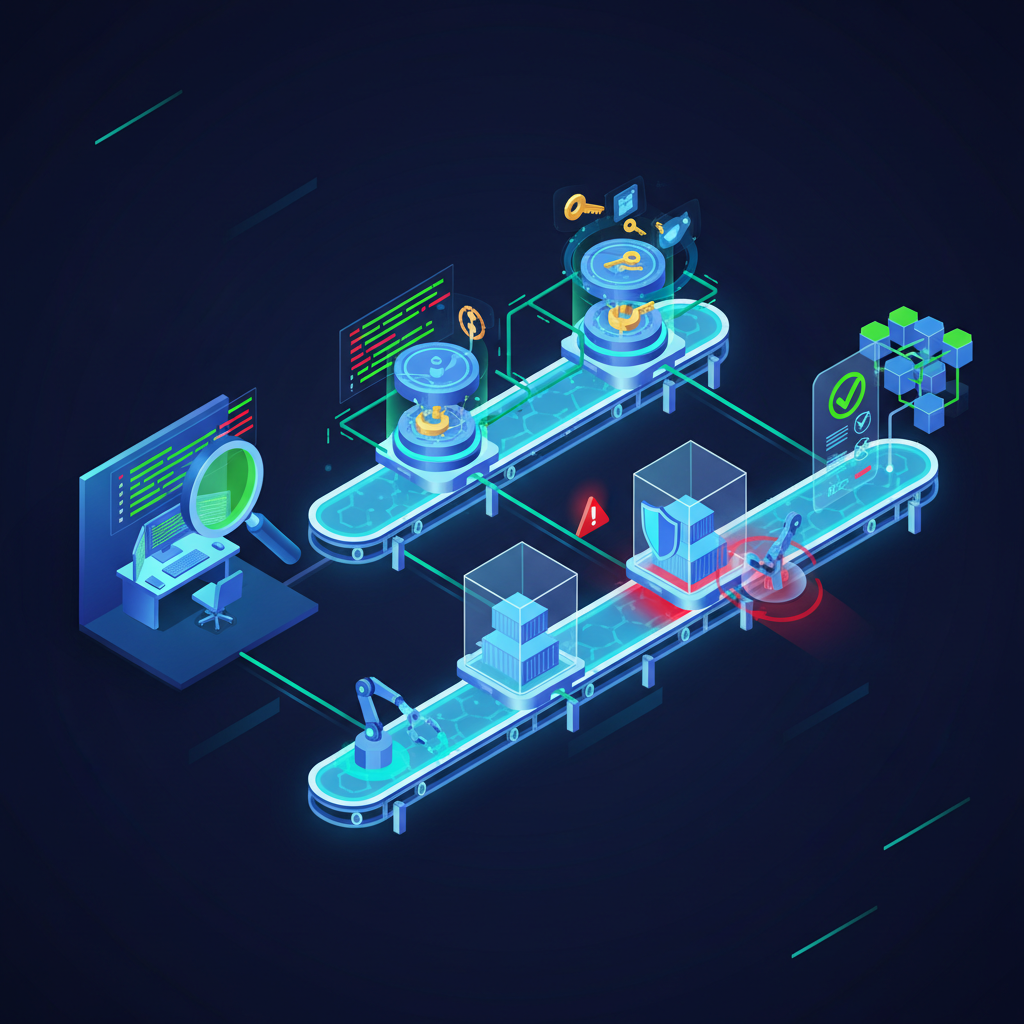
Why Your CI/CD Pipeline Is Now the Primary Attack Surface
SolarWinds. Codecov. 3CX. The common thread isn't a zero-day exploit or a sophisticated nation-state actor — it's a compromised build pipeline. Attackers have figured out what security teams are still internalizing: the fastest path to production is through CI/CD. Poison the pipeline, and you own the software supply chain.
Gartner estimated in 2026 that over 45% of organizations will have suffered a software supply chain attack by year-end, up from 17% in 2021. The blast radius of a single compromised build agent or leaked deployment token can span hundreds of downstream customers. That's not a hypothetical anymore.
So what is CI/CD security, exactly? It's the practice of embedding security controls, automated checks, and governance policies directly into continuous integration and continuous delivery workflows — before, during, and after code ships. Not bolted on after the fact. Baked in.
This guide covers everything: the OWASP Top 10 CI/CD security risks, the tools that actually matter, concrete pipeline hardening techniques, and how to build a security posture that scales with your delivery velocity.
What Is CI/CD Security? The Core Concept
CI/CD security isn't a single product or a checkbox. It's a discipline. At its core, it means ensuring that every stage of your pipeline — from code commit to production deployment — is protected against tampering, credential theft, misconfiguration, and malicious code injection.
Think of your pipeline as a trust chain. Every node — the SCM, the build server, the artifact registry, the deployment target — introduces risk. If any link is weak, an attacker with access to that node can inject malicious code, exfiltrate secrets, or pivot laterally into production infrastructure. The pipeline often has elevated privileges by design, which makes it an extraordinarily high-value target.
Modern Code Security programs treat the pipeline as a first-class security domain, not an afterthought. That means applying the same rigor you'd give to a customer-facing API — authentication, authorization, audit logging, least-privilege access, and continuous monitoring.
OWASP Top 10 CI/CD Security Risks
OWASP published its dedicated CI/CD Security Top 10 list, and it's required reading for any DevSecOps engineer. Here's a breakdown of the most critical risks and why they matter operationally:
1. Insufficient Flow Control Mechanisms (CICD-SEC-1)
Pipelines that lack mandatory approval gates allow developers — or attackers who've compromised a developer account — to push directly to production. No human review. No automated security check. Code ships, consequences follow.
2. Inadequate Identity and Access Management (CICD-SEC-2)
Service accounts with excessive permissions, shared credentials between pipelines, long-lived tokens that never rotate — these are the bread and butter of supply chain attacks. Every pipeline job should operate under a least-privilege identity, scoped to exactly what it needs.
3. Dependency Chain Abuse (CICD-SEC-3)
Dependency confusion attacks — where a malicious public package shadows a private internal one — are trivially easy to execute and devastatingly effective. npm, PyPI, Maven: all viable vectors. Without lockfiles, integrity checks, and a private artifact proxy, you're trusting the internet with your build.
4. Poisoned Pipeline Execution (CICD-SEC-4)
This is the big one. An attacker gains write access to a repository (or a PR from a fork) and injects malicious commands into the CI configuration file. GitHub Actions, GitLab CI, Jenkins — every platform has had real-world PPE incidents. Branch protection rules and restricting pipeline execution contexts are non-negotiable.
5. Insufficient PBAC — Pipeline-Based Access Controls (CICD-SEC-5)
Pipelines themselves can be used as a lateral movement vector. If pipeline A can access secrets scoped to pipeline B, an attacker compromising A gets B's credentials for free. PBAC means enforcing strict boundaries between pipeline contexts.
6. Insufficient Credential Hygiene (CICD-SEC-6)
Hardcoded secrets in pipeline configuration files, environment variables logged in build output, API keys committed directly to repos. IBM's 2026 Cost of a Data Breach report confirmed that compromised credentials remain the top initial attack vector — and CI/CD pipelines are swimming in them. Secret Detection scanning at commit time is the minimum viable defense.
7. Insecure System Configuration (CICD-SEC-7)
Default Jenkins configurations, publicly exposed build dashboards, artifact registries with anonymous read access — misconfigured CI/CD infrastructure is endemic. CIS Benchmarks publish hardening guides for Jenkins, GitHub Actions runners, and more. Use them.
8. Ungoverned Usage of Third-Party Services (CICD-SEC-8)
GitHub Actions marketplace actions, Orbs in CircleCI, shared pipeline templates — third-party pipeline components run with the same trust level as your own code. Pin versions. Audit permissions. Review source code before importing.
9. Improper Artifact Integrity Validation (CICD-SEC-9)
If you're not signing artifacts and verifying those signatures at deployment time, you have no cryptographic proof that what you built is what you deployed. Sigstore and in-toto attestation are the current standards. Build SBOMs. Validate them.
10. Insufficient Logging and Visibility (CICD-SEC-10)
You can't detect what you can't see. Pipeline activity logs, artifact access logs, secret access events — all of these need to feed into your SIEM. Most teams have great application logging and terrible pipeline logging. That's a blind spot attackers exploit.
CI/CD Pipeline Security Best Practices
Theory is fine. Operational guidance is better. Here's what actually moves the needle:
Shift Left — But Don't Stop There
Shift-left means catching vulnerabilities earlier in the SDLC, ideally at the IDE or pre-commit stage. But shifting left is not a replacement for gates at every subsequent stage. A vulnerability not caught at commit should be caught at build. Not caught at build? Caught at staging. The pipeline should be defense-in-depth, not a single fence.
Static analysis via SAST tools — Semgrep, Checkmarx, Sonar — should run on every pull request. Findings should block merges above a configurable severity threshold. Don't just report; enforce.
Harden Your Build Environment
Build agents are privileged machines. Treat them accordingly. Use ephemeral runners that spin up for a single job and terminate — no persistent state, no residual secrets. If you're using self-hosted runners, isolate them from production networks. Apply CIS hardening benchmarks. Monitor them with a runtime agent like Falco.
Container-based builds add another layer: make sure the base images your build containers use are scanned for CVEs. Container Image Scanning should be a mandatory gate before any image is pushed to your registry.
Rotate Secrets. Automate It.
Manual secret rotation doesn't happen consistently. Use a secrets manager — HashiCorp Vault, AWS Secrets Manager, Azure Key Vault — and integrate it directly into your pipeline. Short-lived, just-in-time credentials dramatically reduce the window of opportunity for an attacker who manages to exfiltrate a token. Pair this with automated secret scanning to catch anything that slips through.
Enforce Branch Protection and Code Review
No direct pushes to main. No pipeline runs triggered by unreviewed PRs from forks without context restrictions. Require signed commits (GPG or SSH). Enforce status checks — if SAST fails, the merge is blocked. These aren't bureaucratic hurdles; they're cryptographic proof-of-intent.
Implement Policy-as-Code
Human reviewers miss things. Automated policy engines don't. Policy-as-Code tools like Open Policy Agent (OPA) or Rego can codify security requirements — no image without a vulnerability scan, no deployment without a signed SBOM, no PR merge if critical secrets are detected — and enforce them consistently across every pipeline run, every team, every environment.
Monitor Pipeline Activity in Real Time
Your SIEM should ingest pipeline events. Failed authentications to your build system, unusual secret access patterns, pipeline configurations changed outside of code review — these are early indicators of compromise. Map your pipeline event logs to MITRE ATT&CK for CI/CD supply chain tactics. Threat hunting here is still underutilized.
Top CI/CD Security Tools in 2026
The tooling landscape has matured significantly. Here's an opinionated breakdown of what's worth your attention:
SAST and Code Scanning
Semgrep remains the most flexible open-source static analysis engine, with community rules covering OWASP Top 10, language-specific anti-patterns, and CI/CD-specific findings. CodeQL (GitHub) is powerful for compiled languages. For commercial options, Checkmarx One and Snyk Code offer strong IDE integration and PR-level feedback.
Secret Scanning
TruffleHog and Gitleaks are the dominant open-source options for scanning git history and live commits for exposed secrets. GitHub Advanced Security includes native secret scanning with partner integrations. The key is running these pre-commit (via a git hook) and as a hard pipeline gate — not as a weekly batch job nobody reviews.
SCA and Dependency Scanning
Snyk Open Source, OWASP Dependency-Check, and Trivy all provide software composition analysis (SCA). Trivy, in particular, has become a Swiss Army knife — it scans container images, filesystems, git repos, Kubernetes manifests, and generates SBOMs. If you're only deploying one SCA tool, make it Trivy.
Container and Infrastructure Scanning
Trivy and Grype cover container CVE scanning. For Kubernetes manifests and Helm charts, Kubesec and Checkov catch security misconfigurations before they reach the cluster. Integrate these as pipeline gates in your Vulnerability Management workflow — findings should block deployments that exceed your risk tolerance.
Runtime Security
Falco is the standard for container runtime anomaly detection. It uses eBPF-based kernel instrumentation to detect suspicious syscall patterns — crypto mining, shell spawning from app containers, unexpected file writes. Pair it with a centralized alert pipeline and you have post-deploy visibility that complements your shift-left controls.
Platform-Level Controls
Don't overlook the security features built into your CI/CD platform. GitHub Actions OIDC federation eliminates long-lived secrets entirely for cloud deployments. GitLab's protected environments and deployment approvals enforce human review gates. Jenkins' Role Strategy Plugin and Credentials Binding Plugin are foundational hardening primitives. These are free controls you should be using regardless of what tooling you add on top.
Building a CI/CD Security Cheat Sheet: The Key Gates
A practical CI/CD security cheat sheet boils down to enforcing security checks at four pipeline stages:
Pre-commit: Secret scanning (TruffleHog/Gitleaks git hooks), linting, SAST for critical findings.
Pull Request / Build: Full SAST scan, SCA/dependency check, license compliance, container image scan, IaC security scan (Checkov/Terrascan), SBOM generation.
Staging / Pre-deploy: DAST scanning against staging environment, policy-as-code validation, artifact signature verification, integration test security assertions.
Production / Post-deploy: Runtime security monitoring (Falco), CSPM drift detection, CSPM continuous compliance checks, audit log ingestion to SIEM.
Each gate should have a defined pass/fail policy. Findings don't just create tickets — they gate deployments. That's the difference between a security program and security theater.
How SECRAILS Fits Into the CI/CD Security Picture
Building all of this from scratch — integrating a dozen open-source tools, writing OPA policies, maintaining scanner rules, managing SBOM pipelines — is a significant engineering investment. Most security teams are already stretched thin.
SECRAILS provides a unified platform that covers the critical control surfaces: SAST for source code, secret detection, container image scanning, policy-as-code enforcement, and cloud security posture management. Rather than maintaining five separate tool chains and dashboards, teams get consolidated findings, unified policy enforcement, and a single source of truth for their security posture across code, containers, and cloud.
For teams building or maturing their Code Security program, having those controls natively integrated — rather than glued together with shell scripts and hope — is the operational difference between a security program that scales and one that collapses under its own complexity.
The Compliance Angle: CI/CD Security and Regulatory Frameworks
CI/CD security isn't just an engineering concern anymore. NIS2 Directive requirements explicitly call out software supply chain security. SOC 2 Type II auditors are asking about pipeline access controls and change management processes. ISO 27001:2022 Annex A.8.25 covers secure development lifecycle requirements that map directly to pipeline security gates.
If your organization is pursuing Compliance with any of these frameworks, your CI/CD pipeline documentation and security controls are audit evidence. That means you need not just the controls in place, but the logging and reporting to prove they're working. Automated pipeline security reporting isn't optional in 2026 — it's a compliance deliverable.
Final Take: Security Has to Move at Pipeline Speed
Manual security reviews can't keep pace with modern CI/CD. Teams shipping dozens of deployments per day need automated, policy-driven security that runs in seconds, not days. The answer isn't slowing down delivery — it's embedding security so deeply into the pipeline that it becomes invisible friction, not a bottleneck.
Start with the OWASP CI/CD Top 10 as your threat model. Implement gates at every stage. Automate secret scanning and SAST on every commit. Harden your build environment. Enforce policy-as-code. Monitor runtime. And treat your pipeline with the same security rigor you'd give to production infrastructure — because in 2026, it effectively is production infrastructure.