

The Misconfiguration Problem Is Still Winning
Gartner's 2026 cloud security forecast puts misconfiguration as the root cause in over 70% of cloud data incidents. Not zero-days. Not nation-state exploits. Misconfiguration. In Azure environments specifically, the blast radius of a single misconfigured storage account or overprivileged service principal can expose terabytes of data before any alert fires. IBM's 2026 Cost of a Data Breach report pegged the average breach cost at $4.88M — and cloud misconfigurations consistently rank among the top three contributing factors.
If your Azure security posture is built on periodic audits and manual reviews, you're already behind. The pace of change in cloud-native environments — new resources, new permissions, new integrations — means drift happens faster than any human team can track. Automated, continuous visibility isn't a nice-to-have. It's the baseline.
What Azure Security Posture Actually Means
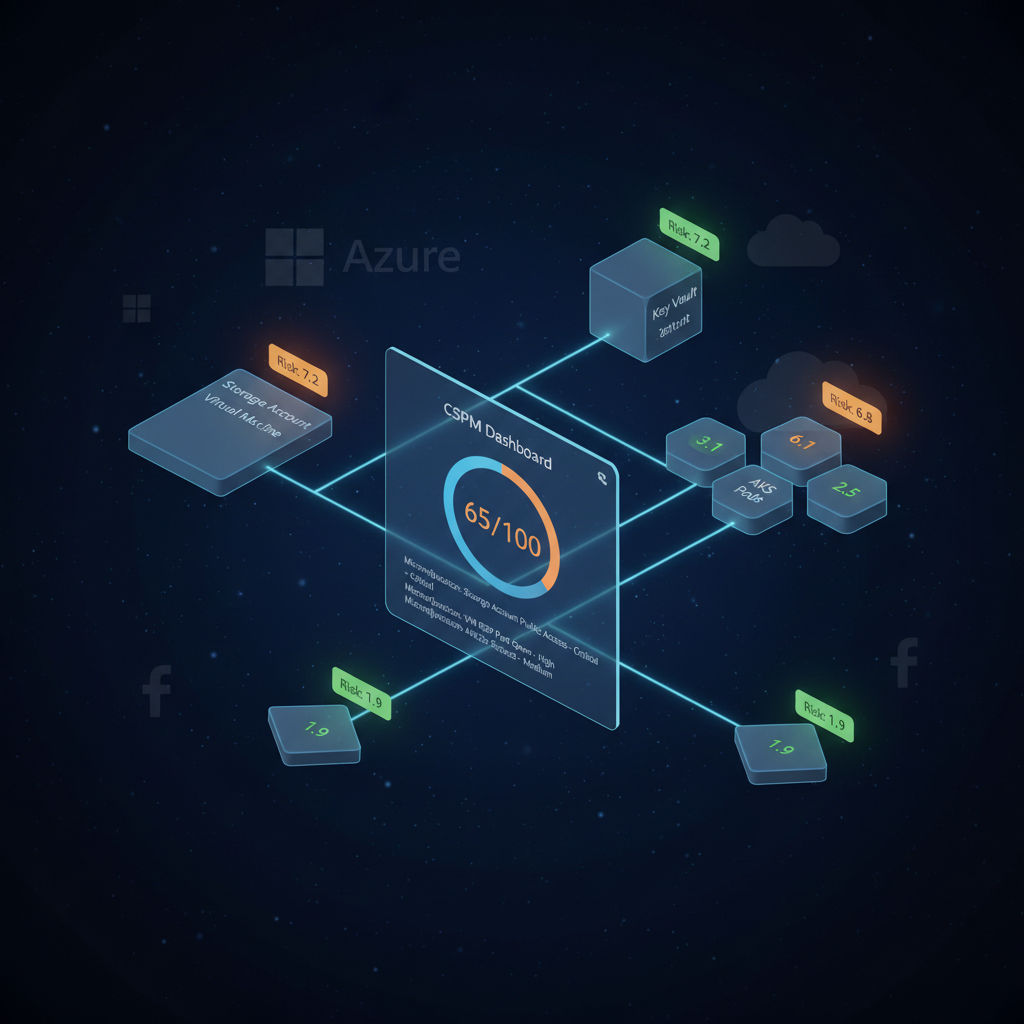
Security posture isn't a dashboard metric. It's a real-time representation of every risk surface across your Azure environment: misconfigurations, excessive permissions, unencrypted data, exposed endpoints, unpatched workloads, and policy violations. Microsoft Defender for Cloud provides a native starting point with its Secure Score, but Secure Score alone doesn't tell the full story — it doesn't capture lateral movement paths, it doesn't correlate misconfiguration chains, and it struggles with multi-cloud context.
A mature Azure security posture strategy covers at minimum six domains: identity and access, network exposure, data protection, workload security, compliance alignment, and threat detection. Miss any one of these and you're operating with a blind spot that attackers will eventually find.
Where Azure Environments Actually Break Down
Overprivileged Identities and Service Principals
IAM least privilege is one of those principles everyone agrees with and almost nobody fully implements. In Azure, the problem manifests as service principals with Contributor or Owner roles at the subscription level, managed identities attached to VMs that have write access to Key Vault, and guest accounts that were provisioned for a project two years ago and never deprovisioned. Cloud infrastructure entitlement management — CIEM — is the discipline that actually tackles this. It goes beyond role assignments to analyze effective permissions, usage patterns, and entitlement drift over time.
The CIS Microsoft Azure Foundations Benchmark v2.0 explicitly calls out the need for periodic access reviews and automated detection of dormant identities. Treat that as a floor, not a ceiling. Our CSPM platform continuously maps Azure identity graphs and flags anomalous permission expansions before they become breach vectors.
Storage Account and Data Exposure
Azure Blob Storage misconfigurations follow the same pattern as S3 bucket security failures in AWS: containers set to anonymous read access, Shared Access Signatures with excessively long expiry windows, and storage accounts with public network access enabled by default. Cloud data encryption is non-negotiable — but encryption at rest doesn't help if the container is publicly readable. You need both.
MITRE ATT&CK technique T1530 (Data from Cloud Storage) is one of the most frequently observed initial access techniques in Azure-targeted incidents. Locking down storage accounts means enforcing private endpoints, disabling shared key authorization where possible, and rotating SAS tokens on short cycles.
Network Security Group Rule Sprawl
NSG rules accumulate. Teams add inbound rules to unblock a deployment, forget to remove them, and six months later you have RDP exposed to 0.0.0.0/0 on a production VM. This isn't hypothetical — it shows up in nearly every Azure environment we assess. Azure Defender for Servers will flag it, but only after the fact. Continuous cloud security posture monitoring catches these in real time, before an attacker finds them first.
Kubernetes and Container Runtime Security
AKS clusters introduce a whole new attack surface. Kubernetes security in Azure means securing the control plane API, enforcing pod security standards, restricting privileged containers, and implementing network policies between namespaces. Container runtime security goes further — it monitors process execution, file system writes, and network connections at runtime to detect compromise post-deployment.
Falco is the go-to open-source runtime security tool for Kubernetes, and it integrates cleanly with AKS. But runtime detection without container image scanning upstream is a mistake — you're catching attackers inside the cluster when you could have blocked the vulnerable image from being deployed at all. Shift left here. Scan images in CI/CD, enforce image signing, and pair that with runtime detection for defense in depth.
CSPM Tools: What They Get Right and Where They Fall Short
Cloud Security Posture Management tools — CSPM tools — have matured significantly. Platforms like Wiz, Prisma Cloud, and Microsoft Defender for Cloud provide broad coverage of misconfiguration detection against frameworks like CIS Benchmarks, NIST CSF 2.0, and SOC 2. They're genuinely good at inventory and compliance mapping.
Where they fall short: multi-cloud drift correlation, actionable remediation in complex environments, and the ability to contextualize risk across identity, workload, and data layers simultaneously. Frankly, most CSPM tools still treat Azure, AWS, and GCP as separate siloes — which is a problem when your attack paths span all three. Multi-cloud security requires a unified graph model, not three separate dashboards.
The CSPM platform at Secrails takes a graph-based approach, mapping relationships between resources, identities, and network paths to surface attack paths that point-in-time scans miss entirely. Pair that with cloud inventory and you get a living, continuously updated map of your entire cloud estate.
Serverless Security and the Invisible Attack Surface
Azure Functions and Logic Apps expand your attack surface in ways that traditional perimeter security completely misses. Serverless security challenges include: over-permissioned function managed identities, insecure environment variable handling (hardcoded secrets show up constantly), missing input validation enabling injection attacks, and cold-start abuse for credential theft.
Serverless workloads are ephemeral by design, which makes forensics harder and runtime monitoring more complex. The fix starts at the code level — static analysis, secret detection in your function code and deployment pipelines, and enforcing least privilege for every function's managed identity. Treat each function as a microservice with its own security boundary.
Policy-as-Code: The Only Scalable Governance Model
Manual security reviews don't scale. When your team is deploying infrastructure via Terraform, Bicep, or ARM templates at speed, the only enforcement mechanism that keeps pace is policy-as-code. Azure Policy and Microsoft Defender for DevOps provide native options, but they're often too coarse-grained for nuanced security requirements.
Policy-as-code lets you define security guardrails as version-controlled rules that run in CI/CD pipelines before anything hits production. Violations get caught at PR review — not in a post-incident audit. This is what shift-left security actually looks like in practice: not a buzzword, but a specific, measurable gate in your deployment pipeline.
Combine policy-as-code with SAST scanning of your infrastructure code and application code, and you close the gap between security intent and runtime reality. CIS Benchmark controls become automated pass/fail checks. NIST CSF 2.0 requirements become pipeline gates. Compliance evidence becomes a byproduct of your normal deployment process.
AWS Security Best Practices Cross-Reference: Lessons That Apply to Azure
Teams operating in multi-cloud environments often find that AWS security best practices translate directly to Azure with minor adaptations. S3 bucket security lessons — block public access, enforce encryption, use bucket policies over ACLs — map to Azure Blob Storage hardening. AWS IAM patterns around permission boundaries and SCPs have Azure equivalents in management group policies and Azure AD Conditional Access.
The key insight from mature multi-cloud security programs: the underlying principles don't change across clouds. Least privilege, encryption in transit and at rest, network segmentation, continuous monitoring. What changes is the implementation surface and the tooling. Build your security controls around principles first, then map them to cloud-specific APIs.
Building a Remediation Workflow That Actually Closes Findings
Finding misconfigurations is the easy part. Closing them at scale is where most programs break down. Common failure modes: too many findings with no priority ranking, remediation ownership unclear, ticketing systems disconnected from cloud context, and no automated re-validation after fixes are applied.
An effective Azure security posture remediation workflow has four components. First, risk-based prioritization — not every HIGH finding is equally urgent. Context matters: is the misconfigured resource internet-facing? Does it have access to sensitive data? Does it sit on a path to a privileged identity? Second, clear ownership mapping — every resource in Azure should have a tagged owner who receives targeted, actionable remediation guidance. Third, automated re-scanning after remediation to confirm closure. Fourth, trend tracking — are you net-positive on finding reduction week over week, or are new misconfigurations accumulating faster than you're fixing them?
For teams that want to go deeper on compliance alignment, compliance tooling that maps findings directly to control frameworks eliminates the manual cross-referencing work that burns security analyst hours.
Cloud Workload Protection: Beyond Posture Into Runtime
Cloud workload protection — CWPP — is the runtime complement to CSPM's configuration focus. Where CSPM asks 'is this resource configured correctly?', CWPP asks 'is this workload behaving correctly right now?'. In Azure, this means Defender for Servers covering vulnerability management and threat detection on VMs, Defender for Containers covering AKS runtime security, and Defender for App Service covering web application threats.
The gap most teams miss: CWPP without upstream VM scanning and image scanning means you're detecting threats in production that could have been blocked pre-deployment. Cloud native application protection — CNAPP — unifies CSPM and CWPP into a single platform that covers the full lifecycle from code to cloud. That's the direction the industry is moving, and for good reason.
The 2026 Azure Security Posture Checklist
If you're doing a posture review this year, these are the non-negotiable controls. Enable Microsoft Defender for Cloud at the subscription level and remediate all critical Secure Score recommendations. Enforce multi-factor authentication for all Azure AD accounts — no exceptions for service accounts. Audit every service principal with subscription-level roles and reduce to minimum required permissions. Enable diagnostic logging for all critical resources and route to a centralized Log Analytics workspace. Enforce private endpoints for storage accounts and Key Vaults. Implement Azure Policy to prevent deployment of non-compliant resources. Scan all container images before deployment and enforce signed images in AKS. Run automated secret detection across all repositories that contain Azure credentials or SAS tokens. Validate network security group rules quarterly and automate detection of any rule exposing management ports to the internet. And finally — test your incident response process. Detection without response is just expensive logging.