

Eighty-three percent of organizations that failed their last compliance audit cited incomplete or poorly organized evidence as the primary reason. Not missing controls. Not bad policies. Just evidence that could not be found, verified, or traced back to a system of record. That is a fixable problem — but only if you treat audit evidence collection as an engineering discipline rather than a last-minute scramble.
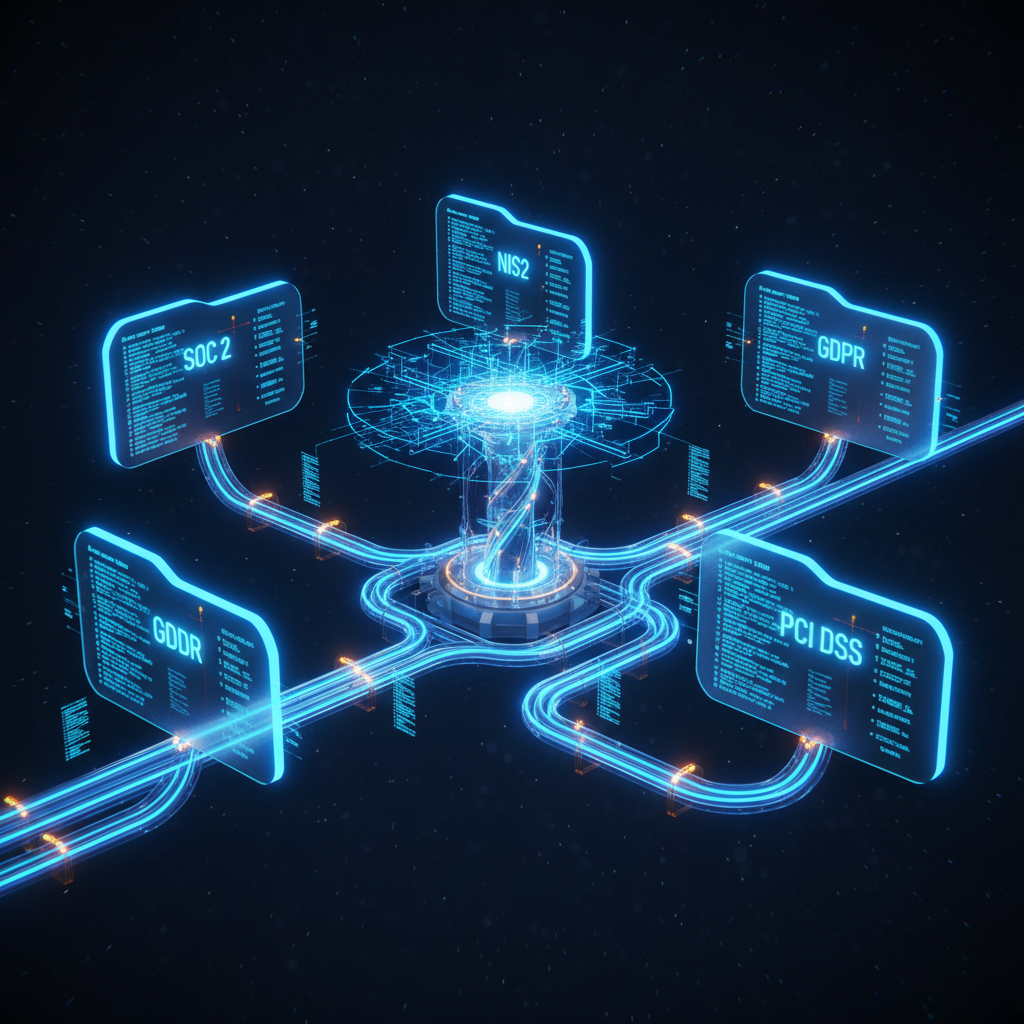
This guide covers what actually matters in 2026: how to build a repeatable, automated evidence pipeline that satisfies SOC 2 type II auditors, NIS2 supervisory authorities, GDPR data protection officers, DORA operational resilience reviewers, PCI DSS QSAs, HIPAA compliance officers, and TISAX assessors — often simultaneously.
What Audit Evidence Actually Is (and What Auditors Reject)
Audit evidence is any documented information that demonstrates a control is operating effectively over a defined period. Screenshots count. Log exports count. Policy documents count. What auditors increasingly reject in 2026 is evidence that cannot be correlated to a timestamp, a system, and an authorized actor.
The AICPA's updated SOC 2 guidance emphasizes what they call the completeness and accuracy principle — evidence must show not just that a control fired once, but that it fired consistently across the entire audit window, typically 12 months for type II. A single access review screenshot from November proves nothing about January through October.
Similarly, under NIS2 Directive Article 21 requirements, Member State supervisory authorities expect organizations to demonstrate continuous risk management processes, not point-in-time snapshots. The shift from showing a policy document to showing that policy operating in practice across 52 weeks is the single biggest driver pushing security teams toward compliance automation platforms.
The Evidence Types Every Major Framework Demands
SOC 2 Compliance Evidence
SOC 2 audits against the Trust Services Criteria require evidence across five categories: security, availability, processing integrity, confidentiality, and privacy. The most commonly cited evidence gaps in 2026 SOC 2 engagements involve access provisioning and deprovisioning logs (CC6.1 through CC6.3), change management records (CC8.1), and risk assessment documentation (CC3.1 through CC3.3).
Auditors specifically want to see: user access reviews with manager sign-off at least quarterly, system configuration change logs with ticket references, vendor risk assessments for all in-scope third parties, and incident response records including detection-to-resolution timelines. If your team is manually exporting CSVs from an identity provider and pasting them into a spreadsheet, you are creating a chain of custody problem before the audit even starts.
NIS2 Directive Evidence Requirements
NIS2 entered enforcement across EU Member States in late 2024, and by mid-2026 supervisory authorities are actively conducting reviews against Article 21's ten security measures. Evidence collection under NIS2 is particularly challenging because the directive covers both essential and important entity categories with different thresholds, and national transpositions vary — Germany's updated BSIG, France's NIS2 transposition, and Romania's implementation each carry local specifics that affect what evidence is sufficient.
Core evidence categories under NIS2 include: risk analysis and information system security policies, incident handling procedures and actual incident records, business continuity and crisis management documentation, supply chain security assessments, and access control and authentication records. Notably, NIS2 explicitly requires evidence of cybersecurity hygiene practices and training — meaning you need logs proving employees actually completed training, not just a policy saying they should.
GDPR Compliance Evidence
GDPR's accountability principle under Article 5(2) is essentially a permanent audit evidence collection mandate. Controllers must be able to demonstrate compliance at any point, not just during a scheduled audit. The practical implication: your Records of Processing Activities, Data Protection Impact Assessments, consent records, and data subject request logs need to be continuously maintained and retrievable within hours, not days.
Data Protection Authorities across the EU have issued fines specifically for inability to produce evidence — not for the underlying violation, but for failing to demonstrate that controls existed. Several 2026 enforcement actions continued this pattern, with cases hinging on whether organizations could produce contemporaneous records of their data protection decision-making processes.
DORA Regulation Evidence
The Digital Operational Resilience Act applies to financial entities and their ICT third-party service providers, with full enforcement running through 2026. DORA's evidence requirements are operationally intensive: ICT risk management framework documentation, digital operational resilience testing results including threat-led penetration testing for significant institutions, ICT-related incident registers, and third-party provider concentration risk assessments.
DORA's Article 30 specifically mandates contractual arrangements with ICT third-party providers that include audit rights — meaning you need evidence not just of your own controls but of your vendors' controls, obtained through direct audits or independent third-party reports such as SOC 2 or ISO 27001 certifications.
PCI DSS 4.0 Evidence Requirements
PCI DSS v4.0, effective since March 2024, introduced customized approach options that change how evidence is structured for some requirements. The standard now emphasizes targeted risk analysis — organizations must document why they chose specific control implementations, and evidence must link back to that analysis. QSAs in 2026 are specifically scrutinizing network segmentation validation evidence, vulnerability scanning results (internal and external, quarterly minimum), penetration testing reports, and access control review records covering all system components in the cardholder data environment.
HIPAA Compliance Evidence
HIPAA's Security Rule requires covered entities and business associates to maintain written policies, procedures, and documentation of security measures. The HHS Office for Civil Rights expects organizations to retain security documentation for six years from creation or last effective date. Evidence collection for HIPAA centers on risk analysis documentation — the most commonly cited deficiency in OCR investigations — workforce training records, access management logs, and audit controls output, meaning actual system activity logs rather than just a policy stating that logs are kept.
TISAX Certification Evidence
TISAX, the Trusted Information Security Assessment Exchange used heavily in the automotive supply chain, requires evidence aligned to the VDA ISA catalog. For organizations handling prototype data or connecting to OEM systems, TISAX assessments demand particularly granular evidence around physical security controls, data classification procedures, and third-party access management. Assessors are trained to probe for evidence gaps between stated policy and operational reality — making continuous evidence collection especially important.
Building an Automated Evidence Collection Pipeline
Manual evidence collection at scale is operationally impossible. A mid-size organization running SOC 2 type II, NIS2, and GDPR simultaneously might have 400 or more individual evidence items to collect, organize, and map to controls — every single year. The teams that handle this without burning out have built automated pipelines.
The architecture looks roughly like this: a policy-as-code layer that codifies controls as machine-evaluable rules, a continuous scanning layer that checks infrastructure state against those rules, an evidence collection layer that captures and timestamps proof of control operation, and a compliance mapping layer that routes evidence to the right framework control identifiers.
The Policy-as-Code approach is foundational. When controls are expressed as code, they can be evaluated automatically against your actual infrastructure state — and the evaluation results themselves become audit evidence. Every policy check that passes generates a timestamped record tied to a specific system configuration, which is exactly what auditors need to confirm continuous operation.
For cloud infrastructure specifically, CSPM tools continuously evaluate cloud configurations against compliance benchmarks including CIS Benchmarks, SOC 2 control mappings, and PCI DSS requirements, generating evidence records automatically. The difference between a CSPM scan result and a valid audit evidence artifact is largely metadata: who ran the scan, against what scope, at what time, with what ruleset version.
Common Evidence Collection Failure Modes
The Screenshot Problem
Screenshots are the lowest-quality evidence artifact. They can be manipulated, they have no guaranteed provenance, and they are almost impossible to automate at scale. Auditors increasingly prefer API-sourced reports, signed log exports, and system-generated records over manual screenshots. If your current process involves an engineer taking screenshots of a cloud console once a month, that is audit technical debt that will eventually come due.
The Coverage Gap Problem
Evidence collected for one framework often covers only part of what another framework requires. A team that has done excellent SOC 2 evidence collection may still have significant gaps for NIS2, which requires supply chain security evidence that SOC 2 does not emphasize, or for DORA, which requires ICT incident classification evidence at a granularity most incident response processes do not capture by default.
The solution is a unified control framework: mapping your controls once to a master taxonomy, then mapping that taxonomy to each specific framework. NIST CSF 2.0 works well as a master framework given its explicit mapping tables to ISO 27001:2022, PCI DSS, HIPAA, and NIST SP 800-53. The Compliance solution from SECRAILS takes this unified approach, allowing teams to collect evidence once and map it to multiple frameworks automatically.
The Chain of Custody Problem
Evidence that cannot be traced from its source to its storage to the auditor's review has a chain of custody problem. This sounds like a legal nicety but it is practically significant: if an auditor questions whether a log file was modified between collection and submission, and you cannot prove it was not, that evidence is compromised. Cryptographic hashing of evidence artifacts at collection time, combined with an immutable audit log of who accessed what, solves this. Some VM Scan outputs and container registry scan results already include integrity verification — the challenge is applying the same rigor consistently across all evidence types in your compliance program.
The Role of Continuous Compliance Monitoring
Point-in-time audits are increasingly considered insufficient by the most demanding frameworks. DORA explicitly requires continuous monitoring of ICT operational resilience. NIS2 expects ongoing risk management processes. SOC 2 type II already spans a full year. The direction of travel is clear: compliance must be demonstrated continuously, not assembled retrospectively in the weeks before an auditor arrives.
Continuous compliance monitoring means your evidence collection pipeline runs around the clock, not just pre-audit. Drift detection — identifying when a compliant configuration changes to a non-compliant one — is particularly valuable. Cloud Inventory capabilities that track configuration changes in real time give you both a control monitoring mechanism and an evidence record of your configuration history, which can be invaluable when an auditor asks whether a particular control was active on a specific date six months ago.
The practical benefit extends beyond audit readiness. Teams with continuous compliance monitoring detect control failures in days rather than months, meaning they can remediate before a failure becomes an audit finding or, worse, a breach. IBM's 2026 Cost of a Data Breach report found that organizations with mature compliance automation reduced breach costs by an average of 1.3 million USD compared to organizations relying on manual compliance processes.
Integrating Evidence Collection Into Your Security Engineering Workflow
The most effective evidence collection programs treat compliance as a byproduct of good security engineering, not a separate workstream that happens in parallel. When your SAST pipeline scans every pull request, those scan results are evidence. When your secret detection tooling flags a credential exposure, the alert record is evidence. When your container image scanning catches a critical CVE before deployment, that scan report is evidence of a functioning vulnerability management process.
The key is instrumentation: every security tool in your pipeline should be configured to produce evidence-quality output — with timestamps, scope definitions, ruleset versions, and result summaries that can be mapped to control requirements. The Container Image Scanning capabilities within automated CI/CD pipelines generate exactly this kind of structured, auditable output that satisfies both internal security teams and external auditors.
Risk assessment frameworks also benefit from this integration. For organizations running NIST CSF 2.0 or ISO 27001:2022 risk assessment processes, evidence of control effectiveness is an input to risk treatment decisions. If your evidence shows that a particular control is failing a meaningful percentage of the time, that is a risk metric that should trigger remediation, not just an audit finding to document. DORA's ICT risk management framework requirements are explicit about this feedback loop: risk assessments must be updated based on operational evidence, not just scheduled annually regardless of what the evidence shows.
What Good Audit Evidence Looks Like in Practice
Strong audit evidence in 2026 has five characteristics. It is machine-generated rather than manually assembled. It is timestamped using reliable system time rather than manually entered dates. It is scoped to a specific control, system, and time period. It is signed or cryptographically hashed for integrity verification. And it is stored in an immutable or append-only system that prevents retroactive modification. Evidence meeting all five criteria is essentially unchallengeable. Evidence meeting only two or three is vulnerable to auditor scrutiny — and in adversarial audit contexts such as regulatory enforcement actions, that vulnerability becomes direct financial liability.
The Vulnerability Management workflow is a useful model for what this looks like operationally: scan results from authenticated scanners, timestamped, scoped to a defined asset inventory, with remediation records that close the loop between finding and fix. Apply that same discipline to every evidence type in your compliance program and you have built something auditors genuinely respect rather than reluctantly accept.
Organizations that build evidence collection as an engineering discipline — rather than compliance theater assembled before each audit — also tend to have better security outcomes overall. The discipline of continuous, verifiable evidence forces clarity about what controls actually exist versus what policies say should exist. That gap, when measured honestly, is usually where the real risk lives. Closing it is both a compliance win and a security win, which is the best possible outcome from an investment in audit evidence infrastructure.